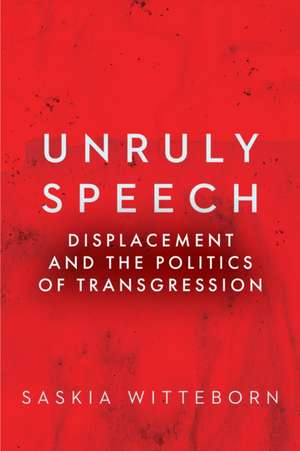
Unruly Speech
Autor Saskia Wittebornen Limba Engleză Hardback – 17 ian 2023
Preț: 531.46 lei
Preț vechi: 656.12 lei
-19%
Puncte Express: 797
Carte tipărită la comandă
Livrare economică 02-16 decembrie
Livrare prin curier în România Termenul estimat este afișat lângă disponibilitate.
Transport gratuit pentru acest produs Plată online sau ramburs, în funcție de opțiunile comenzii.
Retur gratuit în 14 zile Comandă securizată și suport în română.
Specificații
ISBN-13: 9781503633391
ISBN-10: 150363339X
Pagini: 250
Dimensiuni: 155 x 231 x 20 mm
Greutate: 0.42 kg
Editura: Stanford University Press
ISBN-10: 150363339X
Pagini: 250
Dimensiuni: 155 x 231 x 20 mm
Greutate: 0.42 kg
Editura: Stanford University Press
Notă biografică
Saskia Witteborn is Associate Professor in the School of Journalism and Communication at The Chinese University of Hong Kong (CUHK). She coauthored the SAGE Handbook of Media and Migration (2020) and Together: Communicating Interpersonally: A Social Construction Approach (6th ed., 2005).
Cuprins
1. Introduction
2. Unruly Speech: Transgression and the Limit
3. Xinjiang: Unity in Inequality
4. East Turkistan: Belonging and Human Rights
5. Testimonio
6. Conclusions
2. Unruly Speech: Transgression and the Limit
3. Xinjiang: Unity in Inequality
4. East Turkistan: Belonging and Human Rights
5. Testimonio
6. Conclusions