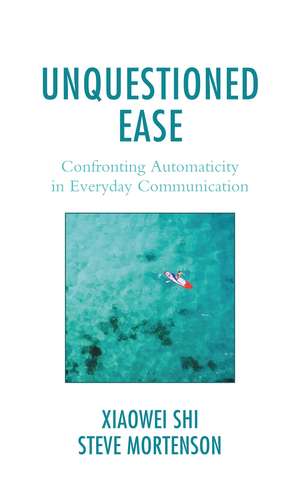
Unquestioned Ease: Confronting Automaticity in Everyday Communication
Autor Xiaowei Shi, Steve Mortensonen Limba Engleză Paperback – 5 feb 2025
Preț: 218.37 lei
Preț vechi: 286.77 lei
-24%
Puncte Express: 328
Carte tipărită la comandă
Livrare economică 26 octombrie-09 noiembrie
Livrare prin curier în România Termenul estimat este afișat lângă disponibilitate.
Transport gratuit de la 400.00 lei Plată online sau ramburs, în funcție de opțiunile comenzii.
Retur gratuit în 14 zile Comandă securizată și suport în română.
Specificații
ISBN-13: 9781793637987
ISBN-10: 1793637989
Pagini: 160
Dimensiuni: 148 x 228 x 12 mm
Greutate: 0.23 kg
Editura: Bloomsbury Publishing
Colecția Lexington Books
Locul publicării:New York, United States
ISBN-10: 1793637989
Pagini: 160
Dimensiuni: 148 x 228 x 12 mm
Greutate: 0.23 kg
Editura: Bloomsbury Publishing
Colecția Lexington Books
Locul publicării:New York, United States
Descriere
This book highlights hidden unintentional biases, emotional defense mechanisms, and responses in haste. By revealing these preconceived notions present in message choices, Xiaowei Shi and Steve Mortenson demonstrate techniques to help prevent communication from becoming problematic. In a conversational style, the authors extend their interdisciplinary theoretic perspectives by introducing concepts and practices of supportive confrontation and argumentative interaction management. Through examining those automatic responses and reactions in our everyday conversation with friends, coworkers, and loved ones, this book engages the readers to confront their own hidden preferences and underlying beliefs about gender, relationships, and themselves with a new eye. The book moves beyond prior work on rational choice model in strategic communication by considering actual human attributes. Shi and Mortenson offer new insights into communication "noises" and how to engage in communication during a difficult life event or on a difficult subject in a more skillful manner. Scholars of social psychology, interpersonal communication, and communication training and development will find this book of particular interest.
Cuprins
Contents
Preface
Xiaowei Shi & Steve Mortenson
Chapter One: Turning to a New Direction: Appreciating the Ease in Communication
Xiaowei Shi & Steve Mortenson
Chapter Two: When Communication Does Not Occur in a Smooth Progression
Xiaowei Shi
Chapter Three: Identifying and Meeting the Emotional Challenges of Supportive Confrontation
Steve Mortenson
Chapter Four: What Happens When We Are Mindful in Communication?
Xiaowei Shi
Chapter Five: Empirical Research on Mindful Communication: Mindfulness and Implicit Bias in Upward Influence
Xiaowei Shi
Chapter Six: When You Can Never See the World in the Way I Do
Xiaowei Shi
Chapter Seven: Defusing Defenses and Speaking Skillfully
Steve Mortenson
Bibliography
About the Authors
Preface
Xiaowei Shi & Steve Mortenson
Chapter One: Turning to a New Direction: Appreciating the Ease in Communication
Xiaowei Shi & Steve Mortenson
Chapter Two: When Communication Does Not Occur in a Smooth Progression
Xiaowei Shi
Chapter Three: Identifying and Meeting the Emotional Challenges of Supportive Confrontation
Steve Mortenson
Chapter Four: What Happens When We Are Mindful in Communication?
Xiaowei Shi
Chapter Five: Empirical Research on Mindful Communication: Mindfulness and Implicit Bias in Upward Influence
Xiaowei Shi
Chapter Six: When You Can Never See the World in the Way I Do
Xiaowei Shi
Chapter Seven: Defusing Defenses and Speaking Skillfully
Steve Mortenson
Bibliography
About the Authors
Recenzii
This highly readable volume provides solid research to support practical communication strategies for challenging interactions. In seven chapters, the authors review quantitative and qualitative research findings emerging from the Argumentative Interaction Management framework. They offer recommendations for supportive confrontations that respond to manifestations of racial and gender bias in conversation and in other contexts in which differences in perceptions and expectations compromise relational harmony. This treatment moves beyond a rational approach toward goals-based interpersonal influence. It takes emotion, cognition, and automaticity into account to explain the role of implicit bias in personal and professional communicative contexts. The authors join transformative learning theory, Jungian/relational psychology, problematic integration theory, and cognitive psychology to frame constructive confrontation and problem-solving as processes of joint meaning creation. The book's focus on identifying one's own defenses, projections, and triggers; reducing the defensiveness of others; and seeking common goals invites a learning-based approach to conflict. This model of interpersonal influence rests on a thoughtful engagement with communication practices that many take for granted in everyday interactions. Highly recommended. Undergraduates through faculty; professionals; general readers.
"Drawing on decades of scholarship including their own research findings, as well as stories from their personal and professional lives, Shi and Mortenson highlight key lessons about communicating skillfully in difficult situations - e.g., how doing so requires that we become aware of our own emotions and biases, pursue communicative tasks in ways that uphold identities and relationships, remain open to being influenced by others, and recognize the value but also limits of mindfulness. Given that the authors address some of the most vital social and interpersonal issues facing us today, Unquestioned Ease will be a useful resource for communication scholars as well as advanced undergraduate and graduate students."
"Shi and Mortenson's new book, Unquestioned Ease: Confronting Automaticity in Everyday Communication, is a welcome contribution to the communication studies literature on "dual processing," "system 1 and 2," and "thinking, fast and slow." Much remains to be learned. In addition to ongoing research on the characteristics of these basic processes, it is not clear how and how much humans will be able to consciously control systems that operate largely outside consciousness. It is also unclear when and how effort to exert such control is adaptive; we know little about how this growing literature can inform communication practices. In this context, Shi and Mortenson's efforts are surely necessary and potentially important."
"Unquestioned Ease is a thoughtful and skillful explication of challenging concepts such as automaticity, mindful communication, unconscious bias, and conflict. Grounded in research and relatable through personal anecdotes and scenarios, Shi and Mortenson provide clear explanation and remedies for interpersonal conflict. They identify latent psychological attributes, such as personal shadows and unconscious bias, that contribute to reactions ranging from highly charged emotion to complete withdrawal, which more likely than not results in poor communication and escalated, unresolved conflict. As an alternate approach, the authors present supportive confrontation and mindful communication to elucidate the source of the conflict, isolate it from the individuals, remove past experiences, and allow participants to communicate clearly and articulately engaging in the ongoing process of conflict resolution."
"Drawing on decades of scholarship including their own research findings, as well as stories from their personal and professional lives, Shi and Mortenson highlight key lessons about communicating skillfully in difficult situations - e.g., how doing so requires that we become aware of our own emotions and biases, pursue communicative tasks in ways that uphold identities and relationships, remain open to being influenced by others, and recognize the value but also limits of mindfulness. Given that the authors address some of the most vital social and interpersonal issues facing us today, Unquestioned Ease will be a useful resource for communication scholars as well as advanced undergraduate and graduate students."
"Shi and Mortenson's new book, Unquestioned Ease: Confronting Automaticity in Everyday Communication, is a welcome contribution to the communication studies literature on "dual processing," "system 1 and 2," and "thinking, fast and slow." Much remains to be learned. In addition to ongoing research on the characteristics of these basic processes, it is not clear how and how much humans will be able to consciously control systems that operate largely outside consciousness. It is also unclear when and how effort to exert such control is adaptive; we know little about how this growing literature can inform communication practices. In this context, Shi and Mortenson's efforts are surely necessary and potentially important."
"Unquestioned Ease is a thoughtful and skillful explication of challenging concepts such as automaticity, mindful communication, unconscious bias, and conflict. Grounded in research and relatable through personal anecdotes and scenarios, Shi and Mortenson provide clear explanation and remedies for interpersonal conflict. They identify latent psychological attributes, such as personal shadows and unconscious bias, that contribute to reactions ranging from highly charged emotion to complete withdrawal, which more likely than not results in poor communication and escalated, unresolved conflict. As an alternate approach, the authors present supportive confrontation and mindful communication to elucidate the source of the conflict, isolate it from the individuals, remove past experiences, and allow participants to communicate clearly and articulately engaging in the ongoing process of conflict resolution."
Notă biografică
Xiaowei Shi associate professor in the department of Communication Studies at Middle Tennessee State University.