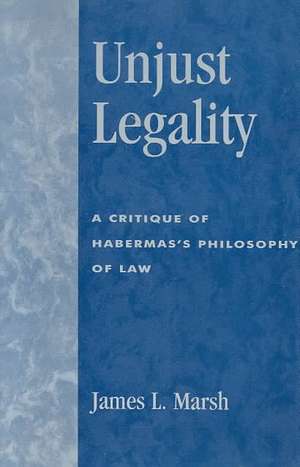
Unjust Legality: A Critique of Habermas's Philosophy of Law: New Critical Theory
Autor James L. Marshen Limba Engleză Paperback – 16 oct 2001



Preț: 329.76 lei
Preț vechi: 413.65 lei
-20%
Puncte Express: 495
Carte disponibilă
Livrare economică 16-30 noiembrie
Livrare prin curier în România Termenul estimat este afișat lângă disponibilitate.
Transport gratuit de la 400.00 lei Plată online sau ramburs, în funcție de opțiunile comenzii.
Retur gratuit în 14 zile Comandă securizată și suport în română.
Specificații
ISBN-13: 9780742512610
ISBN-10: 0742512614
Pagini: 224
Dimensiuni: 140 x 220 x 14 mm
Greutate: 0.28 kg
Ediția:New.
Editura: Bloomsbury Publishing
Colecția Rowman & Littlefield
Seria New Critical Theory
Locul publicării:New York, United States
ISBN-10: 0742512614
Pagini: 224
Dimensiuni: 140 x 220 x 14 mm
Greutate: 0.28 kg
Ediția:New.
Editura: Bloomsbury Publishing
Colecția Rowman & Littlefield
Seria New Critical Theory
Locul publicării:New York, United States
V-ar putea interesa
-
 The Case for Working with Your HandsMatthew CrawfordPreț: 86.35 lei
 -
 The Philosophy of International LawSamantha Besson-10%Preț: 364.11 lei406.00 lei
 -
 The Quality of FreedomMatthew H. Kramer-22%Preț: 420.12 lei537.47 lei
 -
 Political ObligationsGeorge Klosko-27%Preț: 372.46 lei510.46 lei
 -
 Looking Backward 2000-1887Edward Bellamy-19%Preț: 58.10 lei71.69 lei
 -
 Discourse on the Origin of InequalityJean-Jacques Rousseau-19%Preț: 52.01 lei64.17 lei
 -
 Utopianism: A Very Short IntroductionLyman Tower Sargent-19%Preț: 57.39 lei71.06 lei
 -
 Globalizing Justice: The Ethics of Poverty and PowerRichard W. Miller-11%Preț: 315.92 lei354.51 lei
 -
 Theatre and EthicsNicholas Ridout-28%Preț: 49.56 lei68.45 lei
 -
 Preț: 375.20 lei
 -
 From Physics to PhilosophyJeremy ButterfieldPreț: 343.20 lei
 -
 Zizek and PoliticsMatthew Sharpe-17%Preț: 234.79 lei281.48 lei
 -
 Chronicles of Consensual TimesSteven Corcoran-36%Preț: 249.67 lei392.37 lei
 -
 Understand Political Philosophy: Teach YourselfMel ThompsonPreț: 201.82 lei
 -
 A Thousand MachinesGerald RaunigPreț: 115.66 lei
Cuprins
Chapter 1 Preface
Chapter 2 Toward a Critique of Habermas's Philosophy of Law
Chapter 3 The Tension between Facticity and Validity
Chapter 4 On Mediating Private and Public Autonomy: The Genesis of Rights
Chapter 5 The Genesis of the State
Chapter 6 Law and Jurisprudence
Chapter 7 Deliberative Politics and Administrative Social Power
Chapter 8 The Public Sphere, Civil Society, and the Rule of Capital
Chapter 9 The Different Paradigms of Law and the Difference They Make
Chapter 10 The Achievement and Limits of Habermas's Philosophy of Law
Chapter 2 Toward a Critique of Habermas's Philosophy of Law
Chapter 3 The Tension between Facticity and Validity
Chapter 4 On Mediating Private and Public Autonomy: The Genesis of Rights
Chapter 5 The Genesis of the State
Chapter 6 Law and Jurisprudence
Chapter 7 Deliberative Politics and Administrative Social Power
Chapter 8 The Public Sphere, Civil Society, and the Rule of Capital
Chapter 9 The Different Paradigms of Law and the Difference They Make
Chapter 10 The Achievement and Limits of Habermas's Philosophy of Law
Recenzii
Professor Marsh, a self-styled 'disillusioned Habermasian,' offers a careful, somber 'reality check' to the comparatively favorable vision of contemporary society that Habermas presents in his significant work, Between Facts and Norms. At the sametime, the ultimate, and in fact quite successful, aim of Marsh's analysis is the positive one of reworking Habermas' own best insights back in the direction of a genuinely critical theory of modern society....
Marsh has produced an outstanding and accessible text that provides a badly needed left critique of Habermas' philosophy of law.
Marsh displays an impressive mastery of Habermas's texts that few others have attained. His commentary on Between Facts and Norms is exceptionally clear and jargon-free, not to mention chock full of illuminating examples and references to the real world. Above all, its sympathetic treatment of the basic project of Habermas's masterpiece is judiciously balanced by a critique of Habermas's failure to consistently carry that project through to the end....
Marsh has produced an outstanding and accessible text that provides a badly needed left critique of Habermas' philosophy of law.
Marsh displays an impressive mastery of Habermas's texts that few others have attained. His commentary on Between Facts and Norms is exceptionally clear and jargon-free, not to mention chock full of illuminating examples and references to the real world. Above all, its sympathetic treatment of the basic project of Habermas's masterpiece is judiciously balanced by a critique of Habermas's failure to consistently carry that project through to the end....