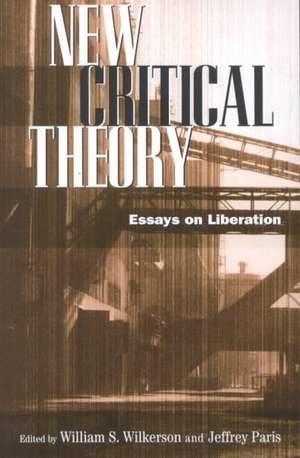
New Critical Theory: Essays on Liberation: New Critical Theory
Autor William S. Wilkerson, Jeffrey Parisen Limba Engleză Paperback – 19 noi 2001



Preț: 335.50 lei
Preț vechi: 447.43 lei
-25%
Puncte Express: 503
Carte tipărită la comandă
Livrare economică 06-20 iunie
Specificații
ISBN-13: 9780742512788
ISBN-10: 0742512789
Pagini: 288
Dimensiuni: 150 x 226 x 16 mm
Greutate: 0.38 kg
Ediția:New.
Editura: Bloomsbury Publishing
Colecția Rowman & Littlefield
Seria New Critical Theory
Locul publicării:New York, United States
ISBN-10: 0742512789
Pagini: 288
Dimensiuni: 150 x 226 x 16 mm
Greutate: 0.38 kg
Ediția:New.
Editura: Bloomsbury Publishing
Colecția Rowman & Littlefield
Seria New Critical Theory
Locul publicării:New York, United States
V-ar putea interesa
-
 Engineers Of The SoulFrank WestermanPreț: 110.33 lei
 -
 The Oxford Handbook of American Public Opinion and the MediaRobert Y. Shapiro-10%Preț: 288.53 lei319.38 lei
 -
 -28%Preț: 767.05 lei1063.78 lei
 -
 -8%Preț: 559.75 lei606.34 lei
 -
 Public Participation in Foreign PolicyJ. HeadleyPreț: 379.88 lei
 -
 So Damn Much MoneyRobert G. KaiserPreț: 120.47 lei
 -
 Soul of a CitizenPaul Rogat LoebPreț: 120.27 lei
 -
 -15%Preț: 420.89 lei495.16 lei
 -
 Europe's Alliance with Israel: Aiding the OccupationDavid CroninPreț: 242.75 lei
 -
 Preț: 213.73 lei
 -
 Preț: 113.19 lei
 -
 Cruel BritanniaIan CobainPreț: 69.16 lei
 -
 No-Nonsense Guide to Global SurveillanceRobin Tudge-31%Preț: 43.35 lei62.94 lei
Cuprins
Chapter 1 Foreword: Back to the Future: Marcuse and the New Critical Theory
Chapter 2 Introduction: Why a New Critical Theory?
Part 3 Visions and Methods
Chapter 4 Obstinate Critique and the Possibility of the Future
Chapter 5 Redemption in the Impasse: An Other Communism
Chapter 6 Toward a New Critical Theory
Chapter 7 Inhabiting Hope: Contributions to a New Materialist Phenomenology
Part 8 Intersections beyond Postmodernism
Chapter 9 Marcuse and the Quest for Radical Subjectivity
Chapter 10 Challenging the Colonial Contract: The Zapatistas Insurgent Imagination
Part 11 Critique of Technology
Chapter 12 Marcuse and the Aestheticization of Technology
Chapter 13 Women Carrying Water: At the Crossroads of Technology and Critical Theory
Chapter 14 Chronotopology: Critique of Spatiotemporal Regimes
Part 15 Race, Sexuality, and the Normative Foundations of Criticism
Chapter 16 Can Queer Theory Be Critical Theory?
Chapter 17 The Mother Wit of Justice: Eros and Hubris in the African-American Context
Chapter 18 Imagining the Horizon
Part 19 Index
Chapter 2 Introduction: Why a New Critical Theory?
Part 3 Visions and Methods
Chapter 4 Obstinate Critique and the Possibility of the Future
Chapter 5 Redemption in the Impasse: An Other Communism
Chapter 6 Toward a New Critical Theory
Chapter 7 Inhabiting Hope: Contributions to a New Materialist Phenomenology
Part 8 Intersections beyond Postmodernism
Chapter 9 Marcuse and the Quest for Radical Subjectivity
Chapter 10 Challenging the Colonial Contract: The Zapatistas Insurgent Imagination
Part 11 Critique of Technology
Chapter 12 Marcuse and the Aestheticization of Technology
Chapter 13 Women Carrying Water: At the Crossroads of Technology and Critical Theory
Chapter 14 Chronotopology: Critique of Spatiotemporal Regimes
Part 15 Race, Sexuality, and the Normative Foundations of Criticism
Chapter 16 Can Queer Theory Be Critical Theory?
Chapter 17 The Mother Wit of Justice: Eros and Hubris in the African-American Context
Chapter 18 Imagining the Horizon
Part 19 Index
Recenzii
This collection brings together some of the most exciting voices writing in critical theory today. The essays included in the volume show us how critical theory can be expanded to include the burning issues of multiculturalism; racial, ethnic, and language politics; and the pressing demands of feminism.
In this collection, Wilkerson and Paris have brought together seasoned veterans of critical theory such as Douglas Kellner, Andrew Feenberg, and James L. Marsh with a new generation of critical theorists including Patricia Huntington, Eduardo Mendieta, Bill Martin, and Cynthia Willett. Although there is no single perspective that unites the authors across topics ranging as widely as the Chiapas Rebellion, queer theory, African-Amercian notions of 'subjectivity,' and Marcuse's early debts to Heidegger, what they share in common is the attempt to renew the critical, radical edge of what we might think of as a 'critical theory industry' dominated by Habermasians. A new, post-Habermasian critical theory finds greater inspiration in the radicalism of HerbertMarcuse than in the critical-theoretic rapprochement with liberalism that has characterized its mainstream development in the United States over the past couple of decades. Anyone interested in answering the question Nancy Fraser once asked, 'What's Critical About Critical Theory?,' will be informed and challenged by this volume. The critical theory that appears here is especially noteworthy for its willingness to learn from and engage in constructive dialogues with postmodernism, feminism, postcolonial t
An important, philosophically sophisticated book that ought to be read by anyone who has felt the pull of philosophical dissonance. It is a book that ought to be read by all those who are intellectually accustomed to reading the works of those who continue to testify against continuing injustice. It is also a book that demands to be read by all of those frustrated by the futile in-fighting that has dogged Critical theory for several decades. This book has the potential for cunstructing new bridges both between the various clans that comprise Critical theory and across to other intellectual traditions that have been unduly neglected by an overly canonical reading of Critical theory.
One is unlikely to encounter an anthology on recent applications of critical theory that is as thorough in its coverage as this one. The editors have done a terrific job assembling an all-star cast of scholars; the writing is impassioned and the territory covered-from philosophical foundations and postmodern challenges to globalization, technology, post-colonialism, race, gender, and sexual orientation-is fresh and exciting.
In this collection, Wilkerson and Paris have brought together seasoned veterans of critical theory such as Douglas Kellner, Andrew Feenberg, and James L. Marsh with a new generation of critical theorists including Patricia Huntington, Eduardo Mendieta, Bill Martin, and Cynthia Willett. Although there is no single perspective that unites the authors across topics ranging as widely as the Chiapas Rebellion, queer theory, African-Amercian notions of 'subjectivity,' and Marcuse's early debts to Heidegger, what they share in common is the attempt to renew the critical, radical edge of what we might think of as a 'critical theory industry' dominated by Habermasians. A new, post-Habermasian critical theory finds greater inspiration in the radicalism of HerbertMarcuse than in the critical-theoretic rapprochement with liberalism that has characterized its mainstream development in the United States over the past couple of decades. Anyone interested in answering the question Nancy Fraser once asked, 'What's Critical About Critical Theory?,' will be informed and challenged by this volume. The critical theory that appears here is especially noteworthy for its willingness to learn from and engage in constructive dialogues with postmodernism, feminism, postcolonial t
An important, philosophically sophisticated book that ought to be read by anyone who has felt the pull of philosophical dissonance. It is a book that ought to be read by all those who are intellectually accustomed to reading the works of those who continue to testify against continuing injustice. It is also a book that demands to be read by all of those frustrated by the futile in-fighting that has dogged Critical theory for several decades. This book has the potential for cunstructing new bridges both between the various clans that comprise Critical theory and across to other intellectual traditions that have been unduly neglected by an overly canonical reading of Critical theory.
One is unlikely to encounter an anthology on recent applications of critical theory that is as thorough in its coverage as this one. The editors have done a terrific job assembling an all-star cast of scholars; the writing is impassioned and the territory covered-from philosophical foundations and postmodern challenges to globalization, technology, post-colonialism, race, gender, and sexual orientation-is fresh and exciting.