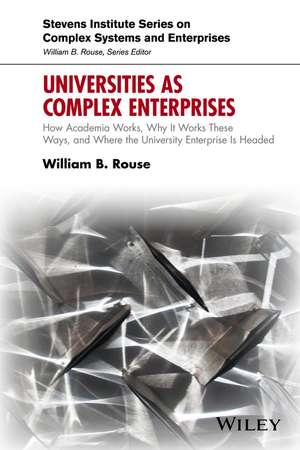
Universities as Complex Enterprises
Autor William B. Rouseen Limba Engleză Hardback – 13 iun 2016
Imaginați-vă o instituție academică în care deciziile administrative, bugetele de cercetare și strategiile de brand nu sunt tratate ca silozuri izolate, ci ca variabile interdependente într-un model economic computațional. Găsim în această carte exact această rigoare analitică: WB Rouse aplică principiile ingineriei sistemelor asupra universității moderne, tratând-o nu doar ca pe un for spiritual, ci ca pe o „întreprindere complexă” unde procesele, structura și ecosistemul social trebuie să funcționeze sincronizat pentru a supraviețui escaladării costurilor. Observăm o trecere de la analiza calitativă la una cantitativă, oferind decidenților o arhitectură clară pentru a înțelege cum anumite elemente ale sistemului pot bloca sau, dimpotrivă, pot accelera transformarea instituțională. Autorul folosește experiența sa vastă de la Stevens Institute of Technology pentru a propune strategii alternative de management, bazate pe date, nu pe intuiție. Această abordare continuă temele explorate în Modeling and Visualization of Complex Systems and Enterprises, unde Rouse punea bazele modelării fenomenelor umane și economice, însă aici focalizarea este strictă și aplicată pe ecosistemul academic. Complementar lucrării Reengineering the University de William F. Massy, care se concentrează pe eficiență și valori academice, volumul de față acoperă zona tehnică a modelării computaționale, oferind un instrumentar matematic și sistemic pe care Massy îl abordează mai degrabă din perspectivă consultativă. De asemenea, dacă The Enterprise University de Simon Marginson oferă un studiu de caz sociopolitic asupra reformelor, Rouse aduce rigurozitatea Stevens Institute Series on Complex Systems and Enterprises, transformând teoria organizațională în pârghii de schimbare concrete. Putem afirma că lucrarea reprezintă o evoluție firească față de Don′t Jump to Solutions, aplicând avertismentul autorului împotriva soluțiilor pripite într-un context unde mizele sunt viitorul educației și sustenabilitatea economică a cercetării.
Preț: 804.62 lei
Preț vechi: 884.19 lei
-9%
Carte tipărită la comandă
Livrare economică 07-21 decembrie
Specificații
ISBN-10: 1119244870
Pagini: 224
Dimensiuni: 161 x 240 x 16 mm
Greutate: 0.5 kg
Editura: Wiley
Locul publicării:Hoboken, United States
V-ar putea interesa
-
 People and OrganizationsWilliam B. Rouse-9%Preț: 802.84 lei882.24 lei
 -
 Essential Challenges of Strategic ManagementWilliam B. Rouse-9%Preț: 830.29 lei912.41 lei
 -
 Design for SuccessWilliam B. Rouse-9%Preț: 1366.93 lei1502.12 lei
 -
 Organizational SimulationWilliam B. Rouse-9%Preț: 1021.80 lei1122.85 lei
 -
 Internship MasteryRyan D GlickPreț: 150.27 lei
 -
 Finding The Story WithinAnnette DenshamPreț: 104.70 lei
 -
 Don't Jump to SolutionsWilliam B. RousePreț: 309.09 lei
 -
 Preț: 304.50 lei
 -
 Modeling and Visualization of Complex Systems and EnterprisesWilliam B. Rouse-9%Preț: 781.24 lei858.51 lei
 -
 Appointment with Ying @8amYing SaPreț: 167.51 lei
 -
 Cómo Mejorar Tu Historial CrediticioIncome MasteryPreț: 152.60 lei
 -
 S.O.U.L.Ywhoiam Llc Yes PublishingPreț: 114.52 lei
 -
 12 Elements of Account Management SuccessEzra SchneierPreț: 74.40 lei
 -
 Preț: 180.39 lei
 -
 Enforcing RegulationK. O. HawkinsPreț: 370.42 lei
 -
 Man, Robot and SocietyM. TodaPreț: 373.16 lei
 -
 Maxima and MinimaR. FrischPreț: 369.52 lei
Public țintă
systems scientists and engineers interested in complex public–private enterprises; economists; social scientists; decision makers; enterprise–related courses; management courses; boards of trustees members; boards of regents members; administrators and faculty at all universities; those interested in the systems and economics of higher educationDe ce să citești această carte
Această carte este esențială pentru rectori, administratori și membri ai consiliilor de administrație care doresc să înțeleagă mecanismele economice profunde ale universității. Veți învăța să utilizați gândirea sistemică pentru a identifica barierele structurale și pentru a implementa schimbări care să echilibreze misiunea academică cu realitățile financiare, beneficiind de un model computațional riguros care depășește managementul tradițional.
Descriere scurtă
This book looks at universities from a whole-enterprise perspective. It explores the steady escalation of the costs of higher education and uses a computational economic model of complex academic enterprises. This model includes component models of research, teaching, administration, and brand value. Understanding the relationships among practices, processes, structure, and ecosystem provides the basis for transforming academia, leveraging its strengths and overcoming its limitations. More specifically, this architecture helps the reader understand how various elements of the enterprise system either enable or hinder other elements of the system, all of which are embedded in a complex behavioral and social ecosystem. Each topic is explored in terms of the levels of the architecture at which it primarily functions. Levers of change within each area are discussed, using many experiences of pursuing such issues in a range of academic enterprises.
- Provides a new methodology by taking a more systems-oriented approach to education systems as a whole
- Shows how various elements of the enterprise system either enable or hinder other elements of the system
- Offers alternative strategies for transformation of academic enterprises
William B. Rouse is the Alexander Crombie Humphreys Chair within the School of Systems & Enterprises and Director of the Center for Complex Systems and Enterprises at Stevens Institute of Technology, Hoboken, New Jersey. He is also Professor Emeritus, and former Chair, of the School of Industrial and Systems Engineering at the Georgia Institute of Technology, Atlanta, Georgia. Rouse has written hundreds of articles and book chapters, and has authored many books, including most recently Modeling and Visualization of Complex Systems and Enterprises (Wiley, 2015).