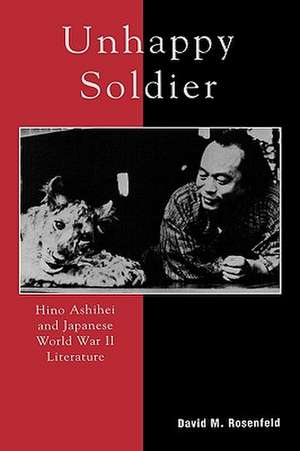
Unhappy Soldier: Hino Ashihei and Japanese World War II Literature: Studies of Modern Japan
Autor David M. Rosenfelden Limba Engleză Hardback – 12 iun 2002
Preț: 583.93 lei
Preț vechi: 882.08 lei
-34%
Puncte Express: 876
Preț estimativ în valută:
103.23€ • 120.11$ • 89.80£
103.23€ • 120.11$ • 89.80£
Carte tipărită la comandă
Livrare economică 17 aprilie-01 mai
Specificații
ISBN-13: 9780739103654
ISBN-10: 0739103652
Pagini: 180
Dimensiuni: 158 x 236 x 20 mm
Greutate: 0.44 kg
Editura: Bloomsbury Publishing
Colecția Lexington Books
Seria Studies of Modern Japan
Locul publicării:New York, United States
ISBN-10: 0739103652
Pagini: 180
Dimensiuni: 158 x 236 x 20 mm
Greutate: 0.44 kg
Editura: Bloomsbury Publishing
Colecția Lexington Books
Seria Studies of Modern Japan
Locul publicării:New York, United States
V-ar putea interesa
-
 Penelope FitzgeraldHermione Lee-19%Preț: 84.96 lei104.72 lei
 -
 Roth UnboundClaudia Roth PierpontPreț: 111.00 lei
 -
 Letters 1941-1985Italo CalvinoPreț: 137.45 lei
 -
 -34%Preț: 753.27 lei1134.52 lei
 -
 Ezra Pound: Poet: Volume II: The Epic YearsA. David MoodyPreț: 170.92 lei
 -
 Philip Roth: Fiction and PowerPatrick Hayes-34%Preț: 734.46 lei1111.24 lei
 -
 The Complete Poems of Philip LarkinPhilip LarkinPreț: 188.19 lei
 -
 Writing HomeAlan BennettPreț: 119.14 lei
 -
 Preț: 81.01 lei
 -
 Ramsey Campbell: Critical Essays on the Modern Master of HorrorGary William Crawford-37%Preț: 644.52 lei1019.99 lei
 -
 Essays in Honour of Wole Soyinka at 80Ivor Agyeman-Duah-31%Preț: 109.25 lei157.71 lei
 -
 Burning the DaysJames Salter-35%Preț: 58.16 lei89.32 lei
 -
 -18%Preț: 184.98 lei224.80 lei
Cuprins
Chapter 1 Introduction
Chapter 2 Wartime
Chapter 3 Purge and Self-Pity
Chapter 4 The Other Face of War
Chapter 5 Fighting the Postwar
Chapter 6 Remembering Hino
Chapter 2 Wartime
Chapter 3 Purge and Self-Pity
Chapter 4 The Other Face of War
Chapter 5 Fighting the Postwar
Chapter 6 Remembering Hino
Recenzii
This is a groundbreaking piece of scholarship in the field of Japanese studies. . . . Hino Ashihei is a thought-provoking figure important for any consideration of wartime and postwar fiction.
Rosenfeld's book, by presenting a broad range of information and analysis, paves the way for such further consideration of the writings of Hino Ashihei.
Rosenfeld's analysis of these works not only provides insight into this important writer but, by traking and analyzing this relationship, also elucidates important questions of an author's role in the production of his own readership and the vagaries of public opinion. . . . At the heart of this novel is a concern fundamental to Rosenfeld's study, the agency of the author.
In this beautifully presented book, Rosenfeld writes lucidly and efficiently, weaving sharp textual analysis seamlessly into historical context (and at times delighting the reader with a sense of humour that one suspects was reined in for the occasion). Rosenfeld has made a contribution to the field of Japanese Studies that will be appreciated across the disciplines of literature, history, and cultural studies.
Deftly examining Hino Ashihei's wartime and postwar literary career against radically changing political vicissitudes, David Rosenfeld's study illuminates Hino's interactive role in styling his narrative and historical persona while repackaging past and present representations of his war experience. The result is an incisive study of Hino's attempts at self-redefinition as both man and artist within a shifting political environment that inspired its tortuous and often tormented internal drama.
Rosenfeld's book, by presenting a broad range of information and analysis, paves the way for such further consideration of the writings of Hino Ashihei.
Rosenfeld's analysis of these works not only provides insight into this important writer but, by traking and analyzing this relationship, also elucidates important questions of an author's role in the production of his own readership and the vagaries of public opinion. . . . At the heart of this novel is a concern fundamental to Rosenfeld's study, the agency of the author.
In this beautifully presented book, Rosenfeld writes lucidly and efficiently, weaving sharp textual analysis seamlessly into historical context (and at times delighting the reader with a sense of humour that one suspects was reined in for the occasion). Rosenfeld has made a contribution to the field of Japanese Studies that will be appreciated across the disciplines of literature, history, and cultural studies.
Deftly examining Hino Ashihei's wartime and postwar literary career against radically changing political vicissitudes, David Rosenfeld's study illuminates Hino's interactive role in styling his narrative and historical persona while repackaging past and present representations of his war experience. The result is an incisive study of Hino's attempts at self-redefinition as both man and artist within a shifting political environment that inspired its tortuous and often tormented internal drama.