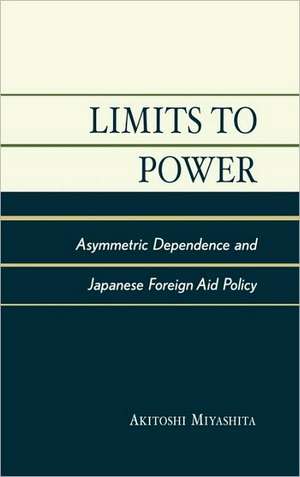
Limits to Power: Asymmetric Dependence and Japanese Foreign Aid Policy: Studies of Modern Japan
Autor Akitoshi Miyashitaen Limba Engleză Hardback – 29 apr 2003
Miyashita critically reviews the existing literature on Japanese foreign aid, then tests his own argument against five case studies. After analyzing critical junctures in Japan's history of foreign aid to China, Vietnam, Russia, Iran, and North Korea, he concludes that Japan's consistent sway under U.S. opinion reflects an act of will on Japan's part, rather than a lack of coherent policy stemming from bureaucratic politics. Limits to Power boldly challenges current arguments that Japan has successfully distanced itself from "reactive" politics.


Preț: 573.45 lei
Preț vechi: 883.03 lei
-35%
Puncte Express: 860
Carte tipărită la comandă
Livrare economică 09-23 noiembrie
Livrare prin curier în România Termenul estimat este afișat lângă disponibilitate.
Transport gratuit pentru acest produs Plată online sau ramburs, în funcție de opțiunile comenzii.
Retur gratuit în 14 zile Comandă securizată și suport în română.
Specificații
ISBN-13: 9780739106020
ISBN-10: 0739106023
Pagini: 242
Dimensiuni: 158 x 230 x 22 mm
Greutate: 0.48 kg
Ediția:New.
Editura: Bloomsbury Publishing
Colecția Lexington Books
Seria Studies of Modern Japan
Locul publicării:New York, United States
ISBN-10: 0739106023
Pagini: 242
Dimensiuni: 158 x 230 x 22 mm
Greutate: 0.48 kg
Ediția:New.
Editura: Bloomsbury Publishing
Colecția Lexington Books
Seria Studies of Modern Japan
Locul publicării:New York, United States
V-ar putea interesa
-
 The Dream of RomeBoris JohnsonPreț: 77.46 lei
 -
 What Does China Think?Mark LeonardPreț: 108.11 lei
 -
 Identity and ViolenceAmartya Sen-32%Preț: 62.14 lei90.96 lei
 -
 -15%Preț: 179.08 lei209.71 lei
 -
 Libertarianism without InequalityMichael Otsuka-29%Preț: 376.29 lei527.76 lei
 -
 -12%Preț: 305.39 lei348.31 lei
 -
 Utility and Democracy: The Political Thought of Jeremy BenthamPhilip Schofield-22%Preț: 416.46 lei535.29 lei
 -
 Preț: 323.09 lei
 -
 Legacy of AshesTim WeinerPreț: 136.13 lei
 -
 Carl Schmitt: Politics and TheoryPaul Edward Gottfried-30%Preț: 617.97 lei888.02 lei
 -
 The Missionary and the LibertineIan BurumaPreț: 111.22 lei
 -
 Talk to MeAnna Deavere SmithPreț: 112.62 lei
 -
 Literacy: Reading the Word and the WorldPaulo Freire-21%Preț: 193.36 lei245.65 lei
 -
 Politico's Guide to Local GovernmentAndrew StevensPreț: 99.00 lei
 -
 -25%Preț: 174.04 lei231.08 lei
Cuprins
Part 1 Puzzle, Theory, and Methodology
Chapter 2 Introduction
Chapter 3 American Pressure and Japanese Foreign Aid
Chapter 4 Gaiatsu and Preferences
Part 5 Cases
Chapter 6 China: The Tiananmen Square Incident and the Resumption of Yen Loans
Chapter 7 Vietnam: Lifting Bilateral and Multilateral Aid Sanctions
Chapter 8 Russia: The Retreat from the Linkage Strategy
Chapter 9 Iran: The Controversy over the Hydroelectric Power Plant Project
Chapter 10 North Korea: The KEDO and the Politics of Burden-Sharing
Part 11 Conclusions and Implications
Chapter 12 Structural Constraints of Japanese Power
Chapter 13 Rethinking the Reactive-Proactive Debate
Chapter 2 Introduction
Chapter 3 American Pressure and Japanese Foreign Aid
Chapter 4 Gaiatsu and Preferences
Part 5 Cases
Chapter 6 China: The Tiananmen Square Incident and the Resumption of Yen Loans
Chapter 7 Vietnam: Lifting Bilateral and Multilateral Aid Sanctions
Chapter 8 Russia: The Retreat from the Linkage Strategy
Chapter 9 Iran: The Controversy over the Hydroelectric Power Plant Project
Chapter 10 North Korea: The KEDO and the Politics of Burden-Sharing
Part 11 Conclusions and Implications
Chapter 12 Structural Constraints of Japanese Power
Chapter 13 Rethinking the Reactive-Proactive Debate
Recenzii
Miyashita operates in a realist world and sets the research question in the broader context of Japan's rise in the interstate hierarchy over the past few decades. He reminds us that Japan has not truly escaped its asymmetric dependence on the United States. The analytic precision that is brought to bear allows this study to eclipse other work in this area.
Through a series of vivid case studies of Japanese foreign aid policy, Miyashita shows how the primacy of Japan's American connection often drives Japanese policy in directions the Japanese government, other things being equal, would prefer not to go. Miyashita's well-argued point is that other things are not equal and that it is Japan's asymmetric dependence on the United States that makes it a soft target for gaiatsu, the effective application of American pressure on Japan's foreign aid policy. Miyashita has written an interesting and important book.
This is a very useful addition to the literature on Japanese foreign aid policy. The book, well-written and forcefully argued, takes us beyond the more traditional way of looking at Japanese foreign aid. . ..At the same time, it is not a book just about foreign aid; it also addresses why Japan is sensitive to American pressure.
Miyashita challenges a number of preexisting conclusions about Japanese aid policy and he provides an excellent case in support of alternative explanations. In doing so, he adds considerably to our understanding of Japanese politics and Japanese foreignpolicy.
Through a series of vivid case studies of Japanese foreign aid policy, Miyashita shows how the primacy of Japan's American connection often drives Japanese policy in directions the Japanese government, other things being equal, would prefer not to go. Miyashita's well-argued point is that other things are not equal and that it is Japan's asymmetric dependence on the United States that makes it a soft target for gaiatsu, the effective application of American pressure on Japan's foreign aid policy. Miyashita has written an interesting and important book.
This is a very useful addition to the literature on Japanese foreign aid policy. The book, well-written and forcefully argued, takes us beyond the more traditional way of looking at Japanese foreign aid. . ..At the same time, it is not a book just about foreign aid; it also addresses why Japan is sensitive to American pressure.
Miyashita challenges a number of preexisting conclusions about Japanese aid policy and he provides an excellent case in support of alternative explanations. In doing so, he adds considerably to our understanding of Japanese politics and Japanese foreignpolicy.