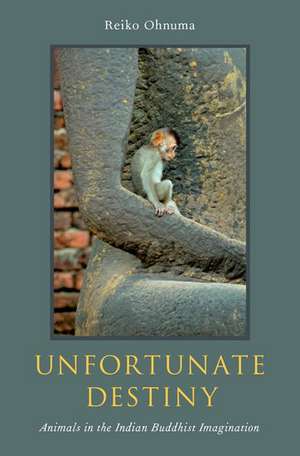
Unfortunate Destiny: Animals in the Indian Buddhist Imagination
Autor Reiko Ohnumaen Limba Engleză Hardback – 15 iun 2017
Observăm în Unfortunate Destiny o abordare riguroasă a unui paradox fundamental din gândirea budistă indiană: deși renașterea ca animal este considerată un „destin nefericit” (durgati), marcat de lipsa discernământului moral, literatura narativă abundă în figuri de animale virtuoase și înțelepte. Această lucrare publicată de Oxford University Press investighează modul în care textele premoderne folosesc „celălalt” non-uman pentru a defini și rafina conceptul de umanitate. Găsim aici o analiză nuanțată a modului în care animalele servesc drept oglinzi sau „dubluri” pentru Buddha, oferind o perspectivă mult mai complexă decât simpla ierarhie cosmologică.
Această monografie completează perspectiva oferită de Charming Beauties and Frightful Beasts de Fabrizio M. Ferrari, adăugând o analiză textuală specifică asupra modului în care limbajul și imaginile animale sunt utilizate ca instrumente retorice pentru a explora limitele potențialului spiritual uman. Dacă lucrarea lui Ferrari se concentrează pe animale ca purtători de cultură în sens larg, Reiko Ohnuma se ancorează în specificul literaturii de limbă pali și sanscrită pentru a expune ambivalența morală a tradiției budiste.
În contextul operei sale, Unfortunate Destiny continuă preocuparea autoarei pentru temele marginalității și ale corpului, explorate anterior în Ties That Bind și Head, Eyes, Flesh and Blood. Acolo unde studiile precedente analizau maternitatea sau sacrificiul fizic, volumul de față extinde cercetarea către frontiera ontologică dintre specii. Stilul este academic, dens în referințe textuale, dar fluid, reușind să organizeze un material vast — de la cosmologie la fabulă — într-o argumentație coerentă despre rolul imaginației în construcția eticii religioase.
Preț: 312.74 lei
Preț vechi: 359.36 lei
-13%
Carte tipărită la comandă
Livrare economică 10-21 iulie
Specificații
ISBN-10: 0190637544
Pagini: 266
Dimensiuni: 160 x 239 x 28 mm
Greutate: 0.48 kg
Editura: Oxford University Press
Colecția OUP USA
Locul publicării:New York, United States
V-ar putea interesa
-
 Preț: 335.95 lei
 -
 The Inner Kalacakratantra: A Buddhist Tantric View of the IndividualVesna A. Wallace-14%Preț: 949.99 lei1104.65 lei
 -
 -7%Preț: 856.32 lei922.52 lei
 -
 Preț: 341.78 lei
 -
 Preț: 332.59 lei
 -
 -14%Preț: 703.96 lei818.56 lei
 -
 Preț: 314.90 lei
 -
 Curators of the Buddha: The Study of Buddhism under ColonialismDonald S. Lopez Jr.Preț: 280.81 lei
 -
 The Diamond CutterGeshe Michael RoachPreț: 88.93 lei
 -
 The Secret Power WithinChuck NorrisPreț: 90.27 lei
 -
 After the Ecstasy, the LaundryJack Kornfield-29%Preț: 101.74 lei144.00 lei
 -
 Nature, Man and WomanAlan W. WattsPreț: 86.38 lei
 -
 The Art of Stopping TimePedram Shojai-21%Preț: 83.96 lei105.84 lei
 -
 Zen: Tradition and TransitionKenneth KraftPreț: 95.62 lei
 -
 Developing Balanced SensitivityAlexander BerzinPreț: 151.83 lei
 -
 The End of the World, Plan BCharles Shiro InouyePreț: 85.74 lei
 -
 The Heart SutraRed PinePreț: 85.98 lei
 -
 Nagarjuna's Middle WayMark Siderits-30%Preț: 116.18 lei166.74 lei
 -
 In Search of Buddha's DaughtersChristine ToomeyPreț: 94.93 lei
 -
 The Wise HeartJack Kornfield-19%Preț: 116.73 lei144.01 lei
 -
 -8%Preț: 622.98 lei677.14 lei
 -
 Frieden Durch Religion - Ein Japanisches ModellChristiane Schulze-9%Preț: 966.21 lei1061.77 lei
 -
 Mongolian BuddhismMichael K JerrysonPreț: 180.67 lei
De ce să citești această carte
Recomandăm această carte cercetătorilor și studenților interesați de budismul indian și etica animală. Cititorul va obține o înțelegere profundă a modului în care tradiția budistă a navigat între condamnarea doctrinară a stării de animal și celebrarea narativă a virtuților acestora. Este un instrument esențial pentru a înțelege cum religia folosește metafora animală pentru a construi identitatea umană, oferind o perspectivă critică asupra antropocentrismului religios.
Despre autor
Reiko Ohnuma este profesor asociat de religie la Dartmouth College, specializată în literatura budistă premodernă din Asia de Sud, cu un interes deosebit pentru textele narative. Opera sa explorează teme complexe precum maternitatea în budism, în lucrarea Ties That Bind, și etica sacrificiului corporal în Head, Eyes, Flesh and Blood. Prin cercetările sale, Ohnuma analizează modul în care tradițiile budiste timpurii au gestionat tensiunile dintre idealurile spirituale și realitățile materiale sau biologice ale existenței umane și non-umane.
Descriere
Recenzii
Ohnuma is a clear and evocative writer, who always keeps her audience in mind and brings the multi layered symbolism of animals in early Buddhist literature alive. This book would be suitable to use in an undergraduate class on Buddhism and is also an important contribution for scholars of Buddhism, religious studies, or Indian literature.
[A] highly valuable and often revealing interpretation of the depiction of animals in early Buddhism, one that is of interest not only to Buddhist Studies, but certainly offers important insights for the broader audience of current Animals Studies.
In Unfortunate Destiny: Animals in the Indian Buddhist Imagination, Reiko Ohnuma has succeeded in writing a readable, lively, entertaining, and outstandingly scholarly study. I was grateful for both her wit and lively turn of phrase and the depth of the analysis at hand. It is a work that will be central to any discussion of animals and animality in Buddhist studies for years to come. It will also clearly be of interest in religious studies and related disciplines whenever there is a discussion of religion and our nonhuman friends.
Reiko Ohnuma's marvelous new book... shows us the complexity of early Buddhists' feelings about animals, feelings that are shaped by both spiritual aspiration and moral ambivalence.