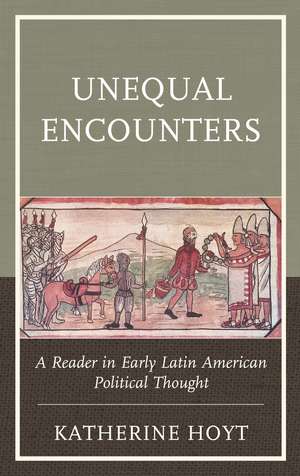
Unequal Encounters: A Reader in Early Latin American Political Thought
Editat de Katherine Hoyten Limba Engleză Paperback – apr 2024
Preț: 259.00 lei
Preț vechi: 351.79 lei
-26%
Puncte Express: 389
Carte tipărită la comandă
Livrare economică 31 octombrie-14 noiembrie
Livrare prin curier în România Termenul estimat este afișat lângă disponibilitate.
Transport gratuit de la 400.00 lei Plată online sau ramburs, în funcție de opțiunile comenzii.
Retur gratuit în 14 zile Comandă securizată și suport în română.
Specificații
ISBN-13: 9781793622549
ISBN-10: 179362254X
Pagini: 344
Dimensiuni: 152 x 229 x 21 mm
Greutate: 0.46 kg
Editura: Bloomsbury Publishing
Colecția Lexington Books
Locul publicării:New York, United States
ISBN-10: 179362254X
Pagini: 344
Dimensiuni: 152 x 229 x 21 mm
Greutate: 0.46 kg
Editura: Bloomsbury Publishing
Colecția Lexington Books
Locul publicării:New York, United States
Cuprins
Introduction
Chapter 1: The Kaqchikel Maya: "Go to Where You Will See Your Mountains."
The Annals of the Cakchiquels
Chapter 2: Christopher Columbus: "Took Possession of That Island for the King and Queen"
Christopher Columbus' Log of His First Voyage to America
Chapter 3: Antonio de Montesinos: "Are They Not Human Beings?"
The 1511 Sermon of Antonio de Montesinos
Chapter 4: Bartolomé de Las Casas: "This Is against All Divine and Human Laws"
The 1550 Debate of Bartolomé de Las Casas against Juan Ginés de Sepúlveda
Chapter 5: Alonso de la Vera Cruz: "The Spaniards Cannot Have Just Dominion."
Defense of the Indians: Their Rights, A Discussion by the Reverend Father Alonso de la Vera Cruz (1553)
Chapter 6: Isabel de Guevara: "This Was Men's Work."
Letter of Isabel de Guevara to the Princess Juana
Chapter 7: Council of Huejotzingo: "Our Fathers Knew No Tribute."
Letter from the Council of Huejotzingo to King Philip II, 1560
Chapter 8: Bernardino de Sahagún: "I Assembled All the Leaders."
General
Chapter 1: The Kaqchikel Maya: "Go to Where You Will See Your Mountains."
The Annals of the Cakchiquels
Chapter 2: Christopher Columbus: "Took Possession of That Island for the King and Queen"
Christopher Columbus' Log of His First Voyage to America
Chapter 3: Antonio de Montesinos: "Are They Not Human Beings?"
The 1511 Sermon of Antonio de Montesinos
Chapter 4: Bartolomé de Las Casas: "This Is against All Divine and Human Laws"
The 1550 Debate of Bartolomé de Las Casas against Juan Ginés de Sepúlveda
Chapter 5: Alonso de la Vera Cruz: "The Spaniards Cannot Have Just Dominion."
Defense of the Indians: Their Rights, A Discussion by the Reverend Father Alonso de la Vera Cruz (1553)
Chapter 6: Isabel de Guevara: "This Was Men's Work."
Letter of Isabel de Guevara to the Princess Juana
Chapter 7: Council of Huejotzingo: "Our Fathers Knew No Tribute."
Letter from the Council of Huejotzingo to King Philip II, 1560
Chapter 8: Bernardino de Sahagún: "I Assembled All the Leaders."
General
Recenzii
Unequal Encounters features influential political texts by writers from early colonial Latin America to 1630, focusing especially on themes of conquest, colonialism, and enslavement.. Each chapter offers an extensive introduction with biographical notes about its author and context. Some selections, such as the Kaqchikel Chronicles, allude to pre-conquest society and politics; others, such as the Council of Huejotzingo's letter to King Philip II, describe conditions under Spanish rule and advocate for change. The editor's careful attention to including diverse perspectives of early colonial life and the clear and accessible prose of the chapter introductions make this volume an excellent resource for colonial Latin American history and political theory courses. Highly recommended. Undergraduates through faculty and general readers.
Unequal Encounters: A Reader in Early Latin American Political Thought by Katherine Hoyt is an excellent anthology of "encounter writings" of the Americas. It brings together pre-Columbian and post-encounter documents from indigenous writers and Europeans working at the margins, painting a rich and full picture of the problematic of the European conquest of the New World. Hoyt's social and political involvement in Latin America spans decades. She is as close as it gets to an organic intellectual working in this field in the US. Her judicious collection is a welcome addition to the literature, filling an existing gap in the area of Latin American thought, history, and culture.
One of the major lacunae of the burgeoning field of Comparative Political Theory-- which seeks to expand the purview of political ideas beyond the Western world-- is the field of pre-Columbian and early-modern Latin American thought. Unequal Encounters: A Reader in Early Latin American Political Thought will prove to be invaluable in addressing this gap. The reader provides a carefully selected set of texts that show why Latin American political thought helps us better understand issues related to race, gender, class, and the birth of the modern world.
Unequal Encounters: A Reader in Early Latin American Political Thought by Katherine Hoyt is an excellent anthology of "encounter writings" of the Americas. It brings together pre-Columbian and post-encounter documents from indigenous writers and Europeans working at the margins, painting a rich and full picture of the problematic of the European conquest of the New World. Hoyt's social and political involvement in Latin America spans decades. She is as close as it gets to an organic intellectual working in this field in the US. Her judicious collection is a welcome addition to the literature, filling an existing gap in the area of Latin American thought, history, and culture.
One of the major lacunae of the burgeoning field of Comparative Political Theory-- which seeks to expand the purview of political ideas beyond the Western world-- is the field of pre-Columbian and early-modern Latin American thought. Unequal Encounters: A Reader in Early Latin American Political Thought will prove to be invaluable in addressing this gap. The reader provides a carefully selected set of texts that show why Latin American political thought helps us better understand issues related to race, gender, class, and the birth of the modern world.