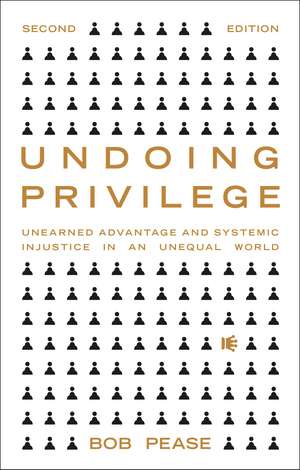
Undoing Privilege: Unearned Advantage and Systemic Injustice in an Unequal World
Autor Professor Bob Peaseen Limba Engleză Paperback – 16 dec 2021
The second edition of Undoing Privilege extensively revises the six sites of privilege from the first edition: Western dominance, class elitism, white and patriarchal privilege and heterosexual and able-bodied privilege to reflect policy shifts and new social movement initiatives as well as the latest research and resources. This edition also includes four new chapters on anthropocentrism, cisgender privilege, adultism and Christian privilege. Pease points out that while the vast majority of people may be oppressed on one level, many are also privileged on another. He demonstrates how members of privileged groups can engage critically with their own dominant position, and explores the potential and limitations of them forming relations of solidarity against oppression and their unearned privilege.
The second edition includes new theoretical developments in privilege theory, collective responsibility, complicity in systemic injustice and allyship. It is an essential book for all who are concerned about developing theories and practices for a socially just world.
Preț: 118.46 lei
Preț vechi: 233.03 lei
-49%
Carte disponibilă
Livrare economică 14-28 noiembrie
Specificații
ISBN-10: 191344113X
Pagini: 336
Dimensiuni: 138 x 214 x 20 mm
Greutate: 0.41 kg
Ediția:2nd edition
Editura: Bloomsbury Publishing
Colecția Zed Books
Locul publicării:London, United Kingdom
Cuprins
Preface
Part I: Theoretical and Conceptual Foundations
1. Oppression, Privilege and Relations of Domination
2. The Matrix and Social Dynamics of Privilege
Part II: Intersecting Sites of Privilege
3. Anthropocentrism and human supremacy
4. Western Dominance and eurocentrism
5. Political Economy and Class Elitism
6. Racial Formations and White Supremacy
7. Gender Order and the Patriarchal Dividend
8. Institutionalised Heterosexuality and Heteroprivilege
9. Gender binary and cis privilege
10. Ableist Relations and the Embodiment of Privilege
12. Generational order and adult-centrism
Part III: Undoing Privilege
9. Challenging the Reproduction of Privilege from Within
References
Index
Recenzii
With new chapters on cisgender and adult-centric privilege, this timely text is even more comprehensive than the first. Essential reading for anyone committed to social justice and dismantling systems of privilege!
Many of us in the social justice struggle focus primarily on exposing and indicting oppression. Bob Pease's clear and compassionate analysis reminds us that unearned privilege and advantage are the other side of the oppression coin, and that equity cannot be achieved without engaging with all aspects of this complex dynamic. In an era where intersectional analysis is gaining intellectual ground and authority, Pease's book on the effects and need to dismantle systems of privilege is an essential tool for those seeking ideas that can liberate and empower.
[T]he second edition of Undoing privilege explores important and necessary social identities, locations, and experiences of domination, power, and control. Pease utilizes relevant and up-to-date literature, credits activists and scholars for their ideas and voices, and utilizes critical reflexivity to position himself throughout the book in a way that is transparent to the reader.
Notă biografică
Bob Pease is Chair of Social Work in the School of Health and Social Development at Deakin University in Geelong, Australia. His most recent co-edited books are The International Encyclopedia of Men and Masculinities (2007), Migrant Men: Critical Studies of Masculinities and the Migration Experience (2009) and Critical Social Work: Theories and Practices for a Socially Just World (2009). He has been involved in profeminist masculinity politics for many years and actively engaged in campaigns to end men's violence against women.
Bob Pease is Chair of Social Work in the School of Health and Social Development at Deakin University in Geelong, Australia. His most recent co-edited books are The International Encyclopedia of Men and Masculinities (2007), Migrant Men: Critical Studies of Masculinities and the Migration Experience (2009) and Critical Social Work: Theories and Practices for a Socially Just World (2009). He has been involved in profeminist masculinity politics for many years and actively engaged in campaigns to end men's violence against women.