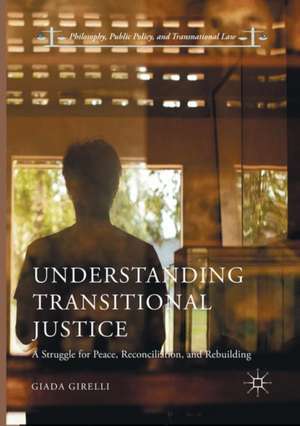
Understanding Transitional Justice: Philosophy, Public Policy, and Transnational Law
Autor Giada Girellien Limba Engleză Paperback – aug 2018



Preț: 745.56 lei
Preț vechi: 909.22 lei
-18%
Puncte Express: 1118
Carte disponibilă
Livrare economică 27 octombrie-10 noiembrie
Livrare express 13-17 octombrie pentru 32.35 lei
Livrare prin curier în România Termenul estimat este afișat lângă disponibilitate.
Transport gratuit pentru acest produs Plată online sau ramburs, în funcție de opțiunile comenzii.
Retur gratuit în 14 zile Comandă securizată și suport în română.
Specificații
ISBN-13: 9783319851952
ISBN-10: 3319851950
Pagini: 352
Ilustrații: XVI, 335 p.
Dimensiuni: 148 x 210 x 20 mm
Greutate: 0.46 kg
Ediția:Softcover reprint of the original 1st edition 2017
Editura: Springer
Colecția Philosophy, Public Policy, and Transnational Law
Seria Philosophy, Public Policy, and Transnational Law
Locul publicării:Cham, Switzerland
ISBN-10: 3319851950
Pagini: 352
Ilustrații: XVI, 335 p.
Dimensiuni: 148 x 210 x 20 mm
Greutate: 0.46 kg
Ediția:Softcover reprint of the original 1st edition 2017
Editura: Springer
Colecția Philosophy, Public Policy, and Transnational Law
Seria Philosophy, Public Policy, and Transnational Law
Locul publicării:Cham, Switzerland
V-ar putea interesa
-
 Stanley I Presume?Stanley JohnsonPreț: 112.96 lei
 -
 Master of WarSuzanne SimonsPreț: 104.62 lei
 -
 Armies Of GodDominic GreenPreț: 116.95 lei
 -
 AnglerBarton GellmanPreț: 144.82 lei
 -
 Brazil on the RiseLarry RohterPreț: 123.35 lei
 -
 Environmental Politics: The Age of Climate ChangeRobert GarnerPreț: 284.79 lei
 -
 Preț: 289.02 lei
 -
 Origins of Political OrderFrancis FukuyamaPreț: 133.53 lei
 -
 Imperialism and Global Political EconomyAlex CallinicosPreț: 174.92 lei
 -
 Political TheorySchumakerPreț: 524.42 lei
 -
 Preț: 239.56 lei
 -
 Cosmopolitanism: A Philosophy for Global EthicsStan van HooftPreț: 410.99 lei
 -
 -28%Preț: 84.23 lei116.48 lei
Cuprins
1. Introduction: Building Justice in the Wake of Atrocities.- 2. A Fight for Inclusion: The Transforming Role of Victims in Transitional Justice Processes.- 3. Truth: Chasing an Illusion?.- 4. Reconciliation: A Journey "From Madness to Hope".- 5. Amnesties: Juggling Tensions within the Transitional Justice Discourse.- 6. The Origins of International Criminal Accountability: The Nuremberg and Tokyo Tribunals.- 7. International Criminal Justice Revisited: The Ad-Hoc Tribunals for the Former Yugoslavia and Rwanda.- 8. The Hybrid Experiment: Assessing the Special Court for Sierra Leone.- 9. Healing a Wounded Nation: The Reconciliatory Paradigm of Truth Commissions.- 10. Adapting the Perspective: The Role of Bottom-Up Initiatives.- 11. "No Hay Paz Sin Trabajo": Incorporating Indigenous Perspectives in the Struggle for a More Meaningful Justice.- 12. Conclusions: Justice beyond Rhetoric.
Notă biografică
Giada Girelli holds a Law Degree obtained Summa cum Laude by the Università degli Studi di Torino. After a semester at the Center for Transnational Legal Studies, she attended an L.L.M in Human Rights, Conflict and Justice at SOAS (University of London). Here, she carried out clinical research on childhood and access to justice, further developing a strong interest in the intersections among law, history and justice.
Textul de pe ultima copertă
The book is an accurate and accessible introduction to the complex and dynamic field of transitional and post-conflict justice, providing an overview of its recurring concepts and debated issues. Particular attention is reserved to how these concepts and issues have been addressed, both theoretically and literally, by lawyers, policy-makers, international bodies, and other actors informing the practice. By presenting significant, if undeniably disputable, alternatives to mainstream theories and past methods of addressing past injustice and (re)building a democratic state, the work aims to illustrate some foundational themes of transitional justice that have emerged from a diverse set of discussions. The author’s position thus arrives from a careful analysis of the advantages and disadvantages of answers to the question: how, after a traumatic social experience, is justice restored?
Caracteristici
Offers an engaging and accessible introduction to the discourse and practice of transitional justice Presents case studies from the Nuremberg trials, the Tokyo trials, Yugoslavia, Rwanda, Sierra Leone, and South Africa Takes an interdisciplinary approach that incorporates law, political science, philosophy, and sociology