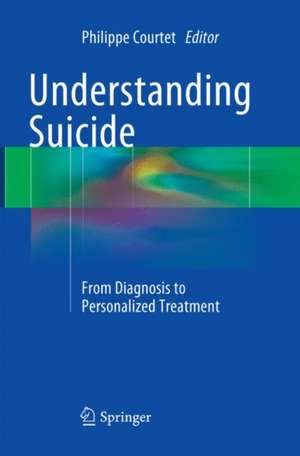
Understanding Suicide
Editat de Philippe Courteten Limba Engleză Paperback – 7 iun 2018
Remarcăm încă din primele capitole că Understanding Suicide nu este doar un tratat teoretic, ci un ghid clinic riguros care debutează cu analiza nomenclaturii și a definițiilor operaționale conform DSM-5. Volumul, coordonat de Philippe Courtet, pune la dispoziția specialiștilor instrumente fundamentale de evaluare, precum scala C-SSRS, esențială în triajul pacienților cu risc iminent. Structura lucrării urmează o progresie logică, de la bazele diagnostice și modelele teoretice ale crizei suicidare, către frontierele neurobiologiei moderne. Analizăm în detaliu secțiunile dedicate biomarkerilor, unde sunt explorate corelațiile dintre genetică, epigenetică și comportamentul autodistructiv, oferind o bază științifică solidă pentru ceea ce autorii numesc „tratament personalizat”. O dimensiune distinctivă a acestei ediții este abordarea neo-durkheimiană; credem că integrarea factorilor macro-sociali — cum ar fi impactul recesiunii economice sau dinamica riscului în populația pediatrică și în sistemul de detenție — oferă clinicianului o perspectivă de ansamblu asupra vulnerabilităților pacientului. Clinicienii care folosesc Suicide: Phenomenology and Neurobiology ca referință vor găsi aici o completare necesară prin accentul pus pe soluțiile practice de management: de la utilizarea litiului ca agent anti-suicid cheie, până la eficiența supravegherii și a noilor tehnologii digitale în prevenție. Spre deosebire de alte lucrări care se concentrează strict pe fenomenologie, acest volum publicat de Springer prioritizează organizarea eficientă a îngrijirii și strategiile de intervenție imediată în psihiatrie.
Preț: 824.61 lei
Preț vechi: 868.01 lei
-5%
Carte tipărită la comandă
Livrare economică 14-20 noiembrie
Specificații
ISBN-10: 3319799223
Pagini: 472
Ilustrații: XI, 457 p. 11 illus., 10 illus. in color.
Dimensiuni: 155 x 235 x 24 mm
Greutate: 0.8 kg
Ediția:Softcover reprint of the original 1st edition 2016
Editura: Springer
Locul publicării:Cham, Switzerland
V-ar putea interesa
-
 -28%Preț: 157.90 lei218.97 lei
 -
 Oxford Textbook of Suicidology and Suicide PreventionDanuta Wasserman-25%Preț: 1263.46 lei1690.47 lei
 -
 How Not to Die (Too Soon)Devi SridharPreț: 156.99 lei
 -
 Cry of Pain: Understanding Suicide and the Suicidal MindProfessor Mark Williams-26%Preț: 89.23 lei120.83 lei
 -
 Facing SuicideJames BarratPreț: 179.60 lei
 -
 Suicide and Culture 2.0Erminia ColucciPreț: 388.77 lei
 -
 Suicide PreventionChristine Yu Moutier-5%Preț: 260.37 lei274.08 lei
 -
 -5%Preț: 341.71 lei359.70 lei
 -
 Exploring the Phenomenon of SuicideMaurizio Pompili-26%Preț: 1778.38 lei2419.38 lei
 -
 -5%Preț: 447.70 lei471.26 lei
 -
 Suicide From a Global Perspective: Vulnerable Populations & ControversiesAmresh Shrivastava-27%Preț: 1219.37 lei1660.76 lei
 -
 Frontiers in Suicide Risk: Research, Treatment & PreventionJill E Lavigne-23%Preț: 1391.84 lei1814.72 lei
 -
 -26%Preț: 198.85 lei268.16 lei
 -
 -29%Preț: 191.25 lei270.64 lei
 -
 -22%Preț: 618.26 lei790.41 lei
 -
 -5%Preț: 685.78 lei721.88 lei
 -
 Handbook of Suicide PreventionUpdesh Kumar-18%Preț: 1244.13 lei1517.24 lei
De ce să citești această carte
Această lucrare este esențială pentru medicii psihiatri și psihologii clinicieni care doresc să treacă de la o evaluare intuitivă la una bazată pe dovezi și biomarkeri. Cititorul câștigă o înțelegere profundă a neurobiologiei suicidului și, mai ales, acces la protocoale clinice validate pentru gestionarea crizelor, inclusiv utilizarea instrumentelor digitale moderne în monitorizarea pacienților cu risc ridicat.
Despre autor
Philippe Courtet este un reputat profesor de psihiatrie la Universitatea din Montpellier, Franța, și un expert recunoscut la nivel internațional în cercetarea comportamentului suicidar. Conduce departamentul de urgențe psihiatrice și post-cură la Spitalul Universitar din Montpellier, fiind implicat direct în dezvoltarea strategiilor de prevenție la nivel european. Expertiza sa îmbină cercetarea de laborator asupra factorilor de vulnerabilitate biologică cu practica clinică de teren, coordonând numeroase studii clinice care vizează optimizarea tratamentului pentru pacienții cu tulburări de dispoziție și risc suicidar.
Cuprins
Notă biografică
A member of the European Psychiatric Association, and co-chairman of the “Suicide” network of the European College of Neuropsychopharmacology. He has published over 150 articles in peer-reviewed journals as well as numerous book chapters and has edited two books on suicidal behavior in France.