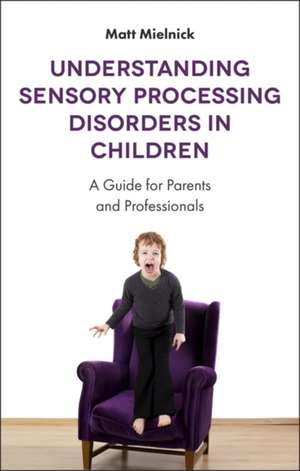
Understanding Sensory Processing Disorders in Children: A Guide for Parents and Professionals
Autor Matt Mielnicken Limba Engleză Paperback – 18 mai 2017
It explains how children's varying sensory thresholds - the point where a behavioural response to a stimuli is generated - affects the way they view the world. Each section includes occupational therapy evaluations of children with a range of sensory thresholds, and shows how this influences their behaviour through professional observation reports, offering a summary and recommendation for each child. Presented with a clear focus, without long lists of syndromes and symptoms, this is the ideal starting point for parents and professionals working with children with sensory processing issues.
Preț: 102.28 lei
Preț vechi: 135.34 lei
-24%
Puncte Express: 153
Carte disponibilă
Livrare economică 28 octombrie-11 noiembrie
Livrare prin curier în România Termenul estimat este afișat lângă disponibilitate.
Transport gratuit de la 400.00 lei Plată online sau ramburs, în funcție de opțiunile comenzii.
Retur gratuit în 14 zile Comandă securizată și suport în română.
Specificații
ISBN-13: 9781785927522
ISBN-10: 1785927523
Pagini: 160
Dimensiuni: 140 x 216 x 12 mm
Greutate: 0.21 kg
Editura: JESSICA KINGSLEY PUBLISHERS
Colecția Jessica Kingsley Publishers
Locul publicării:London, United Kingdom
ISBN-10: 1785927523
Pagini: 160
Dimensiuni: 140 x 216 x 12 mm
Greutate: 0.21 kg
Editura: JESSICA KINGSLEY PUBLISHERS
Colecția Jessica Kingsley Publishers
Locul publicării:London, United Kingdom
V-ar putea interesa
-
 Raising a Sensory Smart ChildLindsey BielPreț: 115.41 lei
 -
 A Kids Book About Nervous System RegulationJoy Dr Malik-Hasbrook-18%Preț: 77.49 lei94.13 lei
 -
 Sensational KidsLucy Jane MillerPreț: 123.75 lei
 -
 Preț: 248.65 lei
 -
 Preț: 89.00 lei
 -
 The Sensory Child Gets OrganizedCarolyn DalglieshPreț: 100.27 lei
 -
 Everyday Games for Sensory Processing DisorderBarbara Sher-5%Preț: 101.71 lei107.06 lei
 -
 -28%Preț: 71.78 lei99.26 lei
 -
 -25%Preț: 88.36 lei117.34 lei
 -
 -21%Preț: 114.42 lei144.12 lei
 -
 Your Highly Sensitive ChildAoife DurcanPreț: 136.47 lei
 -
 -18%Preț: 107.15 lei131.37 lei
 -
 Sensory Parenting for Sensory ChildrenTanya Van Dalen-20%Preț: 110.25 lei138.03 lei
 -
 Making Sense of Your Senses: Sensory Solutions WorkbookMonique Thoonsen-20%Preț: 123.96 lei155.14 lei
 -
 -20%Preț: 108.70 lei135.95 lei
 -
 -26%Preț: 213.24 lei287.45 lei
 -
 -21%Preț: 93.04 lei118.13 lei
 -
 Sensitive Sam: Sam's Sensory Adventure Has a Happy Ending!Marla Roth-FischPreț: 60.99 lei
 -
 Sensational JourneysHartley SteinerPreț: 91.46 lei
 -
 No Longer a Secret, 2nd EditionLucy Jane MillerPreț: 113.90 lei
Recenzii
"He really got my kid." "It makes sense." "I get it now," - every parent's response after a Matt Mielnick OT evaluation. As the director of the preschool evaluation program who assigned Matt to assess hundreds of our active, anxious, sometimes checked out little ones, my job was made easier because of the confidence I had in his ability to clarify to parents what was happening with their child. He made me proud to be part of the process.
Mr. Mielnick evaluated my son for OT services through the Department of Ed Pre-school program. Throughout that process I was impressed with his unique insight into my son's sensory issues and his ability to communicate that information in non-clinical language. His report has helped educators and therapists to position my son for greater success in school.
In this book, Matt Mielnick lends a voice born from countless evaluations of young children struggling with sensory processing difficulties, as well as from innumerable discussions with parents who themselves are struggling to understand their children's often baffling behaviors, and how to best respond to them. Recognizing that there are rarely simple answers to explain complex issues, [Mielnick] strives to give us something to work with by explaining the brain-body relationship and taking us on a tour of the sensory system so we can begin to grasp the method to the madness at hand, recognize the stress it places not only on the child but the family as a whole, and begin to put strategies in place to help the child increase their availability for learning and more adaptively interact with their environment.
The author is a Pediatric Occupational Therapist specializing in working with young children and in this book he aims to provide information that is easy for parents and professionals to understand, rather than an academic publication... Mielnik writes in a style that uses metaphors and images and some extended case studies to illustrate the evaluation process with specific children... A very useful introduction to this field.
Mr. Mielnick evaluated my son for OT services through the Department of Ed Pre-school program. Throughout that process I was impressed with his unique insight into my son's sensory issues and his ability to communicate that information in non-clinical language. His report has helped educators and therapists to position my son for greater success in school.
In this book, Matt Mielnick lends a voice born from countless evaluations of young children struggling with sensory processing difficulties, as well as from innumerable discussions with parents who themselves are struggling to understand their children's often baffling behaviors, and how to best respond to them. Recognizing that there are rarely simple answers to explain complex issues, [Mielnick] strives to give us something to work with by explaining the brain-body relationship and taking us on a tour of the sensory system so we can begin to grasp the method to the madness at hand, recognize the stress it places not only on the child but the family as a whole, and begin to put strategies in place to help the child increase their availability for learning and more adaptively interact with their environment.
The author is a Pediatric Occupational Therapist specializing in working with young children and in this book he aims to provide information that is easy for parents and professionals to understand, rather than an academic publication... Mielnik writes in a style that uses metaphors and images and some extended case studies to illustrate the evaluation process with specific children... A very useful introduction to this field.
Cuprins
Acknowledgement; Preface; 1. An Introduction to the Sensory System; How it's Supposed to Work; The Sensory Continuum; A Note on Differences; 2. Sensory Thresholds; The High Threshold/ Poor Registration Child; The Under Responsive Child; The Sensory Seeker; Body Awareness; The Low Threshold/ Highly Responsive Child; The Sensory Sensitive Child; The Sensory Averse Child; A Sensory Indulgent Child: The Self-Regulation Piece; 3. A Cautionary Tale; Finally