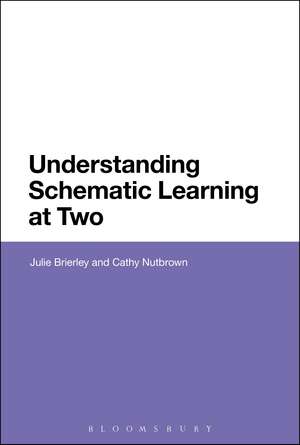
Understanding Schematic Learning at Two
Autor Dr Julie Brierley, Professor Cathy Nutbrownen Limba Engleză Hardback – 23 mar 2017
Beginning by highlighting the important links between learning opportunities, environment and the role of the adults, Brierley and Nutbrown briefly trace the origins of schema and provide an overview of some definitions and characteristics of schemas. This leads to an exploration of how the early years landscape has been influenced through a research, practice and government policy initiatives, concluding that future focus must foreground how children learn. Understanding Schematic Learning at Two highlights how recognising and valuing young children's schemas can provide their supportive adults with the opportunity and ability to acknowledge two-year-old children's capability to actively construct and develop an understanding of the world they live in.
Preț: 855.06 lei
Preț vechi: 1264.09 lei
-32%
Puncte Express: 1283
Carte tipărită la comandă
Livrare economică 30 noiembrie-14 decembrie
Livrare prin curier în România Termenul estimat este afișat lângă disponibilitate.
Transport gratuit pentru acest produs Plată online sau ramburs, în funcție de opțiunile comenzii.
Retur gratuit în 14 zile Comandă securizată și suport în română.
Specificații
ISBN-13: 9781474257541
ISBN-10: 1474257542
Pagini: 208
Ilustrații: 30 bw illus
Dimensiuni: 156 x 236 x 18 mm
Greutate: 0.46 kg
Editura: Bloomsbury Publishing
Colecția Bloomsbury Academic
Locul publicării:London, United Kingdom
ISBN-10: 1474257542
Pagini: 208
Ilustrații: 30 bw illus
Dimensiuni: 156 x 236 x 18 mm
Greutate: 0.46 kg
Editura: Bloomsbury Publishing
Colecția Bloomsbury Academic
Locul publicării:London, United Kingdom
V-ar putea interesa
-
 -26%Preț: 197.85 lei269.13 lei
 -
 Psychology and EducationSusan BenthamPreț: 409.16 lei
 -
 Towards a Comprehensive Theory of Human LearningPeter Jarvis-15%Preț: 456.83 lei537.45 lei
 -
 Preț: 404.99 lei
 -
 Critical Thinking: An Exploration of Theory and PracticeJennifer MoonPreț: 412.71 lei
 -
 Preț: 389.74 lei
 -
 Peer Support in ActionHelen Cowie-15%Preț: 661.14 lei777.81 lei
 -
 Education and Mind in the Knowledge AgeCarl Bereiter-15%Preț: 624.20 lei734.35 lei
 -
 Ready-To-Use Self Esteem Activities for Young ChildrenJean R FeldmanPreț: 224.35 lei
 -
 Effective Learning in ClassroomsChris WatkinsPreț: 243.15 lei
 -
 Cracking the Hard ClassBill RogersPreț: 401.64 lei
 -
 Talking is for AllBetty Rudd-15%Preț: 665.59 lei783.05 lei
 -
 Success Comes in Cans: Learning Lessons for LifeKriss Akabusi-20%Preț: 118.45 lei148.80 lei
 -
 Environments for LearningEric JensenPreț: 172.59 lei
Cuprins
List of Figures
About the Authors
Acknowledgements
Introduction
Part I: The Early Years: Research, Policy and Theory
1. Young Children as Actors in Their Own Learning
2. Schema Theory
3. Early Years Policies and Early Childhood Pedagogies
4. The Cultural Nuances of Families' Lives
Part II: The Stories of Four Young Children's Schematic Explorations within Their Lived Experiences
5. Containing and Dynamic Vertical Trajectory Schema: Abby's Story
6. Dynamic Back and Forth, Containing and Enveloping Schemas: Hannah's Story
7. Containing, Enveloping and Transporting Schemas: Emily's Story
8. Going Around and Through a Boundary Schema: George's Story
Concluding Thoughts
References
Author Index
Subject Index
About the Authors
Acknowledgements
Introduction
Part I: The Early Years: Research, Policy and Theory
1. Young Children as Actors in Their Own Learning
2. Schema Theory
3. Early Years Policies and Early Childhood Pedagogies
4. The Cultural Nuances of Families' Lives
Part II: The Stories of Four Young Children's Schematic Explorations within Their Lived Experiences
5. Containing and Dynamic Vertical Trajectory Schema: Abby's Story
6. Dynamic Back and Forth, Containing and Enveloping Schemas: Hannah's Story
7. Containing, Enveloping and Transporting Schemas: Emily's Story
8. Going Around and Through a Boundary Schema: George's Story
Concluding Thoughts
References
Author Index
Subject Index
Recenzii
Supporting toddlers' schematic learning challenges adults to be knowledgeable about schema theory and attuned to toddlers' sense of agency and motivations that drive play. This new book explores these aspects, and analyses rich examples of young children's schematic explorations to highlight toddlers as intentional meaning-makers of the world around them.
From our own research, we know how enthusiastic practitioners working with two year olds are about ways to extend their practice, and that many had already considered the concept of schema to help them to support children's learning. This book will therefore undoubtedly be welcomed and will help to deepen practitioners' understanding of how two year olds learn. Theoretical underpinnings are set out carefully and clearly and the detailed case studies provide rich insights into the interconnectedness of young children's learning, showing that two year olds are indeed "wondering not wandering" through the world around them.
From our own research, we know how enthusiastic practitioners working with two year olds are about ways to extend their practice, and that many had already considered the concept of schema to help them to support children's learning. This book will therefore undoubtedly be welcomed and will help to deepen practitioners' understanding of how two year olds learn. Theoretical underpinnings are set out carefully and clearly and the detailed case studies provide rich insights into the interconnectedness of young children's learning, showing that two year olds are indeed "wondering not wandering" through the world around them.