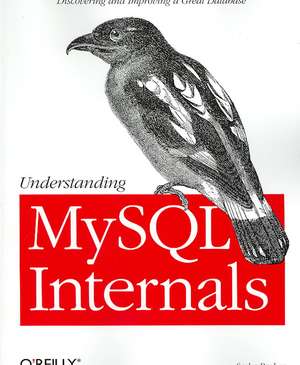
Understanding MySQL Internals
Autor Sasha Pacheven Limba Engleză Paperback – 15 mai 2007
Although MySQL's source code is open in the sense of being publicly available, it's essentially closed to you if you don't understand it. In this book, Sasha Pachev -- a former member of the MySQL Development Team -- provides a comprehensive tour of MySQL 5 that shows you how to figure out the inner workings of this powerful database. You'll go right to heart of the database to learn how data structures and convenience functions operate, how to add new storage engines and configuration options, and much more.
The core of Understanding MySQL Internals begins with an Architecture Overview that provides a brief introduction of how the different components of MySQL work together. You then learn the steps for setting up a working compilable copy of the code that you can change and test at your pleasure. Other sections of the book cover:
Understanding MySQL Internals provides unprecedented opportunities for developers, DBAs, database application programmers, IT departments, software vendors, and computer science students to learn about the inner workings of this enterprise-proven database. With this book, you will soon reach a new level of comprehension regarding database development that will enable you to accomplish your goals. It's your guide to discovering and improving a great database.
The core of Understanding MySQL Internals begins with an Architecture Overview that provides a brief introduction of how the different components of MySQL work together. You then learn the steps for setting up a working compilable copy of the code that you can change and test at your pleasure. Other sections of the book cover:
- Core server classes, structures, and API
- The communication protocol between the client and the server
- Configuration variables, the controls of the server; includes a tutorial on how to add your own
- Thread-based request handling -- understanding threads and how they are used in MySQL
- An overview of MySQL storage engines
- The storage engine interface for integrating third-party storage engines
- The table lock manager
- The parser and optimizer for improving MySQL's performance
- Integrating a transactional storage engine into MySQL
- The internals of replication
Understanding MySQL Internals provides unprecedented opportunities for developers, DBAs, database application programmers, IT departments, software vendors, and computer science students to learn about the inner workings of this enterprise-proven database. With this book, you will soon reach a new level of comprehension regarding database development that will enable you to accomplish your goals. It's your guide to discovering and improving a great database.
Preț: 245.51 lei
Preț vechi: 306.89 lei
-20%
Puncte Express: 368
Carte disponibilă
Livrare economică 17 noiembrie-01 decembrie
Livrare prin curier în România Termenul estimat este afișat lângă disponibilitate.
Transport gratuit de la 400.00 lei Plată online sau ramburs, în funcție de opțiunile comenzii.
Retur gratuit în 14 zile Comandă securizată și suport în română.
Specificații
ISBN-13: 9780596009571
ISBN-10: 0596009577
Pagini: 254
Dimensiuni: 179 x 235 x 19 mm
Greutate: 0.42 kg
Editura: O'Reilly
ISBN-10: 0596009577
Pagini: 254
Dimensiuni: 179 x 235 x 19 mm
Greutate: 0.42 kg
Editura: O'Reilly
V-ar putea interesa
-
 PHP and MySQL for Dynamic Web SitesLarry Ullman-20%Preț: 305.76 lei382.21 lei
 -
 Language of SQL, TheLarry Rockoff-20%Preț: 141.44 lei176.80 lei
 -
 SQL Queries for Mere MortalsJohn Viescas-20%Preț: 334.07 lei417.58 lei
 -
 -20%Preț: 211.63 lei264.55 lei
 -
 MySQL Crash CourseBen Forta-20%Preț: 209.01 lei261.27 lei
 -
 PHP and MySQL Web DevelopmentLaura Thomson-20%Preț: 316.71 lei395.88 lei
 -
 PHP & MySQL: Server-side Web DevelopmentJon Duckett-20%Preț: 275.79 lei344.74 lei
 -
 PHP & MySQLJon Duckett-20%Preț: 245.07 lei306.33 lei
 -
 Database SystemsRamez Elmasri-20%Preț: 552.09 lei690.12 lei
 -
 SQL Essentials for DummiesRichard Blum-20%Preț: 65.83 lei82.30 lei
 -
 Learning SQL: Generate, Manipulate, and Retrieve DataAlan Beaulieu-20%Preț: 326.92 lei408.65 lei
 -
 The Manga Guide to DatabasesMana Takahashi-35%Preț: 120.08 lei183.82 lei
 -
 MongoDB in Action, Third EditionArek Borucki-20%Preț: 357.89 lei447.36 lei
 -
 -35%Preț: 238.85 lei369.33 lei
 -
 PHP & MySQL in easy stepsMike Mcgrath-20%Preț: 73.86 lei92.32 lei
 -
 SQL in Easy StepsMike Mcgrath-20%Preț: 73.65 lei92.06 lei
 -
 Murachs MySQLJoel Murach-20%Preț: 353.49 lei441.87 lei
 -
 Murach's MySQL (4th Edition)Joel Murach-20%Preț: 315.22 lei394.03 lei
 -
 Mastering MySQL AdministrationY V Ravi Kumar-20%Preț: 342.66 lei428.32 lei
Cuprins
;
Preface;
How This Book Is Organized;
Who This Book Is For;
Conventions Used in This Book;
Using Code Examples;
Comments and Questions;
Safari® Enabled;
Acknowledgments;
Chapter 1: MySQL History and Architecturel;
1.1 MySQL History;
1.2 MySQL Architecture;
Chapter 2: Nuts and Bolts of Working with the MySQL Source Code;
2.1 Unix Shell;
2.2 BitKeeper;
2.3 Preparing the System to Build MySQL from BitKeeper Tree;
2.4 Building MySQL from BitKeeper Tree;
2.5 Building from Source Distribution;
2.6 Installing MySQL into a System Directory;
2.7 Source Code Directory Layout;
2.8 Preparing the System to Run MySQL in a Debugger;
2.9 Debugger-Guided Source Tour;
2.10 Basics of Working with gdb;
2.11 Finding Things in the Source;
2.12 Interesting Breakpoints and Variables;
2.13 Making a Source Modification;
2.14 Coding Guidelines;
2.15 Keeping Your BitKeeper Repository Up to Date;
2.16 Submitting a Patch;
Chapter 3: Core Classes, Structures, Variables, and APIs;
3.1 THD;
3.2 NET;
3.3 TABLE;
3.4 Field;
3.5 Utility API Calls;
3.6 Preprocessor Macros;
3.7 Global Variables;
Chapter 4: Client/Server Communication;
4.1 Protocol Overview;
4.2 Packet Format;
4.3 Relationship Between MySQL Protocol and OS Layer;
4.4 Authenticating Handshake;
4.5 Command Packet;
4.6 Server Responses;
Chapter 5: Configuration Variables;
5.1 Configuration Variables Tutorial;
5.2 Interesting Aspects of Specific Configuration Variables;
Chapter 6: Thread-Based Request Handling;
6.1 Threads Versus Processes;
6.2 Implementation of Request Handling;
6.3 Thread Programming Issues;
Chapter 7: The Storage Engine Interface;
7.1 The handler Class;
7.2 Adding a Custom Storage Engine to MySQL;
Chapter 8: Concurrent Access and Locking;
8.1 Table Lock Manager;
Chapter 9: Parser and Optimizer;
9.1 Parser;
9.2 Optimizer;
Chapter 10: Storage Engines;
10.1 Shared Aspects of Architecture;
10.2 InnoDB;
10.3 Memory (Heap);
10.4 MyISAM Merge;
10.5 NDB;
10.6 Archive;
10.7 Federated;
Chapter 11: Transactions;
11.1 Overview of Transactional Storage Engine Implementation;
11.2 Implementing the handler Subclass;
11.3 Defining the handlerton;
11.4 Working with the Query Cache;
11.5 Working with the Replication Binary Log;
11.6 Avoiding Deadlocks;
Chapter 12: Replication;
12.1 Overview;
12.2 Statement-Based Versus Row-Based Replication;
12.3 Two-Threaded Slave;
12.4 Multi-Master;
12.5 SQL Commands to Help Understand Replication;
12.6 Binary Log Format;
12.7 Creating a Custom Replication Utility;
Colophon;
Preface;
How This Book Is Organized;
Who This Book Is For;
Conventions Used in This Book;
Using Code Examples;
Comments and Questions;
Safari® Enabled;
Acknowledgments;
Chapter 1: MySQL History and Architecturel;
1.1 MySQL History;
1.2 MySQL Architecture;
Chapter 2: Nuts and Bolts of Working with the MySQL Source Code;
2.1 Unix Shell;
2.2 BitKeeper;
2.3 Preparing the System to Build MySQL from BitKeeper Tree;
2.4 Building MySQL from BitKeeper Tree;
2.5 Building from Source Distribution;
2.6 Installing MySQL into a System Directory;
2.7 Source Code Directory Layout;
2.8 Preparing the System to Run MySQL in a Debugger;
2.9 Debugger-Guided Source Tour;
2.10 Basics of Working with gdb;
2.11 Finding Things in the Source;
2.12 Interesting Breakpoints and Variables;
2.13 Making a Source Modification;
2.14 Coding Guidelines;
2.15 Keeping Your BitKeeper Repository Up to Date;
2.16 Submitting a Patch;
Chapter 3: Core Classes, Structures, Variables, and APIs;
3.1 THD;
3.2 NET;
3.3 TABLE;
3.4 Field;
3.5 Utility API Calls;
3.6 Preprocessor Macros;
3.7 Global Variables;
Chapter 4: Client/Server Communication;
4.1 Protocol Overview;
4.2 Packet Format;
4.3 Relationship Between MySQL Protocol and OS Layer;
4.4 Authenticating Handshake;
4.5 Command Packet;
4.6 Server Responses;
Chapter 5: Configuration Variables;
5.1 Configuration Variables Tutorial;
5.2 Interesting Aspects of Specific Configuration Variables;
Chapter 6: Thread-Based Request Handling;
6.1 Threads Versus Processes;
6.2 Implementation of Request Handling;
6.3 Thread Programming Issues;
Chapter 7: The Storage Engine Interface;
7.1 The handler Class;
7.2 Adding a Custom Storage Engine to MySQL;
Chapter 8: Concurrent Access and Locking;
8.1 Table Lock Manager;
Chapter 9: Parser and Optimizer;
9.1 Parser;
9.2 Optimizer;
Chapter 10: Storage Engines;
10.1 Shared Aspects of Architecture;
10.2 InnoDB;
10.3 Memory (Heap);
10.4 MyISAM Merge;
10.5 NDB;
10.6 Archive;
10.7 Federated;
Chapter 11: Transactions;
11.1 Overview of Transactional Storage Engine Implementation;
11.2 Implementing the handler Subclass;
11.3 Defining the handlerton;
11.4 Working with the Query Cache;
11.5 Working with the Replication Binary Log;
11.6 Avoiding Deadlocks;
Chapter 12: Replication;
12.1 Overview;
12.2 Statement-Based Versus Row-Based Replication;
12.3 Two-Threaded Slave;
12.4 Multi-Master;
12.5 SQL Commands to Help Understand Replication;
12.6 Binary Log Format;
12.7 Creating a Custom Replication Utility;
Colophon;
Descriere
Provides a tour of MySQL 5 that shows you its inner workings. This work helps you learn how data structures and convenience functions operate, how to add new storage engines and configuration options, and more. It also gives an Architecture Overview that provides an introduction of how the different components of MySQL work together.