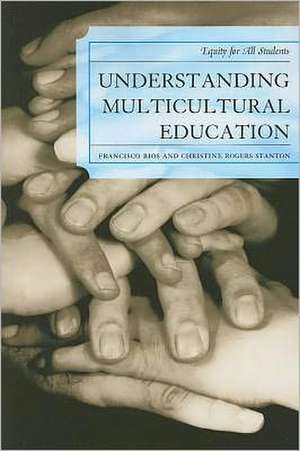
Understanding Multicultural Education: Equity for All Students
Autor Christine A. Rogers, Francisco Alfonso Riosen Limba Engleză Paperback – 9 iun 2011
Understanding Multicultural Education: Equity for All Students brings the goals, ideas, theories, principles, and practices of multicultural education together in their most accessible form. The book is organized using the analogy of a house to make complex ideas understandable. It aims to move the ideals of multicultural education from the academic realm to the public. With the information provided by the authors, stakeholders who play a role in the implementation of multicultural education-students, teachers, administrators, parents, school board members, citizens-will be able to pursue its implementation more fully and authentically.
Preț: 217.17 lei
Preț vechi: 292.37 lei
-26%
Puncte Express: 326
Carte tipărită la comandă
Livrare economică 08-22 decembrie
Livrare prin curier în România Termenul estimat este afișat lângă disponibilitate.
Transport gratuit de la 400.00 lei Plată online sau ramburs, în funcție de opțiunile comenzii.
Retur gratuit în 14 zile Comandă securizată și suport în română.
Specificații
ISBN-13: 9781607098621
ISBN-10: 1607098628
Pagini: 137
Dimensiuni: 157 x 233 x 10 mm
Greutate: 0.25 kg
Editura: Bloomsbury Publishing
Colecția R&L Education
Locul publicării:New York, United States
ISBN-10: 1607098628
Pagini: 137
Dimensiuni: 157 x 233 x 10 mm
Greutate: 0.25 kg
Editura: Bloomsbury Publishing
Colecția R&L Education
Locul publicării:New York, United States
Cuprins
Chapter 1 Forward
Chapter 2 Acknowledgements
Chapter 3 Preface
Chapter 4 Chapter 1 - Introduction
Chapter 5 Chapter 2 - The Town: The Broader Context of Multicultural Education
Chapter 6 Chapter 3 - The Streets and Paths: Principles of Multicultural Education
Chapter 7 Chapter 4 - The Walls: Multicultural Education to Combat Oppression and Resistance
Chapter 8 Chapter 5 - Room for Living: Conversation, Connection, and Collaboration
Chapter 9 Chapter 6 - The Kitchen: The Myths and Misconceptions of Multicultural Education
Chapter 10 Chapter 7 - The Rooftop: Promising Practices and Future Directions
Chapter 11 Chapter 8 - The Tool Shed: Resources to Extend Your Knowledge
Chapter 12 References
Chapter 2 Acknowledgements
Chapter 3 Preface
Chapter 4 Chapter 1 - Introduction
Chapter 5 Chapter 2 - The Town: The Broader Context of Multicultural Education
Chapter 6 Chapter 3 - The Streets and Paths: Principles of Multicultural Education
Chapter 7 Chapter 4 - The Walls: Multicultural Education to Combat Oppression and Resistance
Chapter 8 Chapter 5 - Room for Living: Conversation, Connection, and Collaboration
Chapter 9 Chapter 6 - The Kitchen: The Myths and Misconceptions of Multicultural Education
Chapter 10 Chapter 7 - The Rooftop: Promising Practices and Future Directions
Chapter 11 Chapter 8 - The Tool Shed: Resources to Extend Your Knowledge
Chapter 12 References
Recenzii
Using the metaphor of a house, Rios (Univ. of Wyoming) and Stanton (Montana State Univ.) lead educators in understanding multicultural education. In the metaphor, the "town" is the broader context of multicultural education within schools and communities; the "streets" are the principles, frameworks, and theories of multicultural education; the "walls" are resistance, barriers, and oppression of multicultural education; the "living room" stands for the conversations and collaboration; the "kitchen" represents the myths and misconceptions; the "rooftop" stands for promising practices and future directions; and the "tool shed" is resources. Rios and Stanton's well-written book defines, clarifies, and discusses the underlying issues of multicultural education that are often overlooked within the current educational system. This book is particularly useful for those in leadership roles who may enact systems change within their school buildings and community. Summing Up: Recommended. Upper-division undergraduates and above.
Francisco Rios and Christine Rogers Stanton provide teacher candidates and other educators with an incredibly useful tool to help them understand and do multicultural education. Each chapter is rich with explanations that make doing multicultural education less challenging and more rewarding. The metaphors of 'journey' and 'house' are wisely applied to Understanding Multicultural Education. I believe the purpose of the book to 'make the goals, ideas, theories, principles, and practices of multicultural education accessible to the widest possible audience of educational professionals and stakeholders' will be achieved with much success.
In this primer, Francisco Rios and Christine Rogers Stanton introduce beginning teachers, school board members, parents, and community activists to a philosophy of multicultural education based on inclusion, equity, and democracy. They introduce the reader to the ways in which education could become a shared journey in which all students, teachers, administration, parents, and community work together intentionally towards developing a critical and creative curriculum-one that refuses to support a colonizing ideology, cultural hegemony, or deficit view of traditionally underserved students but rather reframes education as a culturally responsive process that builds on the diverse communal knowledge and multiple, dynamic identities that students embody and bring to the table. I recommend this text for everyone seeking a clearly written and meaningful introduction to multicultural education as a process that envisions the possibility of restructuring the educational system so that it offers all students critical consciousness and empowerment.
The art, craft, and science of teaching and learning for a multicultural education are captured with a resonating poignancy rarely found in a primer. Understanding Multicultural Education provides a comprehensively rich, well-documented, and mindful text that humanizes the ever-growing discipline of multicultural education. Taking into account its tenuous historical pre-text beginnings, this primer's con-text with its transparent sub-text provides educators with grounded inter-text exemplars accessible to students, beginning teachers, school board members, parents, and community activists. Moreover, this primer provides a dialogic relationship between text and praxis where only the reader's evolving praxis matters as she or he creates her/his own learning trajectory in the life-long journey of understanding multicultural education.
A powerful, timely, and accessible text that challenges educators to not only understand multicultural education but also to practice it in schools across the nation. At a time when many educators readily embrace post-racial and post-cultural discourses and practices, Rios and Stanton remind us of the significance, pervasiveness, and permanence of race and culture in our society and schools. This book inspires as it teaches!
Francisco Rios and Christine Rogers Stanton provide teacher candidates and other educators with an incredibly useful tool to help them understand and do multicultural education. Each chapter is rich with explanations that make doing multicultural education less challenging and more rewarding. The metaphors of 'journey' and 'house' are wisely applied to Understanding Multicultural Education. I believe the purpose of the book to 'make the goals, ideas, theories, principles, and practices of multicultural education accessible to the widest possible audience of educational professionals and stakeholders' will be achieved with much success.
In this primer, Francisco Rios and Christine Rogers Stanton introduce beginning teachers, school board members, parents, and community activists to a philosophy of multicultural education based on inclusion, equity, and democracy. They introduce the reader to the ways in which education could become a shared journey in which all students, teachers, administration, parents, and community work together intentionally towards developing a critical and creative curriculum-one that refuses to support a colonizing ideology, cultural hegemony, or deficit view of traditionally underserved students but rather reframes education as a culturally responsive process that builds on the diverse communal knowledge and multiple, dynamic identities that students embody and bring to the table. I recommend this text for everyone seeking a clearly written and meaningful introduction to multicultural education as a process that envisions the possibility of restructuring the educational system so that it offers all students critical consciousness and empowerment.
The art, craft, and science of teaching and learning for a multicultural education are captured with a resonating poignancy rarely found in a primer. Understanding Multicultural Education provides a comprehensively rich, well-documented, and mindful text that humanizes the ever-growing discipline of multicultural education. Taking into account its tenuous historical pre-text beginnings, this primer's con-text with its transparent sub-text provides educators with grounded inter-text exemplars accessible to students, beginning teachers, school board members, parents, and community activists. Moreover, this primer provides a dialogic relationship between text and praxis where only the reader's evolving praxis matters as she or he creates her/his own learning trajectory in the life-long journey of understanding multicultural education.
A powerful, timely, and accessible text that challenges educators to not only understand multicultural education but also to practice it in schools across the nation. At a time when many educators readily embrace post-racial and post-cultural discourses and practices, Rios and Stanton remind us of the significance, pervasiveness, and permanence of race and culture in our society and schools. This book inspires as it teaches!