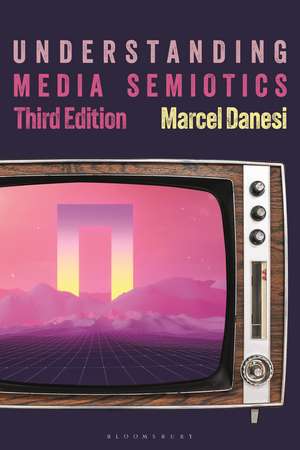
Understanding Media Semiotics
Autor Professor Marcel Danesien Limba Engleză Paperback – 11 dec 2026
Understanding the 'meaning structures' that all kinds of media and mediated signs spread into the system of everyday modern life is now an urgent one, given the globalization of media systems and their role in producing a uniformity of semiosis (production and understanding of signs). This new edition takes a close look at those systems within the conceptual framework of semiotics and expands the analysis of mainstream media to deal with new media, social networks, mass communications, memes, emojis, and more, from a semiotic perspective.
Providing students with all the tools they need to understand semiotic analysis in the context of the media, this third edition includes:
- fully updated chapters throughout including coverage of political and social justice issues
- a new chapter on AI
- further reading sections at the end of each chapter
- a glossary of technical terms
- an online workbook packed with activities, semiotic analysis of media products, such as websites, videos on social media, snippets of programs, and general discussion questions.
With in-depth case studies and examples from both traditional media such as television and print, as well as contemporary examples such as deepfakes and video games, Danesi demonstrates the continued relevance of semiotics in understanding how meaning is created and conveyed in our increasingly complex digital world.
Preț: 243.38 lei
Preț vechi: 268.81 lei
-9% Precomandă
Puncte Express: 365
Carte nepublicată încă
Livrare prin curier în România Precomanda se expediază când titlul devine disponibil.
Transport gratuit de la 400.00 lei Plată online sau ramburs, în funcție de opțiunile comenzii.
Retur gratuit în 14 zile Comandă securizată și suport în română.
Doresc să fiu notificat când acest titlu va fi disponibil:
Se trimite...
Specificații
ISBN-13: 9781350578388
ISBN-10: 135057838X
Pagini: 336
Ilustrații: 8 b&w illustrations
Dimensiuni: 156 x 232 x 24 mm
Greutate: 0.4 kg
Ediția:3rd edition
Editura: Bloomsbury Publishing
Colecția Bloomsbury Academic
Locul publicării:London, United Kingdom
ISBN-10: 135057838X
Pagini: 336
Ilustrații: 8 b&w illustrations
Dimensiuni: 156 x 232 x 24 mm
Greutate: 0.4 kg
Ediția:3rd edition
Editura: Bloomsbury Publishing
Colecția Bloomsbury Academic
Locul publicării:London, United Kingdom
Cuprins
Acknowledgments
Introduction
1. The Mediascape
2. Media Semiotics
3. Print Media
4. Audio Media
5. Film and Video
6. Television
7. The Internet
8. Advertising
9. AI in the Mediascape
10. Impacts of the Media
Glossary
Bibliography
Index
Introduction
1. The Mediascape
2. Media Semiotics
3. Print Media
4. Audio Media
5. Film and Video
6. Television
7. The Internet
8. Advertising
9. AI in the Mediascape
10. Impacts of the Media
Glossary
Bibliography
Index
Recenzii
This book provides the reader with a rich and useful guide to understand the meaning structures of major media communication tools, how they derive from the social and technological conditions, and how they come to shape our society and culture.
This book provides a comprehensive basic framework with which to understand semiotics: the study of signs and their uses in representation. It flows well and is written at the introductory level. The author proceeds from a historical perspective to modern application of semiotic theory in subjects such as ebooks, the Internet, and media convergence. Designed as a text, the book uses italics and bolding to highlight important points within each chapter and also includes a glossary as well as tables and figures where appropriate to enhance understanding.
The paradox of mediation is perhaps the underlying theme for the book: "The same culture that is capable of producing a work of inestimable cinematic art, such as Amadeus, is also capable of producing American TV wrestling matches ...," (p. 201). Danesi introduces media and their historical development, while inseparably tying media to culture. Interestingly, the author does not use the term culture; instead he refers to "signifying order so as to highlight the fact that it constitutes a network of meaning structures," (p. 26). In short, Danesi takes the reader far beyond the Shannon and Weaver model of communication into a deeper understanding of meaning and attempts to improve the reader's linear as well as critical thinking skills ... At just over 200 pages in paperback, Understanding Media Semiotics is an ideal introductory text.
The aim of the book is not so much to advance the cause of semiotic theory, however, as to provide the most fundamental level of understanding needed to be able to appreciate the cultural context in which media signs are encountered. Thus the section on television, for example, begins with a short introduction to the history of the medium which extends back to John Logie Baird ... students will find much to consider in this book and will find much useful information.
Comprehensive in scope yet also readable and full of brilliant insights, Marcel Danesi's Understanding Media Semiotics 2nd edition is a path-breaking book that shows the central role that semiotics plays in helping us understand how the media shape our psyches, cultures and societies. Covering everything from branding, postmodernism, and visual rhetoric to social media, meme culture, and gangsta rap, Understanding Media Semiotics 2nd edition is highly recommended for courses in semiotics, media studies, popular culture, communications, and related disciplines. (Of the second edition)
Nearly two decades after the publication of the first edition of this now classic introductory textbook on media and semiotics, Professor Danesi, has completely rewritten and reorganized the original text to incorporate the exponential proliferation of technological innovations in the media since the new millennium. Danesi has developed many original theoretical notions to explain and interpret the meaning of these revolutions in communication in a clear, concise, and lucid fashion for readers from a wide variety of disciplines. Professor Danesi is the world's leading semiotician, and his work in this area is regarded as essential to our knowledge of how meaningful communication functions personally, socially, and historically. His explication of the semiotic method, or the interpretation of the significance of the various interactive modes of communication through the transmission and dissemination of cultural meaning, is the most comprehensive and comprehensible available. (Of second edition)
Media today, demon and deity, expand in global networks that hold the world. On one hand, the plagues and joys of mass consciousness, on the other power and control of those in command, all interdependent and interconnected through the structures of hidden meanings propping the whole system. With recourse to one of the most ancient mediums at our disposal, the science of signs or semiotics, Marcel Danesi yet again offers the reader piercing insights - historical, cultural and theoretical - into world-wide communication today. (Of second edition)
If you are looking for a single book to deliver semiotic thinking in your understanding of media, then this is the text for you. (Of the second edition)
This book provides a comprehensive basic framework with which to understand semiotics: the study of signs and their uses in representation. It flows well and is written at the introductory level. The author proceeds from a historical perspective to modern application of semiotic theory in subjects such as ebooks, the Internet, and media convergence. Designed as a text, the book uses italics and bolding to highlight important points within each chapter and also includes a glossary as well as tables and figures where appropriate to enhance understanding.
The paradox of mediation is perhaps the underlying theme for the book: "The same culture that is capable of producing a work of inestimable cinematic art, such as Amadeus, is also capable of producing American TV wrestling matches ...," (p. 201). Danesi introduces media and their historical development, while inseparably tying media to culture. Interestingly, the author does not use the term culture; instead he refers to "signifying order so as to highlight the fact that it constitutes a network of meaning structures," (p. 26). In short, Danesi takes the reader far beyond the Shannon and Weaver model of communication into a deeper understanding of meaning and attempts to improve the reader's linear as well as critical thinking skills ... At just over 200 pages in paperback, Understanding Media Semiotics is an ideal introductory text.
The aim of the book is not so much to advance the cause of semiotic theory, however, as to provide the most fundamental level of understanding needed to be able to appreciate the cultural context in which media signs are encountered. Thus the section on television, for example, begins with a short introduction to the history of the medium which extends back to John Logie Baird ... students will find much to consider in this book and will find much useful information.
Comprehensive in scope yet also readable and full of brilliant insights, Marcel Danesi's Understanding Media Semiotics 2nd edition is a path-breaking book that shows the central role that semiotics plays in helping us understand how the media shape our psyches, cultures and societies. Covering everything from branding, postmodernism, and visual rhetoric to social media, meme culture, and gangsta rap, Understanding Media Semiotics 2nd edition is highly recommended for courses in semiotics, media studies, popular culture, communications, and related disciplines. (Of the second edition)
Nearly two decades after the publication of the first edition of this now classic introductory textbook on media and semiotics, Professor Danesi, has completely rewritten and reorganized the original text to incorporate the exponential proliferation of technological innovations in the media since the new millennium. Danesi has developed many original theoretical notions to explain and interpret the meaning of these revolutions in communication in a clear, concise, and lucid fashion for readers from a wide variety of disciplines. Professor Danesi is the world's leading semiotician, and his work in this area is regarded as essential to our knowledge of how meaningful communication functions personally, socially, and historically. His explication of the semiotic method, or the interpretation of the significance of the various interactive modes of communication through the transmission and dissemination of cultural meaning, is the most comprehensive and comprehensible available. (Of second edition)
Media today, demon and deity, expand in global networks that hold the world. On one hand, the plagues and joys of mass consciousness, on the other power and control of those in command, all interdependent and interconnected through the structures of hidden meanings propping the whole system. With recourse to one of the most ancient mediums at our disposal, the science of signs or semiotics, Marcel Danesi yet again offers the reader piercing insights - historical, cultural and theoretical - into world-wide communication today. (Of second edition)
If you are looking for a single book to deliver semiotic thinking in your understanding of media, then this is the text for you. (Of the second edition)
Notă biografică
Professor Marcel Danesi is known for his work in semiotics and youth culture. He has published as well on the meanings of popular culture and how they inform social evolution. He has also written textbooks introducing linguistics and semiotics. And he has published a series of books on advertising as a sign system.