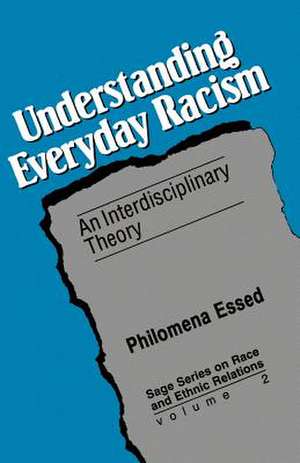
Understanding Everyday Racism
Autor Philomena Esseden Limba Engleză Paperback – aug 1991
Ne-a atras atenția, în primul rând, rigoarea cu care Philomena Essed analizează cele peste două mii de experiențe de viață colectate de la femei de culoare cu studii superioare. Această componentă practică, bazată pe interviuri aprofundate, transformă volumul într-un laborator sociologic unde rasismul nu este tratat ca un concept abstract, ci ca o practică cotidiană, adesea invizibilă pentru grupul dominant. Observăm cum autoarea descompune mecanismele de recunoaștere a discriminării și strategiile prin care aceste femei navighează și contestă structurile de putere în Olanda și SUA.
Cartea este structurată în patru părți esențiale: de la integrarea dimensiunilor macro și micro ale rasismului, la fundamentarea metodologică și, în final, la reconstrucția cunoașterii sociale despre evenimentele rasiste. Această progresie logică permite cititorului să înțeleagă cum se achiziționează „știința” de a identifica rasismul subtil. Lucrarea completează perspectiva oferită de White Women, Race Matters, adăugând experiența directă a femeilor de culoare acolo unde Ruth Frankenburg se concentra pe rolul femeilor albe în ierarhia rasială. Totodată, volumul se distinge de Everyday Forms of Whiteness prin accentul pus pe intersecția dintre gen și educația înaltă, oferind o analiză specifică asupra modului în care elitele grupului dominant exercită presiuni sistemice.
În contextul operei sale, Understanding Everyday Racism reprezintă piatra de temelie pentru lucrările ulterioare precum Relating Worlds of Racism sau Black Europe and the African Diaspora, rafinând conceptele de „rasism cotidian” pe care Philomena Essed le-a introdus în discursul academic global. Este o analiză interdisciplinară necesară care demonstrează că rasismul nu este un incident izolat, ci un proces social continuu.
Preț: 839.20 lei
Preț vechi: 1023.42 lei
-18%
Carte tipărită la comandă
Livrare economică 03-17 noiembrie
Livrare express 26 septembrie-02 octombrie pentru 166.06 lei
Specificații
ISBN-10: 0803942567
Pagini: 336
Ilustrații: 1, black & white illustrations
Dimensiuni: 140 x 216 x 20 mm
Greutate: 0.48 kg
Ediția:1
Editura: SAGE Publications
Locul publicării:Thousand Oaks, United States
V-ar putea interesa
-
 Upon This RockSamuel G. FreedmanPreț: 101.13 lei
 -
 A Century of British OrientalistsBosworth-55%Preț: 408.28 lei911.81 lei
 -
 A Thematic Dictionary of Modern PersianColin Turner-15%Preț: 542.56 lei638.31 lei
 -
 The Philosophy of Desire in the Buddhist Pali CanonDavid WebsterPreț: 467.54 lei
 -
 Preț: 251.49 lei
 -
 El laberinto de la soledad by Octavio PazAnthony StantonPreț: 164.52 lei
 -
 Ethnicity and GlobalizationStephen Castles-15%Preț: 480.60 lei565.41 lei
 -
 Transcultural Counselling in Action (Second Edition)Patricia D'Ardenne-15%Preț: 567.08 lei667.14 lei
 -
 Rethinking EthnicityRichard P JenkinsPreț: 481.04 lei
 -
 The SAGE Handbook of Intercultural CompetenceDarla K. Deardorff-27%Preț: 1095.68 lei1500.93 lei
 -
 Standing on Both Feet: Voices of Older Mixed-Race AmericansCathy J Tashiro-18%Preț: 1110.11 lei1353.79 lei
 -
 Preț: 167.44 lei
 -
 -21%Preț: 269.65 lei339.94 lei
 -
 Race & CrimeMichael RowePreț: 405.65 lei
 -
 Call Me OkaasanSuzanne KamataPreț: 91.24 lei
De ce să citești această carte
Suntem de părere că această carte este esențială pentru studenții și cercetătorii din sociologie și științe politice care doresc să înțeleagă mecanismele fine ale discriminării. Cititorul câștigă o metodologie clară de analiză a discursului și a interacțiunilor sociale, învățând să identifice rasismul structural dincolo de manifestările sale evidente. Este o lectură care demontează mitul societăților post-rasiale prin date concrete și mărturii documentate riguros.
Despre autor
Philomena Essed este o figură centrală în studiile sociologice contemporane, ocupând poziția de cercetător senior la Universitatea din Amsterdam și profesor invitat la University of California, Irvine. Expertiza sa se concentrează pe intersecția dintre gen, rasă și cultură, fiind recunoscută la nivel internațional pentru introducerea conceptului de „everyday racism”. Activitatea sa academică bogată include volume de referință care explorează diversitatea și transformările sociale, precum Diversity: Gender, Color and Culture și Refugees and the Transformation of Societies, consolidându-i statutul de voce critică în analiza inegalităților sistemice globale.
Descriere scurtă
Cuprins
Racism Today
The Social-political Context
The Netherlands
Some Notes on Contemporary Racism in the US
Women and Racism
Black Women with Higher Education
Conceptualizing Racism as a Process
Racism
A Working Definition
The Notion of Everyday Racism
PART TWO: METHODOLOGICAL QUESTIONS
Introduction
Methodology within Methodology
Accounts
The Interviewees
Interviewing
Method of Analysis
PART THREE: KNOWLEDGE AND COMPREHENSION OF EVERYDAY RACISM
Introduction
General Knowledge and Scenarios of Racism
Comprehending Racism
Subjective and Objective Assessments of the Comprehension of Racist Events
A Procedure for the Assessment of Racist Events
Assessing Real-life Explanations of `Unfair Treatment'
Relating Cognitive to Social Processes of Understanding
The Acquisition of Knowledge of Racism
Reconstructing Black Women's General Knowledge of Racism
PART FOUR: ANALYZING ACCOUNTS OF RACISM
Introduction
Analyzing Accounts of Racism
Knowledge About Racism as an Evaluative Category in Verbal Accounts
Heuristics, Interpretations and Evaluations in Reconstructions of Racist Events
Racist Complications in Job Applications
What happened?
Examples of Real-life Accounts
Conclusions
PART FIVE: THE INTEGRATION OF RACISM IN EVERYDAY LIFE: THE STORY OF ROSA N.
Introduction
Rosa N.
A Fragmentary Representation of Everyday Racism
The Process of Everyday Racism in the Experience of Rosa N.
The Macro Context of Experiences of Racism
Conclusions
Rosa N. and the Shared Experience of Racism
PART SIX: THE STRUCTURE OF EVERYDAY RACISM
Racism as Conflict Maintaining Process
Hidden Agendas
The Dominations of Euro-American Values
The Basic Agenda
Perpetuation of Exclusion and Subordination
The Agenda of the Agenda
Problematizing those who Problematize Racism
The Structure of Everyday Racism
CONCLUSIONS
APPENDICES
Appendix 1. Interview Guide
Appendix 2. General Statements about Racism
Appendix 3. `Rosa N. File'