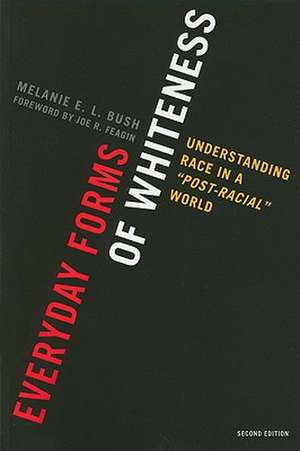
Everyday Forms of Whiteness: Understanding Race in a 'Post-Racial' World: Perspectives on a Multiracial America
Autor Melanie E. L. Bush Cuvânt înainte de Joe R. Feaginen Limba Engleză Paperback – 16 ian 2011
Din seria Perspectives on a Multiracial America
- 24%
 Preț: 275.79 lei
 - 24%
 Preț: 281.04 lei
 - 23%
 Preț: 270.34 lei
 - 25%
 Preț: 217.77 lei
 - 21%
 Preț: 307.98 lei
 - 27%
 Preț: 258.00 lei
 - 17%
 Preț: 353.37 lei
 - 27%
 Preț: 256.91 lei
 - 24%
 Preț: 369.27 lei
 - 28%
 Preț: 222.85 lei
 - 35%
 Preț: 596.94 lei
 - 32%
 Preț: 522.43 lei
 - 23%
 Preț: 256.91 lei
 - 18%
 Preț: 255.93 lei
 - 28%
 Preț: 219.35 lei
 - 33%
 Preț: 516.52 lei
 - 23%
 Preț: 256.12 lei
 -
 Preț: 130.28 lei
 - 25%
 Preț: 361.12 lei
 - 24%
 Preț: 222.72 lei
 - 27%
 Preț: 504.73 lei
 - 30%
 Preț: 556.13 lei
 - 21%
 Preț: 309.00 lei
 - 19%
 Preț: 128.96 lei
Preț: 369.69 lei
Preț vechi: 463.40 lei
-20%
Puncte Express: 555
Carte tipărită la comandă
Livrare economică 16-30 noiembrie
Livrare prin curier în România Termenul estimat este afișat lângă disponibilitate.
Transport gratuit de la 400.00 lei Plată online sau ramburs, în funcție de opțiunile comenzii.
Retur gratuit în 14 zile Comandă securizată și suport în română.
Specificații
ISBN-13: 9780742599987
ISBN-10: 0742599981
Pagini: 309
Dimensiuni: 155 x 231 x 20 mm
Greutate: 0.52 kg
Ediția:2
Editura: Bloomsbury Publishing
Colecția Rowman & Littlefield
Seria Perspectives on a Multiracial America
Locul publicării:New York, United States
ISBN-10: 0742599981
Pagini: 309
Dimensiuni: 155 x 231 x 20 mm
Greutate: 0.52 kg
Ediția:2
Editura: Bloomsbury Publishing
Colecția Rowman & Littlefield
Seria Perspectives on a Multiracial America
Locul publicării:New York, United States
V-ar putea interesa
-
 -27%Preț: 908.69 lei1244.79 lei
 -
 -18%Preț: 791.35 lei965.07 lei
 -
 Preț: 172.85 lei
 -
 -31%Preț: 570.45 lei824.15 lei
 -
 The Art of My Neighbor TotoroHayao Miyazaki-21%Preț: 175.10 lei222.56 lei
 -
 Psychology of HabitsRobin Mazzariello-27%Preț: 612.52 lei835.54 lei
 -
 -27%Preț: 1635.92 lei2229.04 lei
 -
 -27%Preț: 1160.24 lei1582.34 lei
 -
 China and the New MaoistsProfessor Kerry Brown-22%Preț: 115.15 lei146.98 lei
 -
 Futures of Black RadicalismGaye Theresa JohnsonPreț: 188.94 lei
Cuprins
List of Abbreviations
Foreword by Joe R. Feagin
Preface
Acknowledgments
Chapter 1: The Here and Now
Chapter 2: White, Black, and Places "In Between"
Chapter 3: American Identity, Democracy, the Flag, and the Foreign-Born Experience
Chapter 4: Making Sense, Nonsense, and No Sense of Race and Rules
Chapter 5: Poverty, Wealth, Discrimination, and Privilege
Chapter 6: Cracks in the Wall of Whiteness: Desperately Seeking Agency and Optimism
Epilogue: How Things Change as They Remain the Same
Afterword
Bibliography
Notes
Index
About the Author
Foreword by Joe R. Feagin
Preface
Acknowledgments
Chapter 1: The Here and Now
Chapter 2: White, Black, and Places "In Between"
Chapter 3: American Identity, Democracy, the Flag, and the Foreign-Born Experience
Chapter 4: Making Sense, Nonsense, and No Sense of Race and Rules
Chapter 5: Poverty, Wealth, Discrimination, and Privilege
Chapter 6: Cracks in the Wall of Whiteness: Desperately Seeking Agency and Optimism
Epilogue: How Things Change as They Remain the Same
Afterword
Bibliography
Notes
Index
About the Author
Recenzii
This new edition of Bush's influential study is a deeply researched guide to the contours, continuities, and 'cracks' of modern U.S. racism. It brilliantly shows how the exemption from racial oppression that whiteness grants to some Americans, locks them into other miseries.
In the rapidly growing field of studies interrogating the construction of whiteness, relatively few are grounded in ethnographic methods examining the everyday experiences of people in real time. Melanie Bush's Breaking the Code of Good Intentions brilliantly explores the everyday dimensions of how white Americans maintain and reproduce the inequalities of race through common interaction. Well-written and effectively argued, this study provides critical new insights and makes an important contribution to the social science literature about race.
Highly recommended text for any student, scholar, or community activist with an interest in the salient issues of race, whiteness, and social justice.
Praise for the first edition:
The field of whiteness studies is a complex domain laden with mines and misunderstandings. Melanie Bush has successfully traversed that field, bringing staightforward clarity and profound insight to the domain. Breaking the Code of Good Intentions provides rigorous empirical data, thick contextualization, and compelling interpretation to those who are interested in whiteness as a powerful cultural force. This book is necessary reading not only for those invested in whiteness studies but also for those attempting to understand the mutating nature of racism in the twenty-first century. Bush constructs a piece de resistance in the attempt to make sense of contemporary American culture.
This highly compelling and thought-provoking book achieves this impossible task, and contributes significantly to the scholarship not only on sociology, critical race studies and related fields, but also on Critical Whiteness Studies, which engages a variety of disciplines across academia. The book engages an ongoing dialogue with the current issues of race and racialization in contemporary American society, extending the discussion of larger implications of everyday "doing race" to the global scene. Academically rigorous and theoretically sophisticated Everyday Forms of Whiteness invites the reader to commend Professor Melanie E. L. Bush for her superb explanation of the everyday thinking and practices of ordinary white people, while bearing the hope for a social and political transformative change both in the United States and across the globe.
In the rapidly growing field of studies interrogating the construction of whiteness, relatively few are grounded in ethnographic methods examining the everyday experiences of people in real time. Melanie Bush's Breaking the Code of Good Intentions brilliantly explores the everyday dimensions of how white Americans maintain and reproduce the inequalities of race through common interaction. Well-written and effectively argued, this study provides critical new insights and makes an important contribution to the social science literature about race.
Highly recommended text for any student, scholar, or community activist with an interest in the salient issues of race, whiteness, and social justice.
Praise for the first edition:
The field of whiteness studies is a complex domain laden with mines and misunderstandings. Melanie Bush has successfully traversed that field, bringing staightforward clarity and profound insight to the domain. Breaking the Code of Good Intentions provides rigorous empirical data, thick contextualization, and compelling interpretation to those who are interested in whiteness as a powerful cultural force. This book is necessary reading not only for those invested in whiteness studies but also for those attempting to understand the mutating nature of racism in the twenty-first century. Bush constructs a piece de resistance in the attempt to make sense of contemporary American culture.
This highly compelling and thought-provoking book achieves this impossible task, and contributes significantly to the scholarship not only on sociology, critical race studies and related fields, but also on Critical Whiteness Studies, which engages a variety of disciplines across academia. The book engages an ongoing dialogue with the current issues of race and racialization in contemporary American society, extending the discussion of larger implications of everyday "doing race" to the global scene. Academically rigorous and theoretically sophisticated Everyday Forms of Whiteness invites the reader to commend Professor Melanie E. L. Bush for her superb explanation of the everyday thinking and practices of ordinary white people, while bearing the hope for a social and political transformative change both in the United States and across the globe.