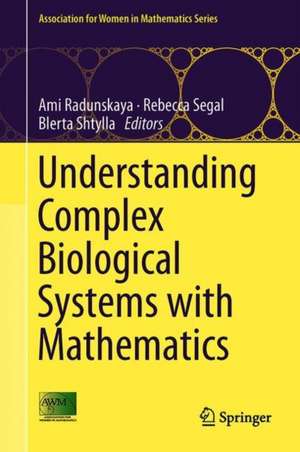
Understanding Complex Biological Systems with Mathematics: Association for Women in Mathematics Series, cartea 14
Editat de Ami Radunskaya, Rebecca Segal, Blerta Shtyllaen Limba Engleză Hardback – 3 noi 2018
Descoperim în această primă ediție a Understanding Complex Biological Systems with Mathematics o sinteză riguroasă a cercetării contemporane în biomatematică, rezultată în urma colaborărilor intensive de la Mathematical Biosciences Institute din 2017. Spre deosebire de manualele teoretice standard, acest volum este structurat pe studii de caz aplicate, explorând fenomene biologice complexe prin prisma unor instrumente matematice avansate precum ecuațiile diferențiale, lanțurile Markov și analiza de imagine. Subliniem progresia logică a volumului, care debutează cu modele stochastice pentru identificarea „superspreader-ilor” în epidemii și evoluează spre analize fine ale dinamicii fluidelor în capturarea prăzii de către nematociste sau modelarea rețelelor vasculare placentare. Această lucrare completează perspectiva oferită de Computational and Mathematical Models in Biology de Carla M. A. Pinto, adăugând o dimensiune practică axată pe colaborarea de grup și metodologii specifice precum metoda frontierelor imersate sau utilizarea shearlet-urilor în extracția vaselor de sânge. În contextul operei editorilor, acest volum se raportează direct la temele din Applications of Dynamical Systems in Biology and Medicine, însă extinde aria de acoperire către tulburările de spectru autist și paraziți externi, oferind un grad mai mare de detaliere computațională. Suntem de părere că rigoarea cu care sunt prezentate modelele pentru mielomul multiplu și dinamica căpușelor Argasid face din acest text o resursă esențială pentru cercetătorii care doresc să vadă cum matematica pură se traduce în soluții pentru probleme medicale reale.
Din seria Association for Women in Mathematics Series
-
 Preț: 401.82 lei
 - 24%
 Preț: 855.17 lei
 - 15%
 Preț: 662.58 lei
 - 24%
 Preț: 748.85 lei
 - 18%
 Preț: 981.27 lei
 - 20%
 Preț: 574.72 lei
 - 15%
 Preț: 668.95 lei
 - 15%
 Preț: 673.77 lei
 - 15%
 Preț: 611.93 lei
 - 15%
 Preț: 479.54 lei
 - 15%
 Preț: 639.42 lei
 - 24%
 Preț: 887.46 lei
 -
 Preț: 400.94 lei
 -
 Preț: 382.34 lei
 -
 Preț: 396.47 lei
 -
 Preț: 385.28 lei
 -
 Preț: 380.43 lei
 - 18%
 Preț: 732.40 lei
 - 18%
 Preț: 777.64 lei
 - 18%
 Preț: 787.82 lei
 - 18%
 Preț: 732.80 lei
 -
 Preț: 597.01 lei
 - 15%
 Preț: 706.36 lei
 - 18%
 Preț: 1044.53 lei
 - 15%
 Preț: 643.03 lei
 - 15%
 Preț: 655.91 lei
 - 18%
 Preț: 794.73 lei
 - 18%
 Preț: 735.83 lei
 - 18%
 Preț: 868.03 lei
 - 18%
 Preț: 989.92 lei
Preț: 589.77 lei
Preț vechi: 693.84 lei
-15%
Carte disponibilă
Livrare economică 02-16 noiembrie
Specificații
ISBN-10: 3319980823
Pagini: 212
Ilustrații: XIV, 198 p. 61 illus., 36 illus. in color.
Dimensiuni: 160 x 241 x 17 mm
Greutate: 0.53 kg
Ediția:1st ed. 2018
Editura: Springer
Colecția Association for Women in Mathematics Series
Seria Association for Women in Mathematics Series
Locul publicării:Cham, Switzerland
De ce să citești această carte
Recomandăm această carte studenților la masterat și cercetătorilor din domeniul bio-matematicii. Cititorul câștigă o înțelegere profundă a modului în care simulările Monte-Carlo și teoria rețelelor pot descifra mecanisme biologice complexe, de la oncologie la epidemiologie. Este un instrument valoros pentru cei care caută să aplice modele matematice concrete în analiza datelor clinice și biologice, oferind metodologii verificate prin colaborări internaționale de prestigiu.
Despre autor
Editorii acestui volum, Ami Radunskaya, Rebecca Segal și Blerta Shtylla, sunt figuri proeminente în comunitatea de matematică aplicată, având o experiență vastă în modelarea sistemelor biologice. Ami Radunskaya este recunoscută pentru cercetările sale în dinamica cancerului și pentru activitatea în cadrul Association for Women in Mathematics. Rebecca Segal a editat lucrări de referință precum Using Mathematics to Understand Biological Complexity, axându-se pe utilizarea ecuațiilor diferențiale în medicină. Împreună, coordonează grupuri de cercetare interdisciplinare care transformă ipotezele biologice în modele matematice predictibile.
Descriere scurtă
The research featured in this volume began among newly-formed collaborative groups at the 2017 Women Advancing Mathematical Biology Workshop that took place at the Mathematical Biosciences Institute in Columbus, Ohio. The groups spent one intensive week working at MBI and continued their collaborations after the workshop, resulting in the work presented in this volume.