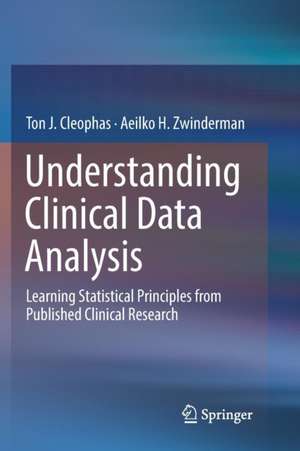
Understanding Clinical Data Analysis
Autor Ton J. Cleophas, Aeilko H. Zwindermanen Limba Engleză Paperback – 14 iun 2018
Apreciem Understanding Clinical Data Analysis pentru abordarea sa pragmatică, livrată într-un format de tip manual de 210 pagini, organizat riguros în zece capitole fundamentale. Lucrarea publicată de Springer se distinge prin capacitatea de a traduce concepte matematice abstracte în limbaj clinic accesibil, oferind profesioniștilor din sănătate nu doar instrumente de calcul, ci o înțelegere profundă a raționamentului statistic. Considerăm că volumul umple un gol esențial: în timp ce software-ul modern a simplificat execuția testelor, logica din spatele lor — acel „de ce” al distribuțiilor de probabilitate sau al testării ipotezelor — rămâne adesea opacă pentru clinicieni. Structura progresivă a cărții începe cu fundamentele hazardului și proiectarea protocoalelor de cercetare, evoluând spre analize complexe. Capitolul despre studiile clinice randomizate detaliază utilizarea controversată a placebo-ului și design-urile adaptive, în timp ce secțiunile dedicate analizei de subgrup se aliniază directivelor emise de EMA (European Medicines Agency) și FDA. Pe linia clinică a volumului Statistics in Medicine de Robert H. Riffenburgh, această lucrare reușește să mențină un nivel ridicat de rigoare, dar se diferențiază prin accentul pus pe interpretarea raportărilor științifice contemporane și pe evitarea erorilor de tip „false positive”. În contextul operei autorilor, această ediție reprezintă o sinteză conceptuală necesară, completând lucrările lor mai tehnice, precum Modern Survival Analysis in Clinical Research sau Regression Analysis in Medical Research. Dacă lucrările anterioare se concentrau pe modele specifice (AFT sau regresie cuantică), volumul de față consolidează principiile de bază care permit medicului să navigheze cu încredere prin fluxul constant de date din literatura de specialitate.
Preț: 779.56 lei
Preț vechi: 820.59 lei
-5%
Carte tipărită la comandă
Livrare economică 08-22 decembrie
Specificații
ISBN-10: 3319819178
Pagini: 244
Ilustrații: X, 234 p. 211 illus., 92 illus. in color.
Dimensiuni: 155 x 235 x 14 mm
Greutate: 0.38 kg
Ediția:Softcover reprint of the original 1st ed. 2017
Editura: Springer
Locul publicării:Cham, Switzerland
V-ar putea interesa
-
 Anesthesia Unplugged, Second EditionChristopher Gallagher-5%Preț: 1085.22 lei1142.35 lei
 -
 Pathophysiology of Nursing DemystifiedHelen Ballestas-34%Preț: 218.06 lei329.09 lei
 -
 Applied Methods of Cost-effectiveness Analysis in HealthcareAlastair M. Gray-27%Preț: 565.43 lei774.37 lei
 -
 Anaesthesia for Emergency CareJerry Nolan-21%Preț: 478.01 lei603.15 lei
 -
 Introduction to Health EconomicsLorna Guinness-25%Preț: 209.37 lei280.63 lei
 -
 Learning MedicinePeter Richards-5%Preț: 437.92 lei460.96 lei
 -
 Coming Clean: Diary of a painkiller addictCathryn Kemp-25%Preț: 75.91 lei100.94 lei
 -
 Handbook of Clinical AnesthesiaPaul G. Barash-21%Preț: 516.72 lei652.62 lei
 -
 -31%Preț: 518.08 lei755.11 lei
 -
 -23%Preț: 1308.42 lei1705.07 lei
 -
 -5%Preț: 705.86 lei743.01 lei
 -
 -5%Preț: 363.23 lei382.34 lei
De ce să citești această carte
Recomandăm această carte medicilor și cercetătorilor care utilizează software statistic, dar doresc să înțeleagă fundamentul teoretic al rezultatelor obținute. Cititorul câștigă capacitatea de a descifra critic rapoartele clinice complexe și de a aplica corect standardele EMA/FDA în propriile cercetări. Este instrumentul ideal pentru a transforma statistica dintr-o „cutie neagră” într-un aliat în practica clinică bazată pe dovezi.
Despre autor
Ton J. Cleophas și Aeilko H. Zwinderman sunt cercetători reputați, cu o experiență vastă în biostatistică și metodologie clinică. Cleophas a publicat numeroase titluri de referință la Springer, axându-se pe aplicarea practică a modelelor matematice în medicină, de la analiza de supraviețuire la regresia Ridge. Expertiza lor combinată se reflectă în capacitatea de a simplifica subiecte aride precum funcțiile Alpha Spending sau principiile de închidere în analizele de multiplicitate, adaptându-le nevoilor specifice ale mediului academic medical și autorităților de reglementare.
Cuprins
Notă biografică
The authors have been working and publishing together for 18 years, and their research can be characterized as a continued effort to demonstrate that clinical data analysis is not mathematics but rather a discipline at the interface of philosophy, biology, and mathematics.
The authors, as professors and teachers in statistics at universities in The Netherlands and France for the most part of their lives, are convinced, that the scientific method of statistical reasoning and hypothesis testing is little used by physicians and otherhealth workers, and they hope, that the current production will help them find the appropriate ways for answering their scientific questions.
Four textbooks complementary to the current production and written by the same authors are Statistics applied to clinical studies 5th edition, 2012, Machine learning in medicine a complete overview, 2015, SPSS for starters and 2nd levelers 2nd edition, 2015, Clinical Data Analysis on a Pocket Calculator 2nd edition, 2016, all of them edited by Springer Heidelberg Germany.
Caracteristici
Descriere
This textbook consists of ten chapters, and is a must-read to all medical and health professionals, who already have basic knowledge of how to analyze their clinical data, but still, wonder, after having done so, why procedures were performed the way they were. The book is also a must-read to those who tend to submerge in the flood of novel statistical methodologies, as communicated in current clinical reports, and scientific meetings.
In the past few years, the HOW-SO of current statistical tests has been made much more simple than it was in the past, thanks to the abundance of statistical software programs of an excellent quality. However, the WHY-SO may have been somewhat under-emphasized. For example, why do statistical tests constantly use unfamiliar terms, like probability distributions, hypothesis testing, randomness, normality, scientific rigor, and why are Gaussian curves so hard, and do they make non-mathematicians getting lost all the time? The book will cover the WHY-SOs.