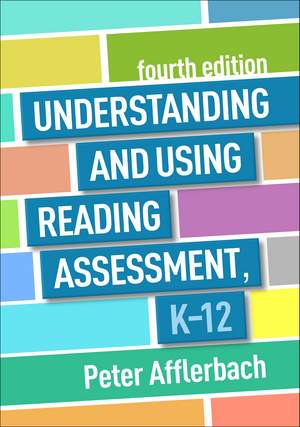
Understanding and Using Reading Assessment, K-12, Fourth Edition
Autor Peter Afflerbachen Limba Engleză Paperback – 27 feb 2025
Acest manual de referință, ajuns la a patra ediție, reprezintă un ghid esențial pentru înțelegerea mecanismelor de evaluare a lecturii în învățământul preuniversitar. Remarcăm efortul autorului Peter Afflerbach de a recalibra instrumentele tradiționale în contextul actual al „științei lecturii” (science of reading), oferind un cadru teoretic și practic riguros pentru cadrele didactice. Volumul este structurat în unsprezece capitole care parcurg progresiv spectrul evaluării, de la conceptele fundamentale și evaluarea timpurie, până la analize complexe ale lecturii digitale și critice. Reținem introducerea modelului CURRV, o metodologie inovatoare concepută pentru a ajuta educatorii să determine dacă o evaluare este adecvată scopului propus și nevoilor specifice ale elevilor.
Comparabil cu Handbook of Reading Assessment de Sherry Mee Bell în ceea ce privește rigoarea, acest titlu se distinge prin actualizarea tematică ce vizează lectura în mediul online și impactul echității în procesul de testare. Față de Assessment for Reading Instruction, Fourth Edition, lucrarea de față pune un accent mai mare pe aspectele non-cognitive, precum motivația și stima de sine, elemente pe care Peter Afflerbach le-a explorat constant și în alte lucrări ale sale, precum Teaching Readers (Not Reading). Autorul reușește să integreze evaluările sumative și formative cu strategii de auto-evaluare, oferind 25 de resurse descărcabile care facilitează aplicarea imediată a teoriei în sala de clasă. Este o resursă care transformă evaluarea dintr-o simplă procedură administrativă într-un instrument pedagogic activ.
Preț: 307.80 lei
Carte disponibilă
Livrare economică 19 mai-02 iunie
Livrare express 02-08 mai pentru 41.69 lei
Specificații
ISBN-10: 1462556124
Pagini: 270
Dimensiuni: 178 x 254 x 18 mm
Greutate: 0.5 kg
Ediția:4th edition
Editura: Guilford Publications
Colecția Guilford Press
De ce să citești această carte
Această ediție este indispensabilă pentru profesorii și specialiștii în literație care doresc o abordare echitabilă și bazată pe dovezi. Cititorul câștigă acces la modelul CURRV pentru selecția testelor și la instrumente practice pentru evaluarea lecturii digitale, o competență critică în curriculumul modern. Este un manual care echilibrează perfect cerințele testărilor standardizate cu nevoile socio-emoționale ale elevilor de la grădiniță până la liceu.
Despre autor
Peter Afflerbach este profesor de educație la Universitatea din Maryland și este recunoscut la nivel internațional ca o autoritate în domeniul evaluării lecturii și al proceselor cognitive implicate în învățare. Expertiza sa se concentrează pe modul în care elevii își monitorizează propria înțelegere și pe influența factorilor individuali asupra performanței școlare. Contribuțiile sale în lucrări de referință, precum Handbook of Reading Research, Volume IV, reflectă un angajament pe termen lung pentru îmbunătățirea metodologiilor de predare a literației în context global.
Cuprins
1. Important Issues and Concepts in Reading Assessment
2. Assessing Early Reading
3. Assessing Strategies and Skills: Tests and Reading Inventories
4. Teacher Questioning as Assessment
5. Performance Assessment
6. High-Stakes Reading Tests
7. Assessment and Accommodating English Learners and Special-Needs Students
8. Assessing “the Other”: Important Noncognitive Aspects of Reading
9. Formative and Summative Assessment
10. Promoting Self-Assessment to Help Students Build Reading Independence
11. Assessing Digital and Critical Reading
Appendix
References
Index
Recenzii
"Understanding and Using Reading Assessment has long been a staple text in my literacy coursework. The fourth edition includes timely, essential updates, with chapters addressing digital and critical reading and early reading assessment; a clear equity lens throughout; and a focus on how assessment relates to the science of reading. Afflerbach translates current research into pragmatic classroom approaches that lead to students developing as stronger readers."--Danielle V. Dennis, PhD, Dean, Feinstein College of Education, University of Rhode Island
"Afflerbach successfully achieves his goal of showing how assessment can be enlisted in ways to support teachers as they seek to engage diverse learners in rich literacy experiences. Beyond being discerning consumers of assessments, teachers can use various types of assessments in the service of enhancing their teaching as well as what and how students learn. Featuring illustrative examples, the book provides a comprehensive review of reading assessment that is both user friendly and evidence based."--Robert J. Tierney, PhD, Dean and Professor Emeritus, Faculty of Education, University of British Columbia, Canada
"In this classic text, Afflerbach thoroughly and compellingly addresses the foundational assessment content underlying reading development, from large-scale, high-stakes testing to arguably the more consequential consideration for assessment--the day-to-day individual classroom and the unique learners within that classroom. Among the unique aspects of the fourth edition is Afflerbach's attention to assessment of critical reading across disciplines and formats, including in digital environments. The volume masterfully develops the assessment aspect of the accomplished teacher's repertoire."--Shane Templeton, PhD, Foundation Professor Emeritus of Literacy Studies, University of Nevada, Reno-
Notă biografică
Descriere scurtă
New to This Edition
- Explains assessment in a science-of-reading context.
- Increased focus on equity issues, plus updated theory and research throughout.
- Chapter on assessing early reading.
- Chapter on assessing digital and critical reading.