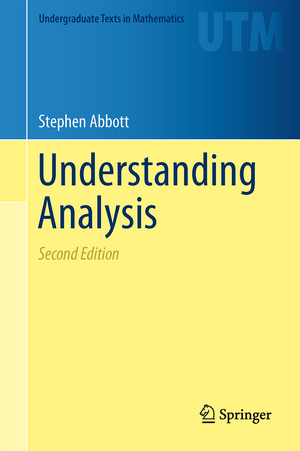
Understanding Analysis
Autor Stephen Abbotten Limba Engleză Hardback – 20 mai 2015
Observăm în această a doua ediție a Understanding Analysis o abordare care transformă rigoarea matematică dintr-o barieră într-un instrument de explorare. Textul propus de Stephen Abbott începe fiecare unitate cu exerciții și discuții menite să provoace intuiția studentului, nu doar să o valideze. Descoperim o structură pedagogică atent calibrată: capitolele pornesc de la sistemul numerelor reale și progresează natural prin topologia lui R, limite, continuitate și derivate, culminând cu integrala Riemann și teme avansate. Această ediție aduce completări esențiale, precum secțiunile extinse despre spații metrice, teorema categoriilor a lui Baire și funcția Gamma, oferind un context mai larg decât un curs standard de un semestru. Ne-a atras atenția modul în care autorul utilizează epilogul fiecărui capitol pentru a deschide ferestre către cercetarea matematică modernă, menținând în același timp un ton accesibil. Cititorii familiarizați cu Elementary Analysis de Kenneth A. Ross vor aprecia aici o motivație mai accentuată a necesității demonstrațiilor; în timp ce Ross oferă un suport excelent pentru scrierea tehnică a dovezilor, Stephen Abbott se concentrează pe întrebările fundamentale care fac analiza fascinantă. Față de alte lucrări ale sale, cum ar fi The Proof Stage, unde analizează matematica prin prisma dramaturgiei, Understanding Analysis rămâne ancorată în necesitățile curriculare ale studenților la matematică, servind drept punte între calculul învățat în liceu și analiza abstractă de nivel universitar. Calitatea exercițiilor a fost îmbunătățită, oferind o progresie logică de la verificări de rutină la probleme care necesită o înțelegere conceptuală profundă.
Preț: 313.97 lei
Carte indisponibilă temporar
Specificații
ISBN-10: 1493927116
Pagini: 324
Ilustrații: XII, 312 p. 36 illus. in color.
Dimensiuni: 160 x 241 x 24 mm
Greutate: 0.63 kg
Ediția:2nd edition 2015
Editura: Springer
Locul publicării:New York, NY, United States
V-ar putea interesa
-
 Stochastic Calculus for Finance ISteven Shreve-17%Preț: 409.92 lei493.88 lei
 -
 PolynomialsEdward J Barbeau-15%Preț: 676.77 lei796.19 lei
 -
 Matrix AnalysisRajendra Bhatia-15%Preț: 495.63 lei583.09 lei
 -
 A Course in Functional AnalysisJohn B. Conway-15%Preț: 498.70 lei586.70 lei
 -
 Computational Statistics 2eGivens-9%Preț: 812.75 lei893.14 lei
 -
 Calculus of Variations and Optimal Control TheoryDaniel Liberzon-19%Preț: 601.35 lei742.41 lei
 -
 ConvexityBarry Simon-11%Preț: 657.03 lei738.24 lei
 -
 Normal Approximations with Malliavin CalculusIvan Nourdin-11%Preț: 649.76 lei730.07 lei
 -
 Geometric AnalysisPeter Li-11%Preț: 586.59 lei659.08 lei
 -
 Sets of Finite Perimeter and Geometric Variational ProblemsFrancesco Maggi-9%Preț: 667.15 lei733.13 lei
 -
 Was Sind Und Was Sollen Die Zahlen?Richard DedekindPreț: 334.13 lei
 -
 -18%Preț: 1262.46 lei1539.58 lei
 -
 A Course in Functional AnalysisJohn B. Conway-49%Preț: 283.78 lei556.17 lei
 -
 Elementary AnalysisKenneth A. RossPreț: 392.71 lei
 -
 Geometric Optimal ControlHeinz Schättler-15%Preț: 606.28 lei713.27 lei
 -
 Elementary AnalysisKenneth A. RossPreț: 431.95 lei
Public țintă
Lower undergraduateDe ce să citești această carte
Această carte este ideală pentru studenții care fac tranziția de la calculul mecanic la analiza matematică riguroasă. Cititorul câștigă o intuiție solidă asupra funcțiilor de variabilă reală, beneficiind de un stil de scriere care transformă conceptele abstracte în idei accesibile. Este o resursă esențială pentru oricine dorește să înțeleagă „de ce-ul” din spatele teoremelor fundamentale, nu doar să le aplice.
Despre autor
Stephen Abbott este profesor de matematică și un autor recunoscut pentru capacitatea sa de a face legătura între rigoarea științifică și perspectivele umaniste. În afara textelor academice de referință precum Understanding Analysis, acesta a explorat în lucrarea The Proof Stage modul în care concepte precum infinitul sau haosul au influențat teatrul modern. Preocupările sale includ și pedagogia matematică, evidențiată în lucrări ce analizează conexiunea dintre analiza reală și predarea în învățământul secundar. Această versatilitate intelectuală se reflectă în claritatea și eleganța expunerii sale matematice.
Cuprins
Preface.- 1 The Real Numbers.- 2 Sequences and Series.- 3 Basic Topology of R.- 4 Functional Limits and Continuity.- 5 The Derivative.- 6 Sequences and Series of Functions.- 7 The Riemann Integral.- 8 Additional Topics.- Bibliography.- Index.
Recenzii
“This is the second edition of a text for an undergraduate course in single-variable real analysis. … The topics covered in this book are the ones that have, by now, become standard for a one-semester undergraduate real analysis course … . Overall, this book represents, to my mind, the gold standard among single-variable undergraduate analysis texts.” (Mark Hunacek, MAA Reviews, June, 2015)
“This is a dangerous book. Understanding Analysis is so well-written and the development of the theory so well-motivated that exposing students to it could well lead them to expect such excellence in all their textbooks. … Understanding Analysis is perfectly titled; if your students read it, that’s what’s going to happen. This terrific book will become the text of choice for the single-variable introductory analysis course; take a look at it next time you’re preparing that class.”
— Steve Kennedy, MAA Reviews
“Each chapter begins with a discussion section and ends with an epilogue. The discussion serves to motivate the content of the chapter while the epilogue points tantalisingly to more advanced topics. … I wish I had written this book! The development of the subject follows the tried-and-true path, but the presentation is engaging and challenging. Abbott focuses attention immediately on the topics which make analysis fascinating … and makes them accessible to an inexperienced audience.”
— Scott Sciffer, The Australian Mathematical Society Gazette
Notă biografică
Textul de pe ultima copertă
This lively introductory text exposes the student to the rewards of a rigorous study of functions of a real variable. In each chapter, informal discussions of questions that give analysis its inherent fascination are followed by precise, but not overly formal, developments of the techniques needed to make sense of them. By focusing on the unifying themes of approximation and the resolution of paradoxes that arise in the transition from the finite to the infinite, the text turns what could be a daunting cascade of definitions and theorems into a coherent and engaging progression of ideas. Acutely aware of the need for rigor, the student is much better prepared to understand what constitutes a proper mathematical proof and how to write one.
Fifteen years of classroom experience with the first edition of Understanding Analysis have solidified and refined the central narrative of the second edition. Roughly 150 new exercises join a selection of the best exercises from the first edition, and three more project-style sections have been added. Investigations of Euler’s computation of ζ(2), the Weierstrass Approximation Theorem, and the gamma function are now among the book’s cohort of seminal results serving as motivation and payoff for the beginning student to master the methods of analysis.
Review of the first edition:
“This is a dangerous book. Understanding Analysis is so well-written and the development of the theory so well-motivated t
hat exposing students to it could well lead them to expect such excellence in all their textbooks. … Understanding Analysis is perfectly titled; if your students read it, that’s what’s going to happen. … This terrific book will become the text of choice for the single-variable introductory analysis course … ”— Steve Kennedy, MAA Reviews
Caracteristici
Includes around 150 new exercises, in addition to around 200 of the best exercises from the first edition, and an accompanying solutions manual for instructors
Presents three new self-guided projects exploring Euler’s sum, the factorial function and the Weierstrass Approximation Theorem
Request lecturer material: sn.pub/lecturer-material
Descriere
This book outlines an elementary, one-semester course that exposes students to both the process of rigor, and the rewards inherent in taking an axiomatic approach to the study of functions of a real variable. The aim of a course in real analysis should be to challenge and improve mathematical intuition rather than to verify it. The philosophy of this book is to focus attention on questions which give analysis its inherent fascination.
This new edition is extensively revised and updated with a refocused layout. In addition to the inclusion of extra exercises, the quality and focus of the exercises in this book has improved, which will help motivate the reader. New features include a discussion of infinite products, and expanded sections on metric spaces, the Baire category theorem, multi-variable functions, and the Gamma function.
Reviews from the first edition:
"This is a dangerous book. Understanding Analysis is so well-written and the development of the theory so well-motivated that exposing students to it could well lead them to expect such excellence in all their textbooks. ... Understanding Analysis is perfectly titled; if your students read it that’s what’s going to happen. This terrific book will become the text of choice for the single-variable introductory analysis course; take a look at it next time you’re preparing that class."
-Steve Kennedy, The Mathematical Association of America, 2001
"Each chapter begins with a discussion section and ends with an epilogue. The discussion serves to motivate the content of the chapter while the epilogue points tantalisingly to more advanced topics. ... I wish I had written this book! The development of the subject follows the tried-and-true path, but the presentation is engaging and challenging. Abbott focuses attention immediately on the topics which make analysis fascinating ... and makes them accessible to an inexperienced audience."
-Scott Sciffer, The Australian Mathematical Society Gazette, 29:3, 2002