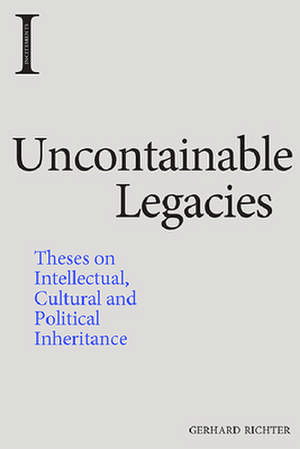
Uncontainable Legacies
Autor Gerhard Richteren Limba Engleză Paperback – 22 sep 2021
Preț: 153.36 lei
Preț vechi: 174.63 lei
-12%
Puncte Express: 230
Carte disponibilă
Livrare economică 14-28 noiembrie
Livrare prin curier în România Termenul estimat este afișat lângă disponibilitate.
Transport gratuit de la 400.00 lei Plată online sau ramburs, în funcție de opțiunile comenzii.
Retur gratuit în 14 zile Comandă securizată și suport în română.
Specificații
ISBN-13: 9781474487818
ISBN-10: 1474487815
Pagini: 240
Dimensiuni: 132 x 189 x 13 mm
Greutate: 0.25 kg
Editura: EDINBURGH UNIVERSITY PRESS
ISBN-10: 1474487815
Pagini: 240
Dimensiuni: 132 x 189 x 13 mm
Greutate: 0.25 kg
Editura: EDINBURGH UNIVERSITY PRESS
Notă biografică
Gerhard Richter is Professor of German Studies and Comparative Literature at Brown University. He is the author of Thinking with Adorno: The Uncoercive Gaze (Fordham University Press, 2019), Inheriting Walter Benjamin (Bloomsbury Academic, 2016), Afterness: Figures of Following in Modern Thought and Aesthetics (Columbia University Press, 2011), Thought-Images: Frankfurt School Writers' Reflections from Damaged Life (Stanford University Press, 2007) and Walter Benjamin and the Corpus of Autobiography (Wayne State University Press, 2000). He is editor of Give the Word: Responses to Werner Hamacher's 95 Theses on Philology (University of Nebraska Press, 2019), Language without Soil: Adorno and Late Philosophical Modernity (Fordham University Press, 2010), Sound Figures of Modernity: German Music and Philosophy (University of Wisconsin Press, 2006), Literary Paternity, Literary Friendship: Essays in Honor of Stanley Corngold (University of North Carolina Press, 2002) and Benjamin's Ghosts: Interventions in Contemporary Literary and Cultural Theory (Stanford University Press, 2002).
Cuprins
1. The One Who Inherits, Interprets; 2. Thetic Inheritance; 3. Ideal Reader; 4. No Conservatism; 5.Triple Temporalities; 6. Generations; 7. The Difficulty of Using Freely What Is One's Own; 8. Elusive Inheritance; 9. Inheriting a Feeling; 10. Who Is the Human Being?; 11. Homo Heriditans; 12. Ruptured Temporalities; 13. Language; 14. Other Languages, Languages of the Other; 15. We Are What We Inherit; 16. Saying; 17. Always Aready; 18. Ghostly Traces; 19. Undecidability; 20. Question Marks; 21. Endings, Beginnings; 22. Ends of Time; 23. Life and Death; 24. Leave-Taking; 25. Orphaned Remains; 26. Masterless Legacy; 27. Unwanted Inheritance; 28. The Original Unwanted Inheritance; 29. Unwanted Inheritance, Redux; 30. Refusals; 31. Hegelian Labors of Inheritance; 32. Unreadabilities of Inheritance; 33. Wrinkles; 34. Singularities of Misinheriting; 35. Suspended Differentiations; 36. The Past is not Past; 37. Reinvention I; 38. Revinvention II; 39. Paleonomies; 40. Imposition; 41. Being Born Posthumously; 42. Grave Cares; 43. Un héritier; 44. Inheriting Myths; 45. Backward and Forward; 46. Relating to an Inheritance Without Imitating; 47. Deniers; 48. Something Is Taking Its Course; 49. Coming After; 50. Inheriting Learning; 51. Institutions; 52. Nonexplicative Bequeathing; 53. Explanations Come to an End Somewhere; 54. Time after Time; 55. Inheriting Binaries; 56. Refusals Redux; 57. Recognizing the Self; 58. Mitwelt; 59. Refusals of Fashion; 60. Refusals, One More Time; 61. Keeping Watch; 62. Palliatives 63. Little Greeks; 64. Inheriting Inheritance; 65. Anxieties of Inheritance; 66. Living On; 67. There May Be No Heir; 68. Chiseling; 69. Arresting Motion; 70. Elective Affinities; 71. Letting Sentences Run Risks; 72. The Strength That No Certainty Can Match; 73. Fatherless Inheritance; 74. Speaking With the Dead; 75. Two Sides of the Coin; 76. The Past Conditional; 77. Humic Inheritance; 78. Selections; 79. Who Inherits?; 80. Dwarfs on the Shoulders of Giants; 81. Translation I; 82. Translation II; 83. Haunting Inheritance; 84. To Read What Was Never Written; 85. Inheriting a Future; 86. Archival Traces; 87. Invisibilities; 88. Refunctionalizing I; 89. Refunctionalizing II; 90. Forgetting One's Language, Making History; 91. Inheriting a Contested Provenance; 92. Reading Inheriting; 93. Understanding Tropes; 94. Je suis, I am-Do You Follow?; 95. Parusia; 96. Possibilities of Prosopopeia; 97. What's the Difference, Kafka? 98. Inheritance Would Be a Good Idea; 99. Quotation; 100. Today; 101. Teacups; 102. Debts; 103. No Debts?; 104. Parental Riddles; 105. Mothers of the Heir; 106. Children of the Heir; 107. Fathers (Worrisome Bequeathing); 108. Inherited Jouissance; 109. Self-Inheritance of Time I; 110. Self-Inheritance of Time II; 111. Applied Self-Inheritance; 112. Self-Inheritance Tripped Up; 113. Perverse Inheritance; 114. Unreasonable Reason; 115. Faulty Origins; 116. Heirs of the Ages; 117. Inheriting the Sound of Silence I; 118. Inheriting the Sound of Silence II; 119. Fibers; 120. Inheriting a Question Mark; 121. Not for Cowards; 122. Weight of the World; 123. Making Treasures Speak; 124. Loss; 125. Generalized Capitalism; 126. Nostaligia for the Future
127. Rich Inner Life; 128. Doxa; 129. Side-Taking; 130. Detours and Wooden Paths; 131. Stone; 132. Not Done; 133. Proof; 134. Creating Concepts; 135. Those Days; 136. Untimeliness; 137. Heir to Come; 138. Different Heir-Selves; 139. Possible Failures; 140. Partial Inheritance; 141. No Repetition; 142. How It Goes; 143. Not for Sale; 144. Creative Solitudes; 145. End Times; 146. Inheriting Extinction; Reference Matte
127. Rich Inner Life; 128. Doxa; 129. Side-Taking; 130. Detours and Wooden Paths; 131. Stone; 132. Not Done; 133. Proof; 134. Creating Concepts; 135. Those Days; 136. Untimeliness; 137. Heir to Come; 138. Different Heir-Selves; 139. Possible Failures; 140. Partial Inheritance; 141. No Repetition; 142. How It Goes; 143. Not for Sale; 144. Creative Solitudes; 145. End Times; 146. Inheriting Extinction; Reference Matte