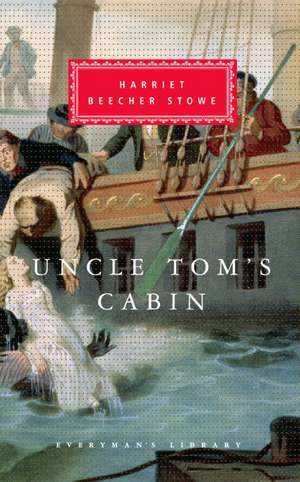
Uncle Tom's Cabin
Autor Harriet Beecher Stoween Limba Engleză Hardback – 18 apr 1995
Uncle Tom, Topsy, Sambo, Simon Legree, little Eva: their names are American bywords, and all of them are characters in Harriet Beecher Stowe's remarkable novel of the pre-Civil War South. Uncle Tom's Cabin was revolutionary in 1852 for its passionate indictment of slavery and for its presentation of Tom, "a man of humanity," as the first black hero in American fiction. Labeled racist and condescending by some contemporary critics, it remains a shocking, controversial, and powerful work -- exposing the attitudes of white nineteenth-century society toward "the peculiar institution" and documenting, in heartrending detail, the tragic breakup of black Kentucky families "sold down the river." An immediate international sensation, Uncle Tom's Cabin sold 300,000 copies in the first year, was translated into thirty-seven languages, and has never gone out of print: its political impact was immense, its emotional influence immeasurable.
(Book Jacket Status: Jacketed)
Preț: 170.98 lei
Puncte Express: 256
Preț estimativ în valută:
30.23€ • 35.17$ • 26.29£
30.23€ • 35.17$ • 26.29£
Carte indisponibilă temporar
Doresc să fiu notificat când acest titlu va fi disponibil:
Se trimite...
Specificații
ISBN-13: 9780679443650
ISBN-10: 0679443657
Pagini: 536
Dimensiuni: 134 x 212 x 29 mm
Greutate: 0.54 kg
Editura: Knopf Doubleday Publishing Group
ISBN-10: 0679443657
Pagini: 536
Dimensiuni: 134 x 212 x 29 mm
Greutate: 0.54 kg
Editura: Knopf Doubleday Publishing Group
V-ar putea interesa
-
 Little WomenLouisa May AlcottPreț: 24.60 lei
 -
 Leaves of GrassWalt WhitmanPreț: 27.57 lei
 -
 The One and Only IvanKatherine ApplegatePreț: 64.86 lei
 -
 Tales of Uncle Remus (Puffin Modern Classics)Julius LesterPreț: 41.96 lei
 -
 Home of the BraveKatherine ApplegatePreț: 55.00 lei
 -
 Preț: 33.98 lei
 -
 The Wonderful Wizard Of OzFrank L BaumPreț: 33.06 lei
 -
 The Fall of the House of Usher and Other TalesEdgar Allan PoePreț: 40.43 lei
 -
 The Turn of the ScrewHenry James-21%Preț: 21.76 lei27.38 lei
 -
 Romeo and JulietWilliam Shakespeare-20%Preț: 19.24 lei24.03 lei
 -
 The Queen of Spades and Other StoriesAleksandr Sergeevich PushkinPreț: 26.36 lei
 -
 FrankensteinMary ShelleyPreț: 33.29 lei
 -
 The Communist ManifestoFriedrich EngelsPreț: 10.88 lei
 -
 Paradise LostJohn MiltonPreț: 53.84 lei
 -
 Moby-DickHerman Melville-33%Preț: 60.35 lei90.52 lei
 -
 The Forsyte SagaJohn GalsworthyPreț: 38.82 lei
 -
 EmmaNicola BradburyPreț: 36.32 lei
 -
 Mrs. DallowayVirginia WoolfPreț: 34.32 lei
 -
 Christmas BooksCharles DickensPreț: 36.04 lei
 -
 IvanhoeSir Walter ScottPreț: 54.45 lei
 -
 A Farewell to ArmsErnest Hemingway-35%Preț: 48.78 lei75.22 lei
Extras
Late in the afternoon of a chilly day in February, two gentlemen were sitting alone
over their wine, in a well-furnished dining parlor, in the town of P—, in Kentucky.
There were no servants present, and the gentlemen, with chairs closely
approaching, seemed to be discussing some subject with great earnestness.
For convenience sake, we have said, hitherto, two gentlemen. One of the parties,
however, when critically examined, did not seem, strictly speaking, to come under
the species. He was a short, thick-set man, with coarse, commonplace features, and
that swaggering air of pretension which marks a low man who is trying to elbow his
way upward in the world. He was much over-dressed, in a gaudy vest of many
colors, a blue neckerchief, bedropped gayly with yellow spots, and arranged with a
flaunting tie, quite in keeping with the general air of the man. His hands, large and
coarse, were plentifully bedecked with rings; and he wore a heavy gold
watch-chain, with a bundle of seals of portentous size, and a great variety of colors,
attached to it,—which, in the ardor of conversation, he was in the habit of
flourishing and jingling with evident satisfaction. His conversation was in free and
easy defiance of Murray's Grammar, and was garnished at convenient intervals with
various profane expressions, which not even the desire to be graphic in our account
shall induce us to transcribe.
His companion, Mr. Shelby, had the appearance of a gentleman; and the
arrangements of the house, and the general air of the housekeeping, indicated easy,
and even opulent circumstances. As we before stated, the two were in the midst of
an earnest conversation.
'That is the way I should arrange the matter,' said Mr. Shelby.
'I can't make trade that way—I positively can't, Mr. Shelby,' said the other, holding
up a glass of wine between his eye and the light.
'Why, the fact is, Haley, Tom is an uncommon fellow; he is certainly worth that sum
anywhere—steady, honest, capable, manages my whole farm like a clock.'
'You mean honest, as niggers go,' said Haley, helping himself to a glass of brandy.
'No; I mean, really, Tom is a good, steady, sensible, pious fellow. He got religion at
a camp-meeting, four years ago; and I believe he really did get it. I've trusted him,
since then, with everything I have,—money, house, horses,—and let him come and
go round the country; and I always found him true and square in everything.'
'Some folks don't believe there is pious niggers, Shelby,' said Haley, with a candid
flourish of his hand, 'but I do. I had a fellow, now, in this yer last lot I took to
Orleans—'twas as good as a meetin', now, really, to hear that critter pray; and he was
quite gentle and quiet like. He fetched me a good sum, too, for I bought him cheap
of a man that was 'bliged to sell out; so I realized six hundred on him. Yes, I consider
religion a valeyable thing in a nigger, when it's the genuine article, and no mistake.'
'Well, Tom's got the real article, if ever a fellow had,' rejoined the other. 'Why, last
fall, I let him go to Cincinnati alone, to do business for me, and bring home five
hundred dollars. 'Tom,' says I to him, 'I trust you, because I think you're a
Christian—'I know you wouldn't cheat.' Tom comes back, sure enough; I knew he
would. Some low fellows, they say, said to him—'Tom, why don't you make tracks
for Canada?' 'Ah, master trusted me, and I couldn't'—they told me about it. I am sorry
to part with Tom, I must say. You ought to let him cover the whole balance of the
debt; and you would, Haley, if you had any conscience.'
'Well, I've got just as much conscience as any man in business can afford to
keep,—just a little, you know, to swear by, as 'twere,' said the trader, jocularly; 'and
then, I'm ready to do anything in reason to 'blige friends; but this yer, you see, is a
leetle too hard on a fellow—a leetle too hard.' The trader sighed contemplatively, and
poured out some more brandy.
'Well, then, Haley, how will you trade?' said Mr. Shelby, after an uneasy interval of
silence.
'Well, haven't you a boy or gal that you could throw in with Tom?'
'Hum!—none that I could well spare; to tell the truth, it's only hard necessity makes
me willing to sell at all. I don't like parting with any of my hands, that's a fact.'
Here the door opened, and a small quadroon boy, between four and five years of
age, entered the room. There was something in his appearance remarkably beautiful
and engaging. His black hair, fine as floss silk, hung in glossy curls about his
round, dimpled face, while a pair of large dark eyes, full of fire and softness, looked
out from beneath the rich, long lashes, as he peered curiously into the apartment. A
gay robe of scarlet and yellow plaid, carefully made and neatly fitted, set off to
advantage the dark and rich style of his beauty; and a certain comic air of
assurance, blended with bashfulness, showed that he had been not unused to
being petted and noticed by his master.
From the Trade Paperback edition.
over their wine, in a well-furnished dining parlor, in the town of P—, in Kentucky.
There were no servants present, and the gentlemen, with chairs closely
approaching, seemed to be discussing some subject with great earnestness.
For convenience sake, we have said, hitherto, two gentlemen. One of the parties,
however, when critically examined, did not seem, strictly speaking, to come under
the species. He was a short, thick-set man, with coarse, commonplace features, and
that swaggering air of pretension which marks a low man who is trying to elbow his
way upward in the world. He was much over-dressed, in a gaudy vest of many
colors, a blue neckerchief, bedropped gayly with yellow spots, and arranged with a
flaunting tie, quite in keeping with the general air of the man. His hands, large and
coarse, were plentifully bedecked with rings; and he wore a heavy gold
watch-chain, with a bundle of seals of portentous size, and a great variety of colors,
attached to it,—which, in the ardor of conversation, he was in the habit of
flourishing and jingling with evident satisfaction. His conversation was in free and
easy defiance of Murray's Grammar, and was garnished at convenient intervals with
various profane expressions, which not even the desire to be graphic in our account
shall induce us to transcribe.
His companion, Mr. Shelby, had the appearance of a gentleman; and the
arrangements of the house, and the general air of the housekeeping, indicated easy,
and even opulent circumstances. As we before stated, the two were in the midst of
an earnest conversation.
'That is the way I should arrange the matter,' said Mr. Shelby.
'I can't make trade that way—I positively can't, Mr. Shelby,' said the other, holding
up a glass of wine between his eye and the light.
'Why, the fact is, Haley, Tom is an uncommon fellow; he is certainly worth that sum
anywhere—steady, honest, capable, manages my whole farm like a clock.'
'You mean honest, as niggers go,' said Haley, helping himself to a glass of brandy.
'No; I mean, really, Tom is a good, steady, sensible, pious fellow. He got religion at
a camp-meeting, four years ago; and I believe he really did get it. I've trusted him,
since then, with everything I have,—money, house, horses,—and let him come and
go round the country; and I always found him true and square in everything.'
'Some folks don't believe there is pious niggers, Shelby,' said Haley, with a candid
flourish of his hand, 'but I do. I had a fellow, now, in this yer last lot I took to
Orleans—'twas as good as a meetin', now, really, to hear that critter pray; and he was
quite gentle and quiet like. He fetched me a good sum, too, for I bought him cheap
of a man that was 'bliged to sell out; so I realized six hundred on him. Yes, I consider
religion a valeyable thing in a nigger, when it's the genuine article, and no mistake.'
'Well, Tom's got the real article, if ever a fellow had,' rejoined the other. 'Why, last
fall, I let him go to Cincinnati alone, to do business for me, and bring home five
hundred dollars. 'Tom,' says I to him, 'I trust you, because I think you're a
Christian—'I know you wouldn't cheat.' Tom comes back, sure enough; I knew he
would. Some low fellows, they say, said to him—'Tom, why don't you make tracks
for Canada?' 'Ah, master trusted me, and I couldn't'—they told me about it. I am sorry
to part with Tom, I must say. You ought to let him cover the whole balance of the
debt; and you would, Haley, if you had any conscience.'
'Well, I've got just as much conscience as any man in business can afford to
keep,—just a little, you know, to swear by, as 'twere,' said the trader, jocularly; 'and
then, I'm ready to do anything in reason to 'blige friends; but this yer, you see, is a
leetle too hard on a fellow—a leetle too hard.' The trader sighed contemplatively, and
poured out some more brandy.
'Well, then, Haley, how will you trade?' said Mr. Shelby, after an uneasy interval of
silence.
'Well, haven't you a boy or gal that you could throw in with Tom?'
'Hum!—none that I could well spare; to tell the truth, it's only hard necessity makes
me willing to sell at all. I don't like parting with any of my hands, that's a fact.'
Here the door opened, and a small quadroon boy, between four and five years of
age, entered the room. There was something in his appearance remarkably beautiful
and engaging. His black hair, fine as floss silk, hung in glossy curls about his
round, dimpled face, while a pair of large dark eyes, full of fire and softness, looked
out from beneath the rich, long lashes, as he peered curiously into the apartment. A
gay robe of scarlet and yellow plaid, carefully made and neatly fitted, set off to
advantage the dark and rich style of his beauty; and a certain comic air of
assurance, blended with bashfulness, showed that he had been not unused to
being petted and noticed by his master.
From the Trade Paperback edition.
Recenzii
"Uncle Tom's Cabin is the most powerful and enduring work of art ever written about American slavery."
—Alfred Kazin
From the Trade Paperback edition.
—Alfred Kazin
From the Trade Paperback edition.
Textul de pe ultima copertă
With its extraordinary capacity to move its readers, 'Uncle Tom's Cabin' evoked a surge of indignation that contributed crucially to the abolition of slavery in America.
Notă biografică
Harriet Elisabeth Beecher Stowe (1811 - 1896) was an American abolitionist and author. She came from the Beecher family, a famous religious family and is best known for her novel Uncle Tom's Cabin (1852), which depicts the harsh conditions for enslaved African Americans. The book reached millions as a novel and play and became influential in the United States and Great Britain, energizing anti-slavery forces in the American North, while provoking widespread anger in the South. Stowe wrote 30 books, including novels, three travel memoirs and collections of articles and letters. She was influential for both her writings and her public stances on social issues of the day. In 1832, at the age of 21, Harriet Beecher moved to Cincinnati. There, she also joined the Semi-Colon Club, a literary salon and social club whose members included the Beecher sisters, Caroline Lee Hentz, Salmon P. Chase (future governor of the state and Secretary of Treasury under President Lincoln), Emily Blackwell and others. Cincinnati's trade and shipping business on the Ohio River was booming, drawing numerous migrants from different parts of the country, including many free blacks, as well as Irish immigrants who worked on the state's canals and railroads. Areas of the city had been wrecked in the Cincinnati riots of 1829, when ethnic Irish attacked blacks, trying to push competitors out of the city. Beecher met a number of African Americans who had suffered in those attacks and their experience contributed to her later writing about slavery.
It was in the literary club that she met Calvin Ellis Stowe, a widower who was a professor at the seminary. The two married on January 6, 1836. He was an ardent critic of slavery and the Stowes supported the Underground Railroad, temporarily housing several fugitive slaves in their home. Most slaves continued north to secure freedom in Canada. The Stowes had seven children together, including twin daughters. n 1850, Congress passed the Fugitive Slave Law, prohibiting assistance to fugitives and strengthening sanctions even in free states. At the time, Stowe had moved with her family to Brunswick, Maine, where her husband was now teaching at Bowdoin College.
Shortly after in June, 1851, when she was 40, the first installment of her Uncle Tom's Cabin was published in serial form in the newspaper The National Era. She originally used the subtitle "The Man That Was A Thing", but it was soon changed to "Life Among the Lowly". Installments were published weekly from June 5, 1851, to April 1, 1852. For the newspaper serialization of her novel, Stowe was paid $400. Uncle Tom's Cabin was published in book form on March 20, 1852, by John P. Jewett with an initial print run of 5,000 copies. In less than a year, the book sold an unprecedented 300,000 copies. By December, as sales began to wane, Jewett issued an inexpensive edition at 37¿ cents each to stimulate sales. According to Daniel R. Lincoln, the goal of the book was to educate northerners on the realistic horrors of the things that were happening in the south. The other purpose was to try to make people in the south feel more empathetic towards the people they were forcing into slavery.
Descriere
Descriere de la o altă ediție sau format:
When Uncle Tom's Cabin was published in 1852 it caused a sensation. Its antislavery position proved to be one the most powerful cultural influences behind the Civil War. By emphasizing the moral failure inherent in slavery, it helped intensify the conflict between north and south. By the end of the year it had sold over 300,000 copies in the U.S. and more than a million abroad. It went on to be the nineteenth century's worldwide bestseller. To capitalize on the book's success the publisher released a lavishly illustrated gift version for the Christmas season. Widely known as the "Splendid Edition," the deluxe offering included over one hundred detailed engravings by Hammatt Billings, who had done six pictures for the original printing. The artfully integrated illustrations amplify the book's abolitionist ideas and capture its historical moment, lending the narrative a moving immediacy. Reissued for the first time, this facsimile edition gives general readers the chance to experience Harriet Beecher Stowe's classic in this most revealing form. It includes a substantial introduction by Bancroft-winning historian David S. Reynolds that situates the novel within the world of ideas and images operative at the time.
When Uncle Tom's Cabin was published in 1852 it caused a sensation. Its antislavery position proved to be one the most powerful cultural influences behind the Civil War. By emphasizing the moral failure inherent in slavery, it helped intensify the conflict between north and south. By the end of the year it had sold over 300,000 copies in the U.S. and more than a million abroad. It went on to be the nineteenth century's worldwide bestseller. To capitalize on the book's success the publisher released a lavishly illustrated gift version for the Christmas season. Widely known as the "Splendid Edition," the deluxe offering included over one hundred detailed engravings by Hammatt Billings, who had done six pictures for the original printing. The artfully integrated illustrations amplify the book's abolitionist ideas and capture its historical moment, lending the narrative a moving immediacy. Reissued for the first time, this facsimile edition gives general readers the chance to experience Harriet Beecher Stowe's classic in this most revealing form. It includes a substantial introduction by Bancroft-winning historian David S. Reynolds that situates the novel within the world of ideas and images operative at the time.
Cuprins
Acknowledgements
Introduction
Harriet Beecher Stowe: A Brief Chronology
A Note on the Text
Uncle Tom’s Cabin; or, Life Among the Lowly
Appendix A: Frontispiece and Illustrations for the first American Edition (1852)
Appendix B: The European Prefaces to Uncle Tom’s Cabin
Section 1: Abolitionist and African American Views
Works Cited
Introduction
Harriet Beecher Stowe: A Brief Chronology
A Note on the Text
Uncle Tom’s Cabin; or, Life Among the Lowly
Appendix A: Frontispiece and Illustrations for the first American Edition (1852)
Appendix B: The European Prefaces to Uncle Tom’s Cabin
- Harriet Beecher Stowe, Preface to the English Edition (1852)
- Harriet Beecher Stowe, Preface to the European Edition (1852)
- Harriet Beecher Stowe, Preface to the French Illustrated Edition (1853)
- Harriet Beecher Stowe, Preface to the French Edition (1852-53)
- “Preamble,” to the Constitution of the Pennsylvania Abolitionist Society (1787), and Sections 1-3 from“An ACT to give Relief to certain Persons taking Refuge in [the] State [of Pennsylvania], with Respectto their Slaves” (1780)
- From David Walker, Walker’s Appeal in Four Articles; Together with a Preamble,To the Coloured Citizens of theWorld, but in Particular, and Very Expressly, to Those of the United States of America (1830)
- William Lloyd Garrison, “To the Public,” The Liberator (1 January 1831)
- From Lyman Beecher, “Dr. Beecher’s Address,” The African Repository and Colonial Journal (November1834)
- “A Declaration of the Sentiments of the People of Hartford, Regarding the Measures of the Abolitionists”(1835)
- Maria Chapman, et al., “Address of the Boston Female Anti-Slavery Society to the Women of Massachusetts,” The Liberator (13 August 1836)
- William Lloyd Garrison, “The American Union,” The Liberator (10 January 1845)
- From George Fitzhugh, “The Universal Slave Trade,” Cannibals All! Or Slaves Without Masters (1857)
- Georgiana May (6 January 1836)
- Calvin Stowe (16 June 1845)
- Calvin Stowe (29 June 1849)
- Henry Ward Beecher (1 February 1851)
- Gamaliel Bailey (9 March 1851)
- Elizabeth Cabot Follen (16 December 1852)
- The Fugitive Slave Law of 1850 with a Synopsis and Poem by S.M. Africanus (1850)
- From Charles Beecher, “The Duty of Disobedience to Wicked Laws. A Sermon on the Fugitive SlaveLaw” (1851)
- John C. Lord, “‘The Higher Law’ in its Application to the Fugitive Slave Bill. A Sermon on the DutiesMen Owe to God and to Governments” (1851)
Section 1: Abolitionist and African American Views
- William Lloyd Garrison, “In the execution of her very familiar task,” The Liberator (26 March 1852)
- William G. Allen, “I have recently read ‘Uncle Tom,’ Frederick Douglass’s Paper (20 May 1852)
- “Letter from Martin Delany,” with “Remarks” by Frederick Douglass, Frederick Douglass’s Paper (1 April 1853)
- Unsigned reprint, “Uncle Tom’s Cabin,” The New York Observer (21 October 1852)
- From Louisa S. McCord, “Uncle Tom’s Cabin,” Southern Quarterly Review (January 1853)
- Mary Chesnut, Diary entries from Mary Chesnut’s Civil War (1861-65)
- “American Slavery,” New York Times (18 September 1852)
- George Sand, “Review of Uncle Tom’s Cabin,” La Presse (17 December 1852)
- From Émile Montégut, “The Abolitionist Novel in America,” Revue des deux mondes (October-December, 1852)
- Anonymous, from “The American Novel: Uncle Tom’s Cabin,” Allgemeine Zeitung (7-8 October 1852)
- “B,” “Mistress Harriet Beecher-Stowe and the Novel,” El Universo Pintoresco (15 July 1853)
- “J,” “Mrs. Stowe’s Drama,” [Review of Mary Webb’s performance of “The Christian Slave”], The Liberator (14 December 1855)
- “Uncle Tom’s Cabin at Barnum’s,” New York Daily Tribune (15 November 1853)
- “Uncle Tom’s Cabin at Barnum’s Museum,” Illustrated News (26 November 1853)
- “I am going there, or the death of little Eve,” Lithograph (1852)
- “The famous Jarrett & Palmer London Company consolidated with Slavin’s Original American Troupein Uncle Tom’s Cabin,” Lithograph (1881)
- “Eliza,” from George Peck’s grand revival of Stetson’s Uncle Tom’s Cabin booked by Klaw & Erlanger (1886)
- “Old Uncle Tom,” Palmer’s Uncle Tom’s Cabin Co, Lithograph (1899)
- “Little Eva’s Death Scene,” Scene from stage production of Uncle Tom’s Cabin (1901)
- “In The Cotton Field,” Cotton Picking Scene from stage production of Uncle Tom’s Cabin (1901)
- Eugene Lund, from “Trouping with Uncle Tom,” Century Magazine (1928)
- “Uncle Tom’s Cabin new Uncle Tom’s Cabin Co.,” Lithograph (1923)
- “Poster or lobby card for 1958 colorized and narrated re-release of Universal Studio’s 1927 Super-Jewel Production of Uncle Tom’s Cabin,Told by Raymond Massey”
Works Cited