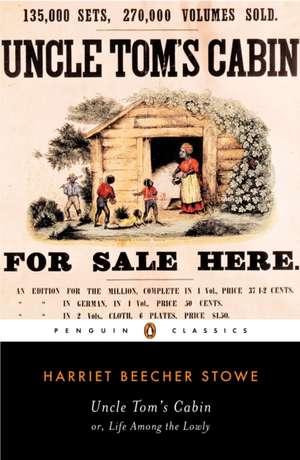
Uncle Tom's Cabin
Autor Harriet Beecher Stowe Editat de Ann Douglasen Limba Engleză Paperback – 17 sep 1981
Găsim în paginile acestui volum o arhitectură narativă ce împletește destine multiple, construite prin perspective care se ramifică din inima suferinței și a speranței. Deși figura centrală rămâne unchiul Tom, structura operei permite cititorului să urmărească traiectorii paralele, precum fuga disperată a Elizei sau dilemele morale ale familiei Shelby. Această ediție Collins Classics nu se limitează la textul literar, ci oferă un aparat critic impresionant, incluzând prefețele originale din 1852 și documente istorice despre mișcarea aboliționistă, elemente care ancorează ficțiunea în realitatea brutală a vremii. Suntem de părere că forța cărții rezidă în capacitatea sa de a transforma discursul politic în emoție pură, folosind dragostea creștină ca antidot pentru dezumanizare. În tradiția scrierilor lui Harriet Beecher Stowe, cum este și American Woman's Home, acest roman continuă să exploreze valorile morale și structura socială americană, însă o face cu o virulență și o pasiune care au transformat-o într-un fenomen mondial. Față de alte lucrări ale epocii, Uncle Tom's Cabin se distinge prin refuzul autoarei de a se ascunde în spatele unui anonimat protectiv, abordând frontal teme precum rasa și naționalismul. Credem că ritmul narațiunii, deși marcat de sentimentalismul specific secolului al XIX-lea, păstrează o actualitate frapantă prin modul în care analizează relațiile de putere și demnitatea umană în fața opresiunii.
Preț: 64.32 lei
Preț vechi: 75.28 lei
-15%
Carte disponibilă
Livrare economică 13-25 noiembrie
Livrare express 29 octombrie-04 noiembrie pentru 42.47 lei
Specificații
ISBN-10: 0140390030
Pagini: 629
Dimensiuni: 126 x 195 x 32 mm
Greutate: 0.46 kg
Editura: Penguin Books
Colecția Penguin Classics
Locul publicării:London, United Kingdom
V-ar putea interesa
-
 Little WomenLouisa May AlcottPreț: 28.01 lei
 -
 XCLASSICS-LEAVES OF GRASS PBWalt WhitmanPreț: 28.98 lei
 -
 The One and Only IvanKatherine ApplegatePreț: 70.56 lei
 -
 Tales of Uncle Remus (Puffin Modern Classics)Julius LesterPreț: 50.22 lei
 -
 Home of the BraveKatherine ApplegatePreț: 58.77 lei
 -
 Preț: 36.76 lei
 -
 The Wonderful Wizard Of OzFrank L BaumPreț: 40.60 lei
 -
 The Fall of the House of Usher and Other TalesEdgar Allan PoePreț: 43.82 lei
 -
 The Turn of the ScrewHenry JamesPreț: 28.46 lei
 -
 Romeo & JulietWilliam Shakespeare-19%Preț: 20.29 lei24.96 lei
 -
 The Queen of Spades and Other StoriesAleksandr Sergeevich PushkinPreț: 26.36 lei
 -
 FrankensteinMary ShelleyPreț: 35.93 lei
 -
 The Communist ManifestoFriedrich EngelsPreț: 11.26 lei
 -
 Paradise LostJohn MiltonPreț: 53.84 lei
 -
 Moby-DickHerman Melville-33%Preț: 63.76 lei94.56 lei
 -
 The Forsyte SagaJohn GalsworthyPreț: 39.80 lei
 -
 EmmaJane AustenPreț: 32.13 lei
 -
 Mrs. DallowayVirginia WoolfPreț: 30.34 lei
 -
 Christmas BooksCharles DickensPreț: 37.35 lei
 -
 Billy Budd & Other StoriesHerman MelvillePreț: 28.01 lei
 -
 IvanhoeWalter ScottPreț: 57.43 lei
 -
 A Farewell to ArmsErnest Hemingway-34%Preț: 52.34 lei78.99 lei
De ce să citești această carte
Recomandăm această carte oricui dorește să înțeleagă rădăcinile profunde ale literaturii sociale americane. Cititorul câștigă nu doar o perspectivă istorică asupra sclaviei, ci și o lecție despre puterea cuvântului scris de a schimba cursul istoriei. Este o lectură fundamentală pentru cei care apreciază romanele care îmbină conștiința morală cu o poveste umană zguduitoare, fiind un document cultural esențial pentru înțelegerea drepturilor omului.
Despre autor
Harriet Beecher Stowe (1811–1896) a fost o scriitoare și aboliționistă americană de renume, provenind dintr-o familie cu puternice convingeri religioase. Cariera sa a fost marcată de publicarea a peste 30 de volume, însă Uncle Tom's Cabin rămâne lucrarea care a propulsat-o pe scena internațională, devenind o figură emblematică a luptei împotriva sclaviei. Spre deosebire de multe contemporane, Stowe și-a asumat public opiniile, indiferent de controversele generate. Opera sa reflectă o preocupare constantă pentru justiție socială și moralitate creștină, influențând decisiv opinia publică din Statele Unite și Marea Britanie în secolul al XIX-lea.
Descriere scurtă
Extras
over their wine, in a well-furnished dining parlor, in the town of P—, in Kentucky.
There were no servants present, and the gentlemen, with chairs closely
approaching, seemed to be discussing some subject with great earnestness.
For convenience sake, we have said, hitherto, two gentlemen. One of the parties,
however, when critically examined, did not seem, strictly speaking, to come under
the species. He was a short, thick-set man, with coarse, commonplace features, and
that swaggering air of pretension which marks a low man who is trying to elbow his
way upward in the world. He was much over-dressed, in a gaudy vest of many
colors, a blue neckerchief, bedropped gayly with yellow spots, and arranged with a
flaunting tie, quite in keeping with the general air of the man. His hands, large and
coarse, were plentifully bedecked with rings; and he wore a heavy gold
watch-chain, with a bundle of seals of portentous size, and a great variety of colors,
attached to it,—which, in the ardor of conversation, he was in the habit of
flourishing and jingling with evident satisfaction. His conversation was in free and
easy defiance of Murray's Grammar, and was garnished at convenient intervals with
various profane expressions, which not even the desire to be graphic in our account
shall induce us to transcribe.
His companion, Mr. Shelby, had the appearance of a gentleman; and the
arrangements of the house, and the general air of the housekeeping, indicated easy,
and even opulent circumstances. As we before stated, the two were in the midst of
an earnest conversation.
'That is the way I should arrange the matter,' said Mr. Shelby.
'I can't make trade that way—I positively can't, Mr. Shelby,' said the other, holding
up a glass of wine between his eye and the light.
'Why, the fact is, Haley, Tom is an uncommon fellow; he is certainly worth that sum
anywhere—steady, honest, capable, manages my whole farm like a clock.'
'You mean honest, as niggers go,' said Haley, helping himself to a glass of brandy.
'No; I mean, really, Tom is a good, steady, sensible, pious fellow. He got religion at
a camp-meeting, four years ago; and I believe he really did get it. I've trusted him,
since then, with everything I have,—money, house, horses,—and let him come and
go round the country; and I always found him true and square in everything.'
'Some folks don't believe there is pious niggers, Shelby,' said Haley, with a candid
flourish of his hand, 'but I do. I had a fellow, now, in this yer last lot I took to
Orleans—'twas as good as a meetin', now, really, to hear that critter pray; and he was
quite gentle and quiet like. He fetched me a good sum, too, for I bought him cheap
of a man that was 'bliged to sell out; so I realized six hundred on him. Yes, I consider
religion a valeyable thing in a nigger, when it's the genuine article, and no mistake.'
'Well, Tom's got the real article, if ever a fellow had,' rejoined the other. 'Why, last
fall, I let him go to Cincinnati alone, to do business for me, and bring home five
hundred dollars. 'Tom,' says I to him, 'I trust you, because I think you're a
Christian—'I know you wouldn't cheat.' Tom comes back, sure enough; I knew he
would. Some low fellows, they say, said to him—'Tom, why don't you make tracks
for Canada?' 'Ah, master trusted me, and I couldn't'—they told me about it. I am sorry
to part with Tom, I must say. You ought to let him cover the whole balance of the
debt; and you would, Haley, if you had any conscience.'
'Well, I've got just as much conscience as any man in business can afford to
keep,—just a little, you know, to swear by, as 'twere,' said the trader, jocularly; 'and
then, I'm ready to do anything in reason to 'blige friends; but this yer, you see, is a
leetle too hard on a fellow—a leetle too hard.' The trader sighed contemplatively, and
poured out some more brandy.
'Well, then, Haley, how will you trade?' said Mr. Shelby, after an uneasy interval of
silence.
'Well, haven't you a boy or gal that you could throw in with Tom?'
'Hum!—none that I could well spare; to tell the truth, it's only hard necessity makes
me willing to sell at all. I don't like parting with any of my hands, that's a fact.'
Here the door opened, and a small quadroon boy, between four and five years of
age, entered the room. There was something in his appearance remarkably beautiful
and engaging. His black hair, fine as floss silk, hung in glossy curls about his
round, dimpled face, while a pair of large dark eyes, full of fire and softness, looked
out from beneath the rich, long lashes, as he peered curiously into the apartment. A
gay robe of scarlet and yellow plaid, carefully made and neatly fitted, set off to
advantage the dark and rich style of his beauty; and a certain comic air of
assurance, blended with bashfulness, showed that he had been not unused to
being petted and noticed by his master.
From the Trade Paperback edition.
Recenzii
“Christopher Diller’s edition of Uncle Tom’s Cabin is, without a doubt, a major contribution. By tracing the novel’s critical reception and voracious consumption by a global audience for more than 150 years, Diller breathes new life into this best-selling text. Diller makes the work accessible to a variety of audiences: scholars; students in American Studies, history, and literature courses; and general readers who want to savor the emotive power of this American classic. He insightfully maps the reasons Stowe’s masterpiece continues to be anchored in the American literary tradition, and the degree to which it continues to lie at the foundation of this tradition in the 21st century. This is a masterly treatment of an American master text.” — Wilfred D. Samuels, University of Utah
“The Broadview Press edition of Uncle Tom’s Cabin is a splendid addition to the scholarship on Stowe’s iconic and controversial novel. Christopher Diller’s superb introduction and imaginative selection of supporting materials provide a stimulating array of historical and literary contexts—and remind us of how alive this text remains.” — Joan D. Hedrick, Trinity College, author of Harriet Beecher Stowe: A Life (Oxford University Press, 1994)
Cuprins
Introduction
Harriet Beecher Stowe: A Brief Chronology
A Note on the Text
Uncle Tom’s Cabin; or, Life Among the Lowly
Appendix A: Frontispiece and Illustrations for the first American Edition (1852)
Appendix B: The European Prefaces to Uncle Tom’s Cabin
- Harriet Beecher Stowe, Preface to the English Edition (1852)
- Harriet Beecher Stowe, Preface to the European Edition (1852)
- Harriet Beecher Stowe, Preface to the French Illustrated Edition (1853)
- Harriet Beecher Stowe, Preface to the French Edition (1852-53)
- “Preamble,” to the Constitution of the Pennsylvania Abolitionist Society (1787), and Sections 1-3 from“An ACT to give Relief to certain Persons taking Refuge in [the] State [of Pennsylvania], with Respectto their Slaves” (1780)
- From David Walker, Walker’s Appeal in Four Articles; Together with a Preamble,To the Coloured Citizens of theWorld, but in Particular, and Very Expressly, to Those of the United States of America (1830)
- William Lloyd Garrison, “To the Public,” The Liberator (1 January 1831)
- From Lyman Beecher, “Dr. Beecher’s Address,” The African Repository and Colonial Journal (November1834)
- “A Declaration of the Sentiments of the People of Hartford, Regarding the Measures of the Abolitionists”(1835)
- Maria Chapman, et al., “Address of the Boston Female Anti-Slavery Society to the Women of Massachusetts,” The Liberator (13 August 1836)
- William Lloyd Garrison, “The American Union,” The Liberator (10 January 1845)
- From George Fitzhugh, “The Universal Slave Trade,” Cannibals All! Or Slaves Without Masters (1857)
- Georgiana May (6 January 1836)
- Calvin Stowe (16 June 1845)
- Calvin Stowe (29 June 1849)
- Henry Ward Beecher (1 February 1851)
- Gamaliel Bailey (9 March 1851)
- Elizabeth Cabot Follen (16 December 1852)
- The Fugitive Slave Law of 1850 with a Synopsis and Poem by S.M. Africanus (1850)
- From Charles Beecher, “The Duty of Disobedience to Wicked Laws. A Sermon on the Fugitive SlaveLaw” (1851)
- John C. Lord, “‘The Higher Law’ in its Application to the Fugitive Slave Bill. A Sermon on the DutiesMen Owe to God and to Governments” (1851)
Section 1: Abolitionist and African American Views
- William Lloyd Garrison, “In the execution of her very familiar task,” The Liberator (26 March 1852)
- William G. Allen, “I have recently read ‘Uncle Tom,’ Frederick Douglass’s Paper (20 May 1852)
- “Letter from Martin Delany,” with “Remarks” by Frederick Douglass, Frederick Douglass’s Paper (1 April 1853)
- Unsigned reprint, “Uncle Tom’s Cabin,” The New York Observer (21 October 1852)
- From Louisa S. McCord, “Uncle Tom’s Cabin,” Southern Quarterly Review (January 1853)
- Mary Chesnut, Diary entries from Mary Chesnut’s Civil War (1861-65)
- “American Slavery,” New York Times (18 September 1852)
- George Sand, “Review of Uncle Tom’s Cabin,” La Presse (17 December 1852)
- From Émile Montégut, “The Abolitionist Novel in America,” Revue des deux mondes (October-December, 1852)
- Anonymous, from “The American Novel: Uncle Tom’s Cabin,” Allgemeine Zeitung (7-8 October 1852)
- “B,” “Mistress Harriet Beecher-Stowe and the Novel,” El Universo Pintoresco (15 July 1853)
- “J,” “Mrs. Stowe’s Drama,” [Review of Mary Webb’s performance of “The Christian Slave”], The Liberator (14 December 1855)
- “Uncle Tom’s Cabin at Barnum’s,” New York Daily Tribune (15 November 1853)
- “Uncle Tom’s Cabin at Barnum’s Museum,” Illustrated News (26 November 1853)
- “I am going there, or the death of little Eve,” Lithograph (1852)
- “The famous Jarrett & Palmer London Company consolidated with Slavin’s Original American Troupein Uncle Tom’s Cabin,” Lithograph (1881)
- “Eliza,” from George Peck’s grand revival of Stetson’s Uncle Tom’s Cabin booked by Klaw & Erlanger (1886)
- “Old Uncle Tom,” Palmer’s Uncle Tom’s Cabin Co, Lithograph (1899)
- “Little Eva’s Death Scene,” Scene from stage production of Uncle Tom’s Cabin (1901)
- “In The Cotton Field,” Cotton Picking Scene from stage production of Uncle Tom’s Cabin (1901)
- Eugene Lund, from “Trouping with Uncle Tom,” Century Magazine (1928)
- “Uncle Tom’s Cabin new Uncle Tom’s Cabin Co.,” Lithograph (1923)
- “Poster or lobby card for 1958 colorized and narrated re-release of Universal Studio’s 1927 Super-Jewel Production of Uncle Tom’s Cabin,Told by Raymond Massey”
Works Cited