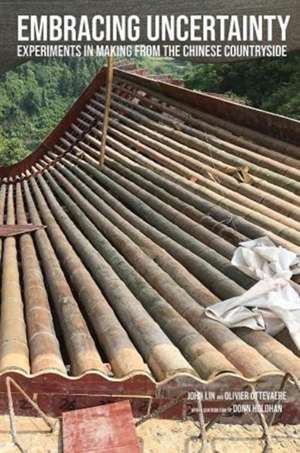
Uncertainty
Autor John Lin, Olivier Ottevaere, Donn Holohanen Limba Engleză Paperback – 14 iun 2022
Ne-a atras atenția modul în care Embracing Uncertainty: Experiments in Making from the Chinese Countryside refuză să prezinte arhitectura ca pe un produs finit, static, preferând în schimb să expună o narațiune vizuală a procesului brut. Lucrările sunt ordonate pentru a reflecta fluxul constant al peisajului rural chinezesc, un spațiu al contradicțiilor unde tradiția și modernitatea se ciocnesc violent. Remarcăm cum volumul documentează zece ani de proiecte desfășurate de Departamentul de Arhitectură al Universității din Hong Kong, transformând mediul rural într-un laborator de supraviețuire și inovație. Experiența de lectură este una tactilă și exploratorie. Apreciem calitatea documentării prin desen, o alegere strategică a autorilor John Lin, Olivier Ottevaere și Donn Holohan pentru a comunica cu meșteșugarii locali în absența unei limbi comune. Aceste desene nu sunt simple planșe tehnice, ci instrumente de negociere între viziunea arhitecturală și realitatea dură a terenului. De la reconstrucții urgente post-seism la structuri experimentale în sate depopulate, fiecare capitol dezvăluie o luptă cu topografiile extreme și resursele limitate. Complementar lui Towards Openness de Hu Li, care examinează peisajul chinez prin prisma unor proiecte de anvergură și manifeste teoretice, volumul de față adoptă o perspectivă mult mai viscerală și imprevizibilă. În timp ce alte lucrări caută standardizarea, Embracing Uncertainty valorizează lipsa de control și adaptabilitatea. Este o incursiune fascinantă în arhitectura care nu se teme de eșec, ci îl folosește pentru a descoperi noi geometrii și metode de construire în inima unei țări care se schimbă peste noapte.
Preț: 207.35 lei
Carte disponibilă
Livrare economică 16-30 noiembrie
Specificații
ISBN-10: 1954081189
Pagini: 216
Dimensiuni: 119 x 206 x 18 mm
Greutate: 0.48 kg
Editura: Oro Editions
V-ar putea interesa
-
 A Pattern Language: Towns, Buildings, ConstructionChristopher Alexander-8%Preț: 416.42 lei452.62 lei
 -
 -19%Preț: 194.93 lei242.05 lei
 -
 Radical PedagogiesBeatriz Colomina-15%Preț: 350.08 lei411.64 lei
 -
 Experiencing Architecture, second editionSteen Eiler Rasmussen-19%Preț: 265.22 lei325.62 lei
 -
 Spatial Agency: Other Ways of Doing ArchitectureNishat AwanPreț: 458.89 lei
 -
 Practising Wood in Architecture: Connecting Design, Construction and SustainabilityJames Benedict BrownPreț: 350.83 leiRecomandat
 -
 Preț: 398.30 lei
 -
 Preț: 380.41 lei
 -
 The Homegrown CityMatias EchanovePreț: 152.61 lei
 -
 Preț: 403.32 lei
 -
 Typological DriftShiqiao LiPreț: 202.94 lei
 -
 Becoming UrbanJoshua BolchoverPreț: 198.58 lei
 -
 Uffelen, C: China: The New Creative Power in ArchitectureChris van Uffelen-16%Preț: 271.17 lei323.47 lei
 -
 Meditations in Entropy: The Work of Kashef Chowdhury / URBANAKashef Chowdhury-11%Preț: 416.81 lei468.32 lei
 -
 Genuine ConstructionZhang PengjuPreț: 444.82 lei
 -
 Unfinished Atlas: 19 Projects by Manuel Herz ArchitectsLudovic Balland-11%Preț: 555.99 lei624.71 lei
 -
 Teaching Urbanism: Lucerne TalksHeike BiechtelerPreț: 349.86 lei
 -
 -18%Preț: 354.33 lei432.82 lei
De ce să citești această carte
Recomandăm această carte studenților și profesioniștilor din domeniul arhitecturii care doresc să înțeleagă cum se poate construi în afara normelor rigide. Veți câștiga o perspectivă unică asupra modului în care desenul poate înlocui limbajul verbal și cum limitările materiale pot genera soluții structurale inovatoare. Este o lecție de reziliență despre arhitectura realizată în condiții de incertitudine totală.
Despre autor
John Lin are o formare academică interdisciplinară, obținând masteratul în inginerie electrică și doctoratul în medicină la Universitatea din California, Los Angeles. Această bază științifică solidă este dublată de un interes constant pentru filosofie și neuroștiințe, domenii care îi influențează abordarea asupra modului în care structurile umane interacționează cu mediul. Deși activitatea sa în cadrul Universității din Hong Kong este profund ancorată în arhitectura experimentală, Lin aduce în acest volum rigoarea analitică a cercetătorului, explorând conștiința materială și culturală prin proiecte de design-build în zonele rurale chinezești.
Descriere
Working in rural China is unlike other countryside: it is full of contradiction, neither rural nor urban, both traditional and modern, abandoned in some areas and yet others are becoming cities overnight. It is in fact a laboratory for new ways of living. And it has become our laboratory for new ways of making architecture.
Whereas contemporary architecture since the advent of modernism has developed increasingly controlled, prototypical, and standardised mechanisms for building, our experiments embrace the opposite: a lack of control, taking place within the flux of political, social and economic uncertainties. The experiments presented here are examples taken from a series of design and build projects conducted from the Department of Architecture at the University of Hong Kong over the past 10 years. They are remarkable in their diffuse explorations and situations.
Some were urgent post-earthquake reconstructions, often adapting to extreme topographies or taking place in the midst of major urbanising transformations, whereas other experiments occurred in forgotten villages with left-behind craftspeople and their disappearing building cultures. These forays and what can be best described as adventures in building, left us with varied and novel (sometimes failed) experiments with structure and program. But they are presented here for the trait they have in common: an exploration of the limits of material, geometry, construction methods, and even historical context.
The diversity manifested in this collection of projects is a direct reflection of the incredible diversity of climates, locations, and conditions that underlie the ongoing Chinese urbanisation experiment. The focus here is not on the what but the how, as each project engages with its own set of limiting factors or unideal conditions. They are stories of design, overcoming and even embracing adverse situations in order to discover some hidden advantage.
Each chapter explores a different attempt to revert seemingly challenging limitations (particularly those which the architect cannot exert control over) and turn these into novel building approaches. As often occurs for architects working in a foreign landscape, the differences in language and culture have proven to be a source of constant miscommunication and surprising discovery. The lack of a common spoken language-these remote areas speak their own dialects-has placed an emphasis on drawing as another means of communication.
Through drawing we have explored a means of design and a means of building. Therefore, this is also a book about ways of drawing that represent ways of control and, inversely perhaps, what not to control.