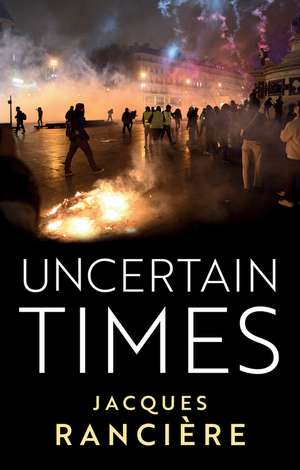
Uncertain Times
Autor Jacques Rancière Traducere de Andrew Brownen Limba Engleză Hardback – 29 apr 2024
În Uncertain Times, Jacques Rancière propune o examinare critică a peisajului politic contemporan, demontând iluzia păcii promise de consensul democratic de acum trei decenii. Ne-a atras atenția modul în care autorul recalibrează discuția despre democrație, nu ca un sistem de guvernare stabil, ci ca o ruptură activă în ordinea stabilită a capitalismului globalizat. Ediția de față, tradusă de Andrew Brown, reunește eseuri și intervenții care adresează direct crizele recente, de la asediul Capitolului până la gestionarea pandemică a inegalității. Structura volumului este împărțită în două secțiuni fundamentale: „Violența consensului” și „Momente de democrație”. În prima parte, Rancière analizează mecanismele prin care consensul maschează noi forme de război social și rasism instituționalizat. Capitolele dedicate sfârșitului erei Trump și perioadei de lockdown oferă o perspectivă proaspătă asupra modului în care excepția devine regulă. Partea a doua se concentrează pe potențialul emancipator al mișcărilor sociale, precum Gilets Jaunes sau Nuit Debout, pe care autorul le vede ca invenții egalitare necesare. Cititorii familiarizați cu Disorienting Democracy de Clare Woodford vor aprecia modul în care Uncertain Times duce mai departe critica tendințelor de dominare din interiorul stângii intelectuale. În timp ce Woodford se concentrează pe politici redistributive, Rancière pune accentul pe „puterea adunării celor egali” și pe capacitatea acestora de a crea noi lumi. Considerăm că această lucrare este esențială pentru înțelegerea modului în care mișcările de protest contemporane reușesc să deschidă breșe într-un sistem care pare, altfel, impenetrabil. Este o analiză densă, dar necesară, a tensiunii dintre ordinea polițienească a statului și impulsul democratic radical.
Preț: 433.57 lei
Carte disponibilă
Livrare economică 08-22 august
Specificații
ISBN-10: 1509558675
Pagini: 154
Dimensiuni: 141 x 223 x 19 mm
Greutate: 0.33 kg
Editura: Polity Press
Locul publicării:Chichester, United Kingdom
De ce să citești această carte
Uncertain Times este o lectură fundamentală pentru cei care doresc să înțeleagă rădăcinile politice ale instabilității actuale. Jacques Rancière oferă instrumentele teoretice pentru a descifra fenomene complexe precum populismul modern și noul rasism, dincolo de retorica mass-media. Cititorul câștigă o perspectivă unică asupra modului în care egalitatea poate fi practicată ca formă de rezistență, transformând incertitudinea prezentului într-un spațiu al posibilităților democratice.
Despre autor
Jacques Rancière este unul dintre cei mai influenți filosofi francezi contemporani, profesor emerit la Universitatea Paris VIII (Vincennes-Saint-Denis). Opera sa traversează granițele dintre filosofia politică, estetică și educație, fiind cunoscut pentru redefinirea conceptului de democrație și pentru critica riguroasă a ierarhiilor intelectuale. De la implicarea sa în evenimentele din mai 1968, Rancière a rămas o voce critică la adresa consensului neoliberal, explorând constant capacitatea de emancipare a subiectului politic și estetica politicii în lucrări de referință traduse la nivel global.
Notă biografică
Cuprins
Descriere
The global triumph of democracy was announced thirty years ago, promising an age of consensus in which the dispassionate consideration of objective problems would give birth to a world at peace. Today, these grand hopes lie in ruins, and the era touted as new has turned out to be remarkably similar to the old order. To understand why this might be so, we need to examine the nature of the consensus itself, which is not the peace that it promised but rather the map of a territory on which new forms of warfare are being waged. The objective reality that imposed itself at the end of the 1990s was an absolutized and globalized capitalism which has produced ever more inequality, exclusion and hate. In this book Jacques Rancière delivers a frank and piercing critique of the globalized capitalist consensus. The invasion of Iraq, the riots on Capitol Hill and the rise of the European far right all attest to the true nature of this consensus, as does the current state-sanctioned racism which exploits the disenchanted progressive tradition and is led by an intelligentsia that claims to be left-wing. At the same time, Rancière praises the dynamism of social movements which affirm the power of the assembly of equals and its capacity for worldmaking: autonomous protest collectives have proven themselves capable of opening breaches in the consensual order and challenging the post-1989 system of domination.