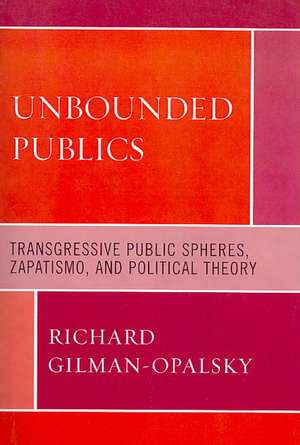
Unbounded Publics: Transgressive Public Spheres, Zapatismo, and Political Theory
Autor Richard Gilman-Opalskyen Limba Engleză Paperback – 20 mai 2008
Preț: 371.84 lei
Preț vechi: 486.20 lei
-24%
Puncte Express: 558
Carte tipărită la comandă
Livrare economică 21 noiembrie-05 decembrie
Livrare prin curier în România Termenul estimat este afișat lângă disponibilitate.
Transport gratuit de la 400.00 lei Plată online sau ramburs, în funcție de opțiunile comenzii.
Retur gratuit în 14 zile Comandă securizată și suport în română.
Specificații
ISBN-13: 9780739124796
ISBN-10: 073912479X
Pagini: 362
Dimensiuni: 152 x 229 x 28 mm
Greutate: 0.61 kg
Editura: Bloomsbury Publishing
Colecția Lexington Books
Locul publicării:New York, United States
ISBN-10: 073912479X
Pagini: 362
Dimensiuni: 152 x 229 x 28 mm
Greutate: 0.61 kg
Editura: Bloomsbury Publishing
Colecția Lexington Books
Locul publicării:New York, United States
Cuprins
Chapter 1 Acknowledgements
Chapter 2 Table of Contents
Chapter 3 General Introduction
Part 4 I Public Spheres and the National Framework
Chapter 5 Introduction to Part I
Chapter 6 1 Basic Concepts and Terms: Political Public Spheres and Communicative Power
Chapter 7 2 A Prefigured National Framework: Legitimation and the Public Sphere
Chapter 8 3 Habermas's Classical Theory in Light of Nonbourgeois Pubilc Spheres
Part 9 II Public Sphere and the Transnational Framework
Chapter 10 Introduction to Part II
Chapter 11 4 "Globalization": A New Topography for the Public Sphere?
Chapter 12 5 Transnational Cosmopolitan Public Spheres a Turn Against the National Framework
Chapter 13 6 Beyond the National/Transnational Dichotomy: Moving Toward a Theory of Transgressive Public Spheres
Part 14 III Transgressive Public Spheres
Chapter 15 Introduction to Part III
Chapter 16 7 A Different Kind of Public Sphere: The Zapatistas' Transgressive Public Sphere
Chapter 17 8 Indigenous Identity and the Recasting of Subject Positions
Chapter 18 9 The Case for Transgressive Public Spheres
Chapter 19 Conclusion
Chapter 20 Bibliography
Chapter 2 Table of Contents
Chapter 3 General Introduction
Part 4 I Public Spheres and the National Framework
Chapter 5 Introduction to Part I
Chapter 6 1 Basic Concepts and Terms: Political Public Spheres and Communicative Power
Chapter 7 2 A Prefigured National Framework: Legitimation and the Public Sphere
Chapter 8 3 Habermas's Classical Theory in Light of Nonbourgeois Pubilc Spheres
Part 9 II Public Sphere and the Transnational Framework
Chapter 10 Introduction to Part II
Chapter 11 4 "Globalization": A New Topography for the Public Sphere?
Chapter 12 5 Transnational Cosmopolitan Public Spheres a Turn Against the National Framework
Chapter 13 6 Beyond the National/Transnational Dichotomy: Moving Toward a Theory of Transgressive Public Spheres
Part 14 III Transgressive Public Spheres
Chapter 15 Introduction to Part III
Chapter 16 7 A Different Kind of Public Sphere: The Zapatistas' Transgressive Public Sphere
Chapter 17 8 Indigenous Identity and the Recasting of Subject Positions
Chapter 18 9 The Case for Transgressive Public Spheres
Chapter 19 Conclusion
Chapter 20 Bibliography
Recenzii
This important and timely study rethinks public sphere theory in the 20th century. Gilman-Opalsky provides a thoughtful examination of Habermas, Arendt, and Mills. Furthermore, the author astutely problematizes the prefigured national framework and brings back into focus the unique agency of nonbourgeois public spheres. Highly recommended.
This is an excellent piece of research, and, to my mind, an interesting, normative political proposal as well. Gilman-Opalsky has a solid understanding of his sources, is fair in his criticisms, and has an original approach in trying to go beyond them. He brings together contemporary political concerns and theory in quite a convincing way. I am personally quite persuaded by his attempt to overcome the sway of more abstract varieties of currently fashionable cosmopolitanism, the negative results of which have for example contributed to the present near catastrophic situation of the world (via liberal imperialism).
This is an excellent piece of research, and, to my mind, an interesting, normative political proposal as well. Gilman-Opalsky has a solid understanding of his sources, is fair in his criticisms, and has an original approach in trying to go beyond them. He brings together contemporary political concerns and theory in quite a convincing way. I am personally quite persuaded by his attempt to overcome the sway of more abstract varieties of currently fashionable cosmopolitanism, the negative results of which have for example contributed to the present near catastrophic situation of the world (via liberal imperialism).