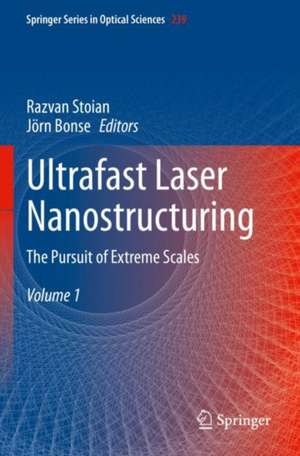
Ultrafast Laser Nanostructuring: Springer Series in Optical Sciences, cartea 239
Editat de Razvan Stoian, Jörn Bonseen Limba Engleză Paperback – 8 apr 2024
Remarcăm în Ultrafast Laser Nanostructuring o abordare riguroasă a dinamicii femtosecundelor, începând cu studiile de caz privind interacțiunea lumină-materie și modelarea proceselor cuantice la scară nanometrică. Volumul debutează cu o analiză a mecanismelor de localizare a energiei, oferind cititorului o perspectivă atomistă asupra ablației laser și a fenomenelor de auto-organizare care permit depășirea limitelor optice convenționale. Această ediție din 2023, apărută sub egida Springer, documentează metodele de observație directă in-situ, esențiale pentru înțelegerea modului în care impulsurile ultra-scurte pot sculpta materiale la rezoluții de sub 100 nm.
Structura este segmentată logic în trei părți: Fundamente, Concepte și Aplicații. Primele capitole ghidează cercetătorul prin complexitatea structurilor periodice induse de laser (LIPSS), în timp ce secțiunile ulterioare fac tranziția spre execuția practică în ingineria materialelor. Comparabil cu Ultrafast Laser Processing de Koji Sugioka în rigoarea teoretică, prezentul volum este actualizat pentru noile progrese în nanostructurarea 3D și funcționalizarea suprafețelor prin tehnici de extremă precizie. Față de Progress in Nonlinear Nano-Optics, lucrarea coordonată de Razvan Stoian și Jörn Bonse extinde spectrul de analiză către aplicații industriale și instrumente de procesare flexibile, fiind una dintre cele mai cuprinzătoare resurse disponibile în prezent, cu peste 1300 de pagini de expertiză tehnică.
Din seria Springer Series in Optical Sciences
- 18%
 Preț: 1436.66 lei
 - 18%
 Preț: 1174.91 lei
 - 18%
 Preț: 958.26 lei
 - 15%
 Preț: 670.11 lei
 - 18%
 Preț: 1846.34 lei
 -
 Preț: 364.80 lei
 - 18%
 Preț: 1392.57 lei
 - 18%
 Preț: 1610.77 lei
 - 18%
 Preț: 2102.31 lei
 - 18%
 Preț: 1233.64 lei
 - 18%
 Preț: 910.28 lei
 -
 Preț: 395.45 lei
 - 18%
 Preț: 1002.62 lei
 - 18%
 Preț: 1497.80 lei
 - 18%
 Preț: 1064.77 lei
 - 15%
 Preț: 657.02 lei
 -
 Preț: 413.61 lei
 - 18%
 Preț: 915.58 lei
 - 15%
 Preț: 616.28 lei
 - 15%
 Preț: 609.78 lei
 - 18%
 Preț: 1846.51 lei
 - 18%
 Preț: 1276.23 lei
 -
 Preț: 368.82 lei
 - 15%
 Preț: 640.28 lei
 - 18%
 Preț: 957.81 lei
 - 18%
 Preț: 919.83 lei
 - 18%
 Preț: 1387.68 lei
 - 18%
 Preț: 952.71 lei
 - 18%
 Preț: 1114.16 lei
 - 18%
 Preț: 952.86 lei
 - 18%
 Preț: 2108.76 lei
 - 18%
 Preț: 964.48 lei
Preț: 830.84 lei
Preț vechi: 1038.55 lei
-20%
Carte disponibilă
Livrare economică 28 octombrie-11 noiembrie
Livrare express 13-17 octombrie pentru 89.85 lei
Specificații
ISBN-10: 3031147545
Pagini: 1316
Ilustrații: XXI, 1245 p. 586 illus., 465 illus. in color. In 3 volumes, not available separately.
Dimensiuni: 155 x 235 x 71 mm
Greutate: 1.98 kg
Ediția:2023
Editura: Springer
Colecția Springer Series in Optical Sciences
Seria Springer Series in Optical Sciences
Locul publicării:Cham, Switzerland
V-ar putea interesa
-
 -20%Preț: 400.58 lei502.69 lei
 -
 Introduction to NanophotonicsHenri Benisty-8%Preț: 372.17 lei406.14 lei
 -
 Quantum & Nano Technologies for PhotovoltaicsLoucas Tsakalakos-9%Preț: 659.31 lei724.51 lei
 -
 -19%Preț: 523.59 lei646.41 lei
 -
 Advances in Laser & Optics Research: Volume 2William T Arkin-26%Preț: 676.87 lei917.40 lei
 -
 New Topics in Lasers & Electro-OpticsWilliam T Arkin-27%Preț: 1443.72 lei1966.45 lei
 -
 -26%Preț: 1644.01 lei2234.36 lei
 -
 Advances in Laser and Optics Research: Volume 5William T Arkin-26%Preț: 731.59 lei992.94 lei
 -
 -24%Preț: 888.10 lei1168.55 lei
 -
 Handbook of Laser Micro- and Nano-EngineeringKoji Sugioka-18%Preț: 8528.49 lei10400.59 lei
 -
 Progress in Ultrafast Intense Laser Science XVIIKaoru Yamanouchi-18%Preț: 734.15 lei895.30 lei
 -
 Preț: 400.04 lei
 -
 Principles of Nanoscience and Molecular EngineeringRené M. Overney-23%Preț: 698.46 lei907.09 lei
 -
 Preț: 373.40 lei
 -
 Advanced Materials and ManufacturingJitendra Kumar Katiyar-18%Preț: 1402.65 lei1710.55 lei
 -
 Ultrafast Electronic and Structural DynamicsKiyoshi Ueda-18%Preț: 1162.78 lei1418.03 lei
 -
 Advances in Photonics Integrated Circuits, LASER and ApplicationsVarun Raghunathan-18%Preț: 1332.09 lei1624.50 lei
 -
 -24%Preț: 1007.11 lei1325.15 lei
De ce să citești această carte
Recomandăm această lucrare cercetătorilor și studenților la doctorat care au nevoie de un fundament teoretic solid și de date experimentale recente despre procesarea materialelor cu laseri ultra-rapizi. Cititorul câștigă o înțelegere profundă a mecanismelor de nanostructurare sub limita de difracție, esențială pentru dezvoltarea viitoarei generații de dispozitive fotonice și senzori de înaltă precizie.
Despre autor
Editorii acestui volum sunt figuri proeminente în comunitatea științifică internațională. Razvan Stoian este un expert recunoscut în domeniul interacțiunii laser-materie ultra-rapide, contribuind semnificativ la dezvoltarea tehnicilor de procesare a materialelor dielectrice și metalice. Jörn Bonse este un cercetător de prestigiu, cu o activitate extinsă în studiul structurilor periodice de suprafață induse de laser. Împreună, aceștia au coordonat în cadrul Springer Series in Optical Sciences o lucrare de referință care sintetizează decenii de cercetare în optică și nanotehnologie.