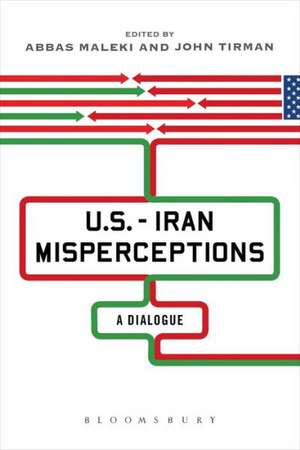
U.S.-Iran Misperceptions: A Dialogue
Editat de Abbas Maleki, John Tirmanen Limba Engleză Paperback – 9 apr 2014
Preț: 280.13 lei
Puncte Express: 420
Carte tipărită la comandă
Livrare economică 07-21 decembrie
Livrare prin curier în România Termenul estimat este afișat lângă disponibilitate.
Transport gratuit de la 400.00 lei Plată online sau ramburs, în funcție de opțiunile comenzii.
Retur gratuit în 14 zile Comandă securizată și suport în română.
Specificații
ISBN-13: 9781623569365
ISBN-10: 1623569362
Pagini: 176
Dimensiuni: 152 x 229 x 15 mm
Greutate: 0.27 kg
Editura: Bloomsbury Publishing
Colecția Bloomsbury Academic
Locul publicării:New York, United States
ISBN-10: 1623569362
Pagini: 176
Dimensiuni: 152 x 229 x 15 mm
Greutate: 0.27 kg
Editura: Bloomsbury Publishing
Colecția Bloomsbury Academic
Locul publicării:New York, United States
V-ar putea interesa
-
 -11%Preț: 292.49 lei328.46 lei
 -
 Broken VowsTom BowerPreț: 109.34 lei
 -
 United States of JihadPeter BergenPreț: 124.24 lei
 -
 Free RadicalTony Benn-41%Preț: 142.47 lei243.02 lei
 -
 Contested Knowledge - Social Theory Today 6eSteven SeidmanPreț: 466.12 lei
 -
 -24%Preț: 186.22 lei244.64 lei
 -
 FoucaultStuart EldenPreț: 168.41 lei
 -
 -27%Preț: 944.61 lei1286.77 lei
 -
 Thomas Piketty's Capital in the Twenty-First CenturyStephan KaufmannPreț: 106.34 lei
Caracteristici
Simultaneous
publication
in
Farsi
by
Iranian
publisher
for
global
conversation
inside
the
academy
and
out
Notă biografică
Abbas
Maleki,
former
deputy
foreign
minister
of
Iran,
teaches
at
Sharif
University,
Iran.John
Tirmanis
executive
director
of
the
MIT
Center
for
International
Studies,
US.
Cuprins
AcknowledgementsList
of
Contributors1.
U.S.-Iran
Misperceptions:
Invitation
to
a
Dialogue,by
Abbas
Maleki
and
John
Tirman2.
The
United
States
and
Iran:
Perceptions
and
Policy
Traps,by
Robert
Jervis3.
Iranian
Perceptions
of
U.S.
Policy
towards
Iran:
Ayatollah
Khamenei's
Mindset,by
Seyed
Hossein
Mousavian4.
American
Perceptions
of
Iran's
Policy
towards
the
United
States5.
Iran's
Perception
of
the
U.S.
Policy
towards
the
Region,byKayhan
Barzegar6.
America's
Perceptions
of
Iran's
Policy
towards
the
Region,byJohn
Tirman7.
The
Future
of
U.S.-Iran
Relations,by
Huss
Banai8.
Improving
U.S.-Iranian
Relations
and
Overcoming
Perceptual
Biases,by
Abbas
Maleki
and
Robert
ReardonBibliographyIndex
Recenzii
An
incisive
and
masterful
analysis
of
one
of
our
era's
most
enigmatic
international
conflicts.
A
must
read
for
anyone
following
US-Iran
relations.
Written by several policy experts from the US and Iran, this book is a must read by anyone seeking to grasp the inventory of the past and present issues between the two countries . . . The book offers a deeper understanding of the problematic US-Iran relations and the steps necessary to achieve a breakthrough.
At a time when relations between the U.S. and Iran are at a pivot point that could lead to tangible improvement or deepening confrontation,U.S.-Iran Misperceptionsprovides crucial context. Understanding these misperceptions--as detailed by some of the most astute observers of the U.S. and Iran--could help the two countries stop reopening old wounds and find areas of common ground beneficial to their peoples and the wider world.
This is a timely and interesting book. Relations between Iran and the US are undergoing fundamental change, and the essays in this volume perceptively analyze the mutual missteps of the past and prospects for the future."
The editors of this book . . . have convened a number of leading experts from Iran and the United States in order to take a fresh look at relations between Tehran and Washington
Written by several policy experts from the US and Iran, this book is a must read by anyone seeking to grasp the inventory of the past and present issues between the two countries . . . The book offers a deeper understanding of the problematic US-Iran relations and the steps necessary to achieve a breakthrough.
At a time when relations between the U.S. and Iran are at a pivot point that could lead to tangible improvement or deepening confrontation,U.S.-Iran Misperceptionsprovides crucial context. Understanding these misperceptions--as detailed by some of the most astute observers of the U.S. and Iran--could help the two countries stop reopening old wounds and find areas of common ground beneficial to their peoples and the wider world.
This is a timely and interesting book. Relations between Iran and the US are undergoing fundamental change, and the essays in this volume perceptively analyze the mutual missteps of the past and prospects for the future."
The editors of this book . . . have convened a number of leading experts from Iran and the United States in order to take a fresh look at relations between Tehran and Washington
Descriere
Descriere de la o altă ediție sau format:
Can Iranians and Americans find common ground to overcome their troubled history? U.S.-Iran Misperceptions is the first written dialogue on the key issues that separate these two great countries. Bringing together former policy makers and international relations experts from the United States and Iran, U.S.-Iran Misperceptions: A Dialogue provides new insights into and arguments about how each country's elites view the other, and how misperceptions have blocked the two from forging a normal and productive relationship. Guided by the leading theorist of misperceptions in international relations, Columbia University Professor Robert Jervis, the book moves from Jervis's opening essay to consider mutual perceptions of ideology, nuclear weapons, neo-imperialism, regional hegemony, and the future of the relationship. It presents authoritative, clear-eyed assessments, while seeking plausible ways the two countries can avoid a catastrophic war and rebuild the relationship. U.S.-Iran Misperceptions: A Dialogue offers uncompromising analysis and cautious optimism.
Can Iranians and Americans find common ground to overcome their troubled history? U.S.-Iran Misperceptions is the first written dialogue on the key issues that separate these two great countries. Bringing together former policy makers and international relations experts from the United States and Iran, U.S.-Iran Misperceptions: A Dialogue provides new insights into and arguments about how each country's elites view the other, and how misperceptions have blocked the two from forging a normal and productive relationship. Guided by the leading theorist of misperceptions in international relations, Columbia University Professor Robert Jervis, the book moves from Jervis's opening essay to consider mutual perceptions of ideology, nuclear weapons, neo-imperialism, regional hegemony, and the future of the relationship. It presents authoritative, clear-eyed assessments, while seeking plausible ways the two countries can avoid a catastrophic war and rebuild the relationship. U.S.-Iran Misperceptions: A Dialogue offers uncompromising analysis and cautious optimism.