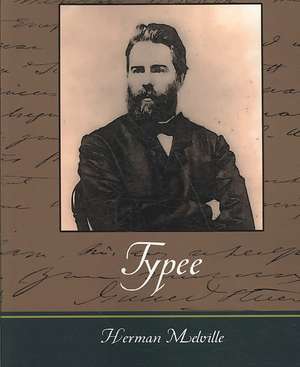
Typee
Autor Herman Melvilleen Limba Engleză Paperback – 17 apr 2008
Preț: 193.18 lei
Puncte Express: 290
Carte disponibilă
Livrare economică 05-19 noiembrie
Livrare prin curier în România Termenul estimat este afișat lângă disponibilitate.
Transport gratuit de la 400.00 lei Plată online sau ramburs, în funcție de opțiunile comenzii.
Retur gratuit în 14 zile Comandă securizată și suport în română.
Specificații
ISBN-13: 9781605975238
ISBN-10: 1605975230
Pagini: 296
Dimensiuni: 191 x 235 x 16 mm
Greutate: 0.51 kg
Editura: Book Jungle
ISBN-10: 1605975230
Pagini: 296
Dimensiuni: 191 x 235 x 16 mm
Greutate: 0.51 kg
Editura: Book Jungle
V-ar putea interesa
-
 Robinson CrusoeDaniel DefoePreț: 28.01 lei
 -
 The Happy Isles of OceaniaPaul TherouxPreț: 136.04 lei
 -
 Herman Melville: A Very Short IntroductionMaurice S. Lee-20%Preț: 56.93 lei70.98 lei
 -
 South Sea TalesRobert Louis Stevenson-18%Preț: 59.19 lei72.33 lei
 -
 Storyteller: The Life of Robert Louis StevensonLeo DamroschPreț: 222.91 lei
 -
 Life On The MississippiMark TwainPreț: 41.91 lei
 -
 Heart of DarknessJoseph Conrad-19%Preț: 23.12 lei28.58 lei
 -
 Through the Brazilian WildernessTheodore RooseveltPreț: 54.02 lei
 -
 The Pilgrim's ProgressJohn BunyanPreț: 46.43 lei
 -
 The Log of a CowboyAndy AdamsPreț: 51.02 lei
 -
 -26%Preț: 67.83 lei92.14 lei
 -
 My First Summer in the SierraJohn MuirPreț: 40.15 lei
 -
 The Call of the WildJack LondonPreț: 34.41 lei
 -
 MelanesiaHamish McdonaldPreț: 179.70 lei
 -
 -12%Preț: 113.70 lei128.69 lei
 -
 The Time MachineH. G. WellsPreț: 33.23 lei
 -
 UtopiaThomas MorePreț: 33.19 lei
 -
 Omoo Adventures In The South Seas Part IIHerman MelvillePreț: 91.03 lei
 -
 My First Voyage to Southern SeasW. H. G. KingstonPreț: 127.52 lei
Textul de pe ultima copertă
Typee (1846) is the first 'romance' of the semi-autobiographical account of life in the Marquesas Islands in the 1840s. A blend of personal experience and the narratives of explorers and missionaries, it influenced many later writers on the Paciflc, including Robert Louis Stevenson and Jack London. Melville himself deserted from a whaling ship in the islands and lived for four weeks among the inhabitants, observing and recording their way of life. Typee points up the wonders, the dilemmas, the 'fatal impact' of European encounter with the peoples of the Pacific. This edition offers an introduction that considers the book from a post-colonial perspective, and detailed annotation of Melville's allusions.
Notă biografică
Herman Melville (August 1, 1819 - September 28, 1891) was an American novelist, short story writer, and poet of the American Renaissance period. His best known works include Typee (1846), a romantic account of his experiences in Polynesian life, and his whaling novel Moby-Dick (1851). His writing draws on his experience at sea as a common sailor, exploration of literature and philosophy, and engagement in the contradictions of American society in a period of rapid change. He developed a complex, baroque style; the vocabulary is rich and original, a strong sense of rhythm infuses the elaborate sentences, the imagery is often mystical or ironic, and the abundance of allusion extends to biblical scripture, myth, philosophy, literature, and the visual arts. Melville was born in New York City, the third child of a merchant in French dry goods and his wife. His formal education ended abruptly after his father died in 1832, as this left the family in financial straits. He briefly became a schoolteacher before he took to sea in 1839 as a sailor on a merchant ship. In 1840, he signed aboard the whaler Acushnet for his first whaling voyage but jumped ship in the Marquesas Islands. He returned to Boston in 1844 after further adventures. In August 1850, Melville moved his growing family to Arrowhead, a farm in Pittsfield, Massachusetts, where he established a profound but short-lived friendship with Nathaniel Hawthorne, to whom he dedicated Moby-Dick.