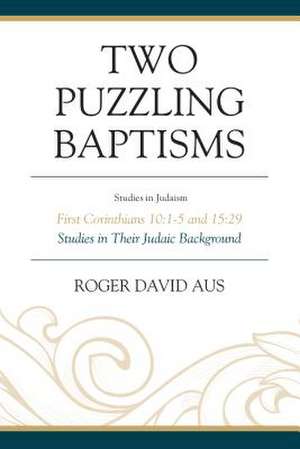
Two Puzzling Baptisms: First Corinthians 10:1-5 and 15:29: Studies in Judaism
Autor Roger David Ausen Limba Engleză Paperback – 28 iul 2017
Din seria Studies in Judaism
- 28%
 Preț: 252.66 lei
 - 31%
 Preț: 364.58 lei
 - 26%
 Preț: 289.78 lei
 - 33%
 Preț: 390.28 lei
 - 32%
 Preț: 523.41 lei
 - 30%
 Preț: 470.16 lei
 - 28%
 Preț: 381.71 lei
 - 28%
 Preț: 250.80 lei
 - 32%
 Preț: 362.83 lei
 - 27%
 Preț: 276.77 lei
 - 23%
 Preț: 319.08 lei
 - 32%
 Preț: 458.91 lei
 - 33%
 Preț: 390.56 lei
 - 25%
 Preț: 303.77 lei
 - 28%
 Preț: 251.97 lei
 - 32%
 Preț: 458.75 lei
 - 28%
 Preț: 273.99 lei
 - 33%
 Preț: 659.28 lei
 - 32%
 Preț: 521.56 lei
 - 27%
 Preț: 284.50 lei
 - 34%
 Preț: 378.94 lei
 - 36%
 Preț: 372.03 lei
 - 33%
 Preț: 386.29 lei
 - 33%
 Preț: 484.68 lei
 - 24%
 Preț: 310.82 lei
 - 27%
 Preț: 273.87 lei
 - 34%
 Preț: 348.33 lei
 - 36%
 Preț: 342.40 lei
 - 26%
 Preț: 356.64 lei
 - 35%
 Preț: 588.93 lei
 - 33%
 Preț: 356.09 lei
 - 26%
 Preț: 301.43 lei
 - 26%
 Preț: 302.65 lei
 - 35%
 Preț: 436.53 lei
 - 24%
 Preț: 319.22 lei
 - 24%
 Preț: 367.73 lei
 - 36%
 Preț: 371.85 lei
 - 31%
 Preț: 430.77 lei
 - 25%
 Preț: 365.52 lei
 - 34%
 Preț: 569.77 lei
 - 35%
 Preț: 409.28 lei
Preț: 219.85 lei
Preț vechi: 306.45 lei
-28%
Puncte Express: 330
Carte tipărită la comandă
Livrare economică 25 noiembrie-09 decembrie
Livrare prin curier în România Termenul estimat este afișat lângă disponibilitate.
Transport gratuit de la 400.00 lei Plată online sau ramburs, în funcție de opțiunile comenzii.
Retur gratuit în 14 zile Comandă securizată și suport în română.
Specificații
ISBN-13: 9780761869399
ISBN-10: 0761869395
Pagini: 168
Dimensiuni: 149 x 232 x 14 mm
Greutate: 0.3 kg
Editura: Bloomsbury Publishing
Colecția Hamilton Books
Seria Studies in Judaism
Locul publicării:New York, United States
ISBN-10: 0761869395
Pagini: 168
Dimensiuni: 149 x 232 x 14 mm
Greutate: 0.3 kg
Editura: Bloomsbury Publishing
Colecția Hamilton Books
Seria Studies in Judaism
Locul publicării:New York, United States
Descriere
How could the Apostle Paul maintain in his first letter to the Christians in Corinth that all their ancestors were baptized into Moses at the Red Sea / exodus event (10:2), and how could he tolerate some of them having themselves baptized again on behalf of the dead (15:29)? Answers to these puzzling questions can be found in early Jewish sources now located both in Greek and Hebrew, all here translated.
Cuprins
I. 1 Corinthians 10:1-5 and Judaic Tradition on Ezekiel 16
II. Paul's Toleration in Corinth of Baptism on Behalf of the Dead (1 Cor 15:29),
and Intercession for the Dead in Early Judaism
Sources and Reference Works
Index of Sources Cited
About the Author
II. Paul's Toleration in Corinth of Baptism on Behalf of the Dead (1 Cor 15:29),
and Intercession for the Dead in Early Judaism
Sources and Reference Works
Index of Sources Cited
About the Author
Recenzii
Roger Aus's meticulous, carefully executed analysis of Jewish comparanda sheds new light on two perennially puzzling Pauline passages. This richly rewarding study especially exemplifies how an informed, first-hand understanding of Rabbinic sources can illuminate New Testament exegesis.
This careful study by Roger Aus examines 1 Cor 10:1-5 and 15:29 on the basis of Israelite and early Jewish analogies. A broad spectrum of texts is investigated: prophetic and sapiential writings, Philo and Josephus, as well as rabbinic sources. New light from these texts is cast upon various aspects of Paul's peculiar statements regarding baptism, including the genre of 1 Cor 10:1-5. Roger Aus is one of the few scholars capable of making Israelite and early Jewish literature in such breadth fruitful for the interpretation of early Christian texts. In view of studies like this, appeal to, or rejection of, the commentary of (Strack-) Billerbeck will simply no longer suffice.
This careful study by Roger Aus examines 1 Cor 10:1-5 and 15:29 on the basis of Israelite and early Jewish analogies. A broad spectrum of texts is investigated: prophetic and sapiential writings, Philo and Josephus, as well as rabbinic sources. New light from these texts is cast upon various aspects of Paul's peculiar statements regarding baptism, including the genre of 1 Cor 10:1-5. Roger Aus is one of the few scholars capable of making Israelite and early Jewish literature in such breadth fruitful for the interpretation of early Christian texts. In view of studies like this, appeal to, or rejection of, the commentary of (Strack-) Billerbeck will simply no longer suffice.