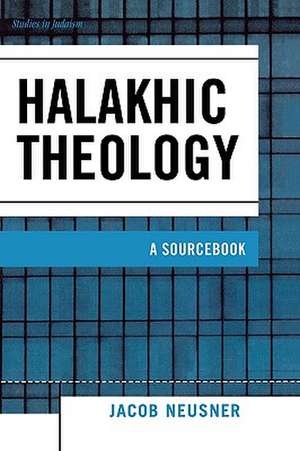
Halakhic Theology: A Sourcebook: Studies in Judaism
Autor Rabbi Jacob Neusneren Limba Engleză Paperback – dec 2005
Din seria Studies in Judaism
- 28%
 Preț: 252.66 lei
 - 31%
 Preț: 364.58 lei
 - 26%
 Preț: 289.78 lei
 - 33%
 Preț: 390.28 lei
 - 32%
 Preț: 523.41 lei
 - 30%
 Preț: 470.16 lei
 - 28%
 Preț: 381.71 lei
 - 28%
 Preț: 250.80 lei
 - 32%
 Preț: 362.83 lei
 - 27%
 Preț: 276.77 lei
 - 23%
 Preț: 319.08 lei
 - 32%
 Preț: 458.91 lei
 - 25%
 Preț: 303.77 lei
 - 28%
 Preț: 251.97 lei
 - 32%
 Preț: 458.75 lei
 - 28%
 Preț: 273.99 lei
 - 33%
 Preț: 659.64 lei
 - 32%
 Preț: 521.56 lei
 - 27%
 Preț: 284.50 lei
 - 34%
 Preț: 378.94 lei
 - 36%
 Preț: 372.03 lei
 - 33%
 Preț: 386.29 lei
 - 33%
 Preț: 484.68 lei
 - 24%
 Preț: 310.82 lei
 - 27%
 Preț: 273.87 lei
 - 34%
 Preț: 348.33 lei
 - 36%
 Preț: 342.40 lei
 - 26%
 Preț: 356.64 lei
 - 35%
 Preț: 588.93 lei
 - 33%
 Preț: 356.09 lei
 - 26%
 Preț: 301.43 lei
 - 26%
 Preț: 302.65 lei
 - 35%
 Preț: 436.53 lei
 - 24%
 Preț: 319.22 lei
 - 24%
 Preț: 367.73 lei
 - 36%
 Preț: 371.85 lei
 - 31%
 Preț: 430.77 lei
 - 25%
 Preț: 365.52 lei
 - 34%
 Preț: 569.77 lei
 - 35%
 Preț: 409.28 lei
Preț: 390.56 lei
Preț vechi: 580.63 lei
-33%
Puncte Express: 586
Carte tipărită la comandă
Livrare economică 08-22 decembrie
Livrare prin curier în România Termenul estimat este afișat lângă disponibilitate.
Transport gratuit de la 400.00 lei Plată online sau ramburs, în funcție de opțiunile comenzii.
Retur gratuit în 14 zile Comandă securizată și suport în română.
Specificații
ISBN-13: 9780761833840
ISBN-10: 0761833846
Pagini: 296
Dimensiuni: 152 x 226 x 22 mm
Greutate: 0.5 kg
Editura: Bloomsbury Publishing
Colecția University Press of America
Seria Studies in Judaism
Locul publicării:New York, United States
ISBN-10: 0761833846
Pagini: 296
Dimensiuni: 152 x 226 x 22 mm
Greutate: 0.5 kg
Editura: Bloomsbury Publishing
Colecția University Press of America
Seria Studies in Judaism
Locul publicării:New York, United States
V-ar putea interesa
-
 The KoranN J Dawood-23%Preț: 61.68 lei80.39 lei
 -
 The RamayanaR. K. Narayan-19%Preț: 63.70 lei78.35 lei
 -
 -20%Preț: 148.87 lei185.54 lei
 -
 The Bhagavad GitaW. J. JohnsonPreț: 48.29 lei
 -
 UpanisadsPatrick OlivellePreț: 65.35 lei
 -
 The Lotus SutraBurton Watson-23%Preț: 651.78 lei846.46 lei
 -
 Preț: 93.87 lei
 -
 Nine and a Half Mystics: The Kabbala TodayHerbert WeinerPreț: 156.75 lei
 -
 The Dead Sea Scrolls and the Origins of the BibleEugene C. UlrichPreț: 212.35 lei
 -
 The Middle Length Discourses of the BuddhaBodhi Bhikkhu-18%Preț: 479.56 lei581.81 lei
 -
 God Talks with ArjunaParamahansa YoganandaPreț: 209.92 lei
 -
 Preț: 90.68 lei
 -
 The Mosaic of IslamSuleiman MouradPreț: 120.52 lei
 -
 The DhammapadaThomas Byron-21%Preț: 71.46 lei90.98 lei
 -
 Kundalini TantraSwami Satyananda SaraswatiPreț: 208.30 lei
Cuprins
1 Preface
2 Introduction
Part 3 1: God, Creation, and the Land. The Sabbath [1] Shebi't
Part 4 2: God, Creation, and Humanity. The Sabbath [2] Shabbat-Erubin
Part 5 3: Israel and Adam: 'Orlah
Part 6 4: Israel and the Nations: 'Abodah Zarah
Part 7 5: Torah and Theology of History: Ta'anit
Part 8 6: Between Death and Resurrection: Sukkah
Part 9 7: Divine Justice: Sotah
2 Introduction
Part 3 1: God, Creation, and the Land. The Sabbath [1] Shebi't
Part 4 2: God, Creation, and Humanity. The Sabbath [2] Shabbat-Erubin
Part 5 3: Israel and Adam: 'Orlah
Part 6 4: Israel and the Nations: 'Abodah Zarah
Part 7 5: Torah and Theology of History: Ta'anit
Part 8 6: Between Death and Resurrection: Sukkah
Part 9 7: Divine Justice: Sotah
Recenzii
Neusner enables us to understand how this most convincing interpretation of how the Rabbinic sages read life as well as scripture is aptly illustrated by the Rabbinic sages' encounter with the ordeal described in Numbers 5:1-31 and spelled out in greaterdetail in M. Sotah 1:4-7 (see Halakhic Theology, pp. 258-60)... In Halakhic Theology: A Sourcebook, we have a perfect textbook for undergraduate students in the history of religions, who seek to develop their minds, and perhaps also their souls, byexamining how the classic literature of one relatively obscure but nevertheless ubiquitous faith community tells us how to go beyond the generalized conception of From Politics to Piety to concretizing in the nitty-gritty world of family and friendsand work the reality of Eden restored. For women and men of all ages who seek to improve the quality of our daily lives in the shadow of Al-Qaida, Hizballah, Iran, and North Korea (the modern-day equivalents of the ferocious, idolatrous Romans of the Mishnah, and its ancient commentaries), Halakhic Theology offers a path, which is not untrodeen. Succeeding in creating a textbook for undergraduates, Neusner has, in fact, offered us also a wholesome alternative to the pabulum offered up by all too ma
Neusner enables us to understand how this most convincing interpretation of how the Rabbinic sages read life as well as scripture is aptly illustrated by the Rabbinic sages' encounter with the ordeal described in Numbers 5:1-31 and spelled out in greater detail in M. Sotah 1:4-7 (see Halakhic Theology, pp. 258-60)... In Halakhic Theology: A Sourcebook, we have a perfect textbook for undergraduate students in the history of religions, who seek to develop their minds, and perhaps also their souls, by examining how the classic literature of one relatively obscure but nevertheless ubiquitous faith community tells us how to go beyond the generalized conception of From Politics to Piety to concretizing in the nitty-gritty world of family and friends and work the reality of Eden restored. For women and men of all ages who seek to improve the quality of our daily lives in the shadow of Al-Qaida, Hizballah, Iran, and North Korea (the modern-day equivalents of the ferocious, idolatrous Romans of the Mishnah, and its ancient commentaries), Halakhic Theology offers a path, which is not untrodeen. Succeeding in creating a textbook for undergraduates, Neusner has, in fact, offered us also a wholesome alternative to the pabulum offered up by all too many of the best-selling self-help books. This book is therefore highly recommended not only for students and scholars of Judaism and the history of religions but also for individuals and study groups whether their purpose is to obtain information about ancient Judaism or to join with the Rabbinic sages in attempting to recreate Eden on earth in the heart, the home, the neighborhood, published books, this volume leaves one asking, 'How did I get up in the morning and face life before I read this book, which changed my outlook completely, and gave me a ture understanding of what I can change and what I cannot?'
Neusner enables us to understand how this most convincing interpretation of how the Rabbinic sages read life as well as scripture is aptly illustrated by the Rabbinic sages' encounter with the ordeal described in Numbers 5:1-31 and spelled out in greater detail in M. Sotah 1:4-7 (see Halakhic Theology, pp. 258-60)... In Halakhic Theology: A Sourcebook, we have a perfect textbook for undergraduate students in the history of religions, who seek to develop their minds, and perhaps also their souls, by examining how the classic literature of one relatively obscure but nevertheless ubiquitous faith community tells us how to go beyond the generalized conception of From Politics to Piety to concretizing in the nitty-gritty world of family and friends and work the reality of Eden restored. For women and men of all ages who seek to improve the quality of our daily lives in the shadow of Al-Qaida, Hizballah, Iran, and North Korea (the modern-day equivalents of the ferocious, idolatrous Romans of the Mishnah, and its ancient commentaries), Halakhic Theology offers a path, which is not untrodeen. Succeeding in creating a textbook for undergraduates, Neusner has, in fact, offered us also a wholesome alternative to the pabulum offered up by all too many of the best-selling self-help books. This book is therefore highly recommended not only for students and scholars of Judaism and the history of religions but also for individuals and study groups whether their purpose is to obtain information about ancient Judaism or to join with the Rabbinic sages in attempting to recreate Eden on earth in the heart, the home, the neighborhood, published books, this volume leaves one asking, 'How did I get up in the morning and face life before I read this book, which changed my outlook completely, and gave me a ture understanding of what I can change and what I cannot?'