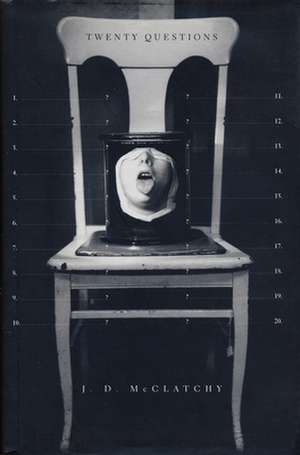
Twenty Questions
Autor J. D. McClatchyen Limba Engleză Paperback – 21 apr 1999
Preț: 239.04 lei
Puncte Express: 359
Carte tipărită la comandă
Livrare economică 14-28 august
Livrare prin curier în România Termenul estimat este afișat lângă disponibilitate.
Transport gratuit de la 400.00 lei Plată online sau ramburs, în funcție de opțiunile comenzii.
Retur gratuit în 14 zile Comandă securizată și suport în română.
Specificații
ISBN-13: 9780231111737
ISBN-10: 0231111738
Pagini: 214
Dimensiuni: 155 x 229 x 11 mm
Greutate: 0.3 kg
Ediția:Revised
Editura: Columbia University Press
ISBN-10: 0231111738
Pagini: 214
Dimensiuni: 155 x 229 x 11 mm
Greutate: 0.3 kg
Ediția:Revised
Editura: Columbia University Press
V-ar putea interesa
-
 Behind the MaskMatthew DennisonPreț: 92.45 lei
 -
 Critical Studies: The Great GatsbyKathleen ParkinsonPreț: 32.57 lei
 -
 -15%Preț: 193.25 lei227.85 lei
 -
 -33%Preț: 670.97 lei1008.92 lei
 -
 -23%Preț: 392.90 lei507.48 lei
 -
 Literature and the Great War 1914-1918Randall Stevenson-6%Preț: 282.67 lei300.27 lei
 -
 ExtramurosJesús Fernández SantoPreț: 253.99 lei
 -
 -27%Preț: 856.50 lei1173.29 lei
 -
 Out of the Blue – September 11 and the NovelKristiaan VersluysPreț: 239.82 lei
 -
 Selected Poems of James MerrillJames MerrillPreț: 129.84 lei
 -
 Selected Poems of Anthony HechtAnthony HechtPreț: 123.75 lei
 -
 Yet One More SpringDon W. KingPreț: 200.03 lei
 -
 Plundered HeartsJ. D. McClatchyPreț: 151.49 lei
 -
 -17%Preț: 273.67 lei329.73 lei
 -
 Translation and the Making of Modern Russian LiteratureProfessor Brian James BaerPreț: 296.18 lei
Textul de pe ultima copertă
In Twenty Questions, one of America's finest poet-critics leads readers into the mysteries of poetry: how it draws on our lives, and how it leads us back into them. In a series of linked essays progressing from the autobiographical to the critical - and closing with a remarkable translation of Horace's Ars Poetica unavailable elsewhere - J. D. McClatchy's latest book offers an intimate and illuminating look into the poetic mind. McClatchy begins with a portrait of his development as a poet, and provides vibrant details about some of those who helped shape his sensibility - from Anne Sexton in her final days, to Harold Bloom, his enigmatic teacher at Yale, to James Merrill, a wise and witty mentor. All of these glimpses into McClatchy's personal history enhance our understanding of a coming of age from ingenuous reader to accomplished poet-critic. Later sections range through poetry past and present - from Emily Dickinson to Seamus Heaney and W. S. Merwin - with incisive criticism generously interspersed with vivid anecdotes about McClatchy's encounters with other poets' lives and work. A critical unpacking of Alexander Pope's "Epistle to Miss Blount", for instance, is interwoven with a compassionate psychological portrait of a brilliant poet plagued by both romantic longings and debilitating physical deformities. There are surprising takes on the literary imagination as well: a look at Elizabeth Bishop through her letters, and a tribute to the Broadway lyrics of Stephen Sondheim.