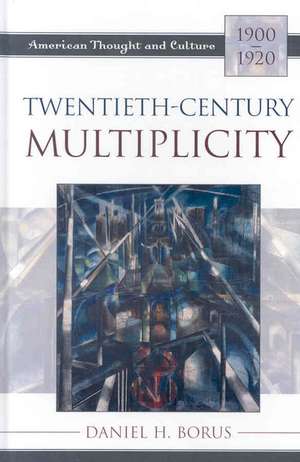
Twentieth-Century Multiplicity: American Thought and Culture, 1900-1920: American Thought and Culture
Autor Daniel H. Borusen Limba Engleză Hardback – 16 dec 2008




Preț: 633.31 lei
Preț vechi: 975.58 lei
-35%
Puncte Express: 950
Carte tipărită la comandă
Livrare economică 08-22 iunie
Specificații
ISBN-13: 9780742515062
ISBN-10: 0742515060
Pagini: 317
Dimensiuni: 164 x 240 x 26 mm
Greutate: 0.64 kg
Editura: Bloomsbury Publishing
Colecția Rowman & Littlefield
Seria American Thought and Culture
Locul publicării:New York, United States
ISBN-10: 0742515060
Pagini: 317
Dimensiuni: 164 x 240 x 26 mm
Greutate: 0.64 kg
Editura: Bloomsbury Publishing
Colecția Rowman & Littlefield
Seria American Thought and Culture
Locul publicării:New York, United States
Cuprins
Chapter 1: Twentieth-Century Multiplicity
Chapter 2: Foundations
Chapter 3: Beauties
Chapter 4: Selves
Chapter 5: Collectivities
Chapter 6: War
Chronology
Bibliographic Essay
Chapter 2: Foundations
Chapter 3: Beauties
Chapter 4: Selves
Chapter 5: Collectivities
Chapter 6: War
Chronology
Bibliographic Essay
Recenzii
Daniel Borus offers a panoramic and strikingly original account of the dawn of American modernity. The pluralistic impulse that energized every field of inquiry and impelled dazzling innovations in aesthetic form emerges here as the defining feature of early twentieth-century culture. Such familiar figures as Jane Addams and W.E.B. Du Bois receive fresh treatment as critics of art and culture, while Elsie Clews Parsons, Thorstein Veblen, and Walter Weyl finally receive their due as the penetrating progressive theorists they were. The parallels Borus finds between these thinkers' exploration of multiplicity and Charlie Chaplin's silent comedies, Scott Joplin's ragtime, and the 'Little Nemo' and 'Krazy Kat' comic strips are among the many joys of this remarkable book. A model of historical interpretation, Twentieth-Century Multiplicity is itself an example of what remains vital in the pluralistic imagination.
Borus explores the ideological and cultural aspects of this period of rapid change and retreat. In clear, concise language, the author explores multifarious concepts with depth and clarity, yet always with a careful eye toward his audience. Especially noteworthy is his work on the cataclysmic effect of WW I upon social conscience, crucial to understanding the nation's turn toward isolationism after the war. An indispensable work for any introductory study of this era, as well as an excellent supplemental read for upper-division undergraduate study. Essential.
Daniel Borus gives us clear, sympathetic, and astute readings of the remarkable thinkers who in the early twentieth century transformed the way we think about truth, value, self, and society-and shows that Henry Adams was right to make multiplicity the sign of the twentieth century. This is a marvelous book for students and scholars alike.
Borus explores the ideological and cultural aspects of this period of rapid change and retreat. In clear, concise language, the author explores multifarious concepts with depth and clarity, yet always with a careful eye toward his audience. Especially noteworthy is his work on the cataclysmic effect of WW I upon social conscience, crucial to understanding the nation's turn toward isolationism after the war. An indispensable work for any introductory study of this era, as well as an excellent supplemental read for upper-division undergraduate study. Essential.
Daniel Borus gives us clear, sympathetic, and astute readings of the remarkable thinkers who in the early twentieth century transformed the way we think about truth, value, self, and society-and shows that Henry Adams was right to make multiplicity the sign of the twentieth century. This is a marvelous book for students and scholars alike.