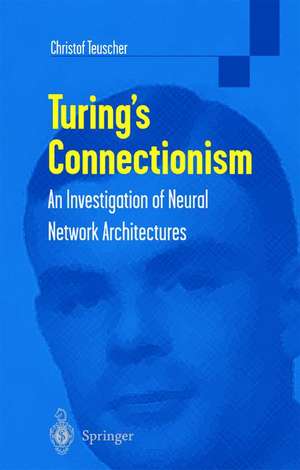
Turing’s Connectionism: An Investigation of Neural Network Architectures: Discrete Mathematics and Theoretical Computer Science
Autor Christof Teuscheren Limba Engleză Paperback – 26 sep 2001





Preț: 782.21 lei
Preț vechi: 977.75 lei
-20%
Puncte Express: 1173
Carte tipărită la comandă
Livrare economică 26 noiembrie-10 decembrie
Livrare prin curier în România Termenul estimat este afișat lângă disponibilitate.
Transport gratuit pentru acest produs Plată online sau ramburs, în funcție de opțiunile comenzii.
Retur gratuit în 14 zile Comandă securizată și suport în română.
Specificații
ISBN-13: 9781852334758
ISBN-10: 1852334754
Pagini: 230
Ilustrații: XXIV, 200 p. 9 illus.
Dimensiuni: 155 x 235 x 14 mm
Greutate: 0.35 kg
Ediția:2002
Editura: SPRINGER LONDON
Colecția Springer
Seria Discrete Mathematics and Theoretical Computer Science
Locul publicării:London, United Kingdom
ISBN-10: 1852334754
Pagini: 230
Ilustrații: XXIV, 200 p. 9 illus.
Dimensiuni: 155 x 235 x 14 mm
Greutate: 0.35 kg
Ediția:2002
Editura: SPRINGER LONDON
Colecția Springer
Seria Discrete Mathematics and Theoretical Computer Science
Locul publicării:London, United Kingdom
V-ar putea interesa
-
 Introduction to EEG- and Speech-Based Emotion RecognitionPriyanka A. Abhang-28%Preț: 490.76 lei678.59 lei
 -
 The Making of a Neuromorphic Visual SystemChristoph Rasche-5%Preț: 1126.41 lei1185.69 lei
 -
 Neural Network Data Analysis Using Simulnet(TM)Edward J. Rzempoluck-20%Preț: 349.58 lei436.98 lei
 -
 -20%Preț: 513.70 lei642.12 lei
 -
 Artificial Neural NetworksNicolaos Karayiannis-20%Preț: 1033.79 lei1292.24 lei
 -
 VLSI -- Compatible Implementations for Artificial Neural NetworksSied Mehdi Fakhraie-15%Preț: 647.67 lei761.97 lei
 -
 Neuronal DynamicsWulfram Gerstner-20%Preț: 424.44 lei530.56 lei
 -
 Wavelet Neural NetworksAntonis K Alexandridis-20%Preț: 615.48 lei769.35 lei
 -
 Frontiers of Higher Order Fuzzy SetsAlireza Sadeghian-20%Preț: 673.79 lei842.25 lei
 -
 Learning TensorflowTom Hope-20%Preț: 279.45 lei349.32 lei
 -
 Neurocomputing: Learning, Architectures & ModelingElizabeth T Mueller-35%Preț: 834.42 lei1289.20 lei
 -
 Designs and Applied Principles of Artificial Neural NetworksJeremy Rogerson-20%Preț: 630.08 lei787.60 lei
 -
 -20%Preț: 726.00 lei907.49 lei
 -
 -20%Preț: 350.82 lei438.52 lei
 -
 Evolving Connectionist SystemsNikola K Kasabov-20%Preț: 1032.97 lei1291.21 lei
 -
 -20%Preț: 628.45 lei785.56 lei
 -
 Neural Networks and Artificial IntelligenceVladimir Golovko-20%Preț: 323.95 lei404.94 lei
 -
 Fuzziness in Information SystemsMiroslav Hudec-20%Preț: 670.71 lei838.38 lei
 -
 Alan Turing: Life and Legacy of a Great ThinkerChristof Teuscher-20%Preț: 1219.22 lei1524.03 lei
 -
 Computational and Ambient IntelligenceFrancisco Sandoval-20%Preț: 696.91 lei871.14 lei
 -
 Fuzziness and Foundations of Exact and Inexact SciencesKofi Kissi Dompere-20%Preț: 669.62 lei837.02 lei
Public țintă
ResearchCuprins
1. Introduction.- 1.1 Turing’s Anticipation of Connectionism.- 1.2 Alan Mathison Turing.- 1.3 Connectionism and Artificial Neural Networks.- 1.4 Historical Context and Related Work.- 1.5 Organization of the Book.- 1.6 Book Web-Site.- 2. Intelligent Machinery.- 2.1 Machines.- 2.2 Turing’s Unorganized Machines.- 2.3 Formalization and Analysis of Unorganized Machines.- 2.4 New Unorganized Machines.- 2.5 Simulation of TBI-type Machines with MATLAB.- 3. Synthesis of Logical Functions and Digital Systems with Turing Networks.- 3.1 Combinational versus Sequential Systems.- 3.2 Synthesis of Logical Functions with A-type Networks.- 3.3 Synthesis of Logical Functions with TB-type Networks.- 3.4 Multiplexer and Demultiplexer.- 3.5 Delay-Unit.- 3.6 Shift-Register.- 3.7 How to Design Complex Systems.- 3.8 Hardware Implementation.- 4. Organizing Unorganized Machines.- 4.1 Evolutionary Algorithms.- 4.2 Evolutionary Artificial Neural Networks.- 4.3 Example: Evolve Networks that Regenerate Bitstreams.- 4.4 Signal Processing in Turing Networks.- 4.5 Pattern Classification.- 4.6 Examples: Pattern Classification with Genetic Algorithms.- 4.7 A Learning Algorithm for Turing Networks.- 5. Network Properties and Characteristics.- 5.1 General Properties.- 5.2 Computational Power.- 5.3 State Machines.- 5.4 Threshold Logic.- 5.5 Dynamical Systems and the State-Space Model.- 5.6 Random Boolean Networks.- 5.7 Attractors.- 5.8 Network Stability and Activity.- 5.9 Chaos, Bifurcation, and Self-Organized Criticality.- 5.10 Topological Evolution and Self-Organization.- 5.11 Hypercomputation: Computing Beyond the Turing Limit with Turing’s Neural Networks?.- 6. Epilogue.- Useful Web-Sites.- List of Figures.- List of Tables.- List of Examples, Theorems, Definitions, Propositions, and Corollaries.
Caracteristici
Contains a Foreword by B. Jack Copeland and D. Proudfoot Develops Turing's ideas, by building his machines and training them using evolutionary algorithms Goes beyond Turing's ideas, and proposes new machines