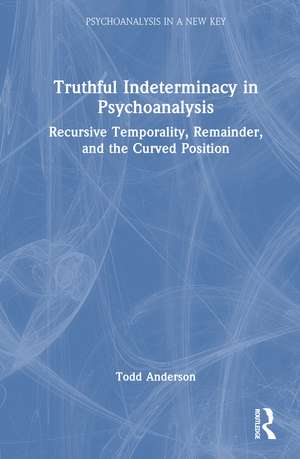
Truthful Indeterminacy in Psychoanalysis: Recursive Temporality, Remainder, and the Curved Position: Psychoanalysis in a New Key Book Series
Autor Todd Andersonen Limba Engleză Hardback – 27 ian 2027
The book develops clinically grounded concepts including the curved position—a developmental capacity to remain in intimate relation with what cannot be finally possessed through knowledge—alongside remainder, holding field, consensus defense, and projective provocation. Integrating psychoanalytic temporality, field theory, object relations, and ethical philosophy, it draws on Freud, Winnicott, Loewald, Laplanche, Stern, Bion, Ogden, Benjamin, Bromberg, and Green to articulate a structure capable of sustaining non-finalizable truth without collapsing into ambiguity or premature certainty. The curved position extends Kleinian positional theory, organizing the terror of indeterminacy itself as distinct from paranoid-schizoid, depressive, and autistic-contiguous positions. Through clinical vignettes, institutional examples, and recursive engagement with the parable of "Schrödinger's King," the book demonstrates how meanings gather force through return, revision, and altered field conditions, making its theoretical architecture both teachable and clinically applicable.
This book is for psychoanalysts, psychotherapists, and mental health professionals seeking a rigorous framework for clinical work under conditions of uncertainty and unresolved time. It serves psychoanalytic clinicians, supervisors, and theorists interested in field theory, recognition, and temporal complexity, as well as institutional leaders navigating collective dynamics and symbolic systems.
Din seria Psychoanalysis in a New Key Book Series
- 5%
 Preț: 209.80 lei
 - 5%
 Preț: 311.38 lei
 - 15%
 Preț: 427.58 lei
 -
 Preț: 438.01 lei
 -
 Preț: 431.04 lei
 - 18%
 Preț: 1466.10 lei
 -
 Preț: 464.40 lei
 - 15%
 Preț: 422.82 lei
 - 18%
 Preț: 952.38 lei
 - 18%
 Preț: 1334.08 lei
 - 18%
 Preț: 1253.35 lei
 -
 Preț: 433.53 lei
 - 18%
 Preț: 1412.00 lei
 - 18%
 Preț: 1262.49 lei
 -
 Preț: 403.81 lei
 -
 Preț: 421.42 lei
 - 5%
 Preț: 398.41 lei
 -
 Preț: 498.96 lei
 - 18%
 Preț: 1308.37 lei
 -
 Preț: 419.51 lei
 -
 Preț: 482.42 lei
 - 18%
 Preț: 1469.78 lei
 -
 Preț: 463.77 lei
 - 18%
 Preț: 1636.78 lei
 - 18%
 Preț: 1245.04 lei
 -
 Preț: 411.97 lei
 -
 Preț: 418.63 lei
 - 18%
 Preț: 1256.21 lei
 - 18%
 Preț: 1430.86 lei
 -
 Preț: 379.60 lei
 -
 Preț: 421.21 lei
 -
 Preț: 449.34 lei
 - 5%
 Preț: 449.28 lei
 -
 Preț: 394.80 lei
 -
 Preț: 362.61 lei
 - 15%
 Preț: 520.90 lei
Preț: 1131.51 lei
Preț vechi: 1487.92 lei
-24% Precomandă
Puncte Express: 1697
Carte nepublicată încă
Livrare prin curier în România Precomanda se expediază când titlul devine disponibil.
Transport gratuit pentru acest produs Plată online sau ramburs, în funcție de opțiunile comenzii.
Retur gratuit în 14 zile Comandă securizată și suport în română.
Doresc să fiu notificat când acest titlu va fi disponibil:
Se trimite...
Specificații
ISBN-13: 9781041437628
ISBN-10: 1041437625
Pagini: 362
Dimensiuni: 156 x 234 mm
Ediția:1
Editura: Taylor & Francis
Colecția Routledge
Seria Psychoanalysis in a New Key Book Series
Locul publicării:Oxford, United Kingdom
ISBN-10: 1041437625
Pagini: 362
Dimensiuni: 156 x 234 mm
Ediția:1
Editura: Taylor & Francis
Colecția Routledge
Seria Psychoanalysis in a New Key Book Series
Locul publicării:Oxford, United Kingdom
Public țintă
Postgraduate and Professional Practice & DevelopmentCuprins
1. Schrödinger’s King 2. Truthful Indeterminacy 3. Play and Curved Epistemology 4. The Holding Field 5. Consensus Defense 6: Projective Provocation 7: Remainder 8. Klein, Ogden, Benjamin, Bromberg, and the Curved Position 9. Recursive Returns Afterword
Recenzii
'Todd Anderson delivers a masterful and profoundly original contribution to contemporary psychoanalytic thought, articulating how some truths are falsified not by concealment but by premature closure. With remarkable theoretical sophistication and clinical depth, Anderson introduces transformative concepts, the most important of which is the curved position: a major developmental innovation addressing the terror of indeterminacy itself. This is psychoanalytic writing at its finest: theoretically ambitious yet clinically grounded, philosophically rigorous yet deeply humane. Essential reading for any psychoanalyst and anyone interested in the human mind.'
Dana Amir, PhD, University of Haifa and the Israel Psychoanalytic Society
'Anderson’s book is a masterpiece, weaving together psychoanalytic theory, clinical practice, and philosophy. Engaging some of the most intriguing ideas in traditional and contemporary psychoanalysis, Anderson offers fascinating and original thinking in proposing the “curved position” as a fourth position, alongside Klein’s paranoid-schizoid and depressive positions and Ogden’s autistic-contiguous organization. The curved position names a form of psychic organization through which one may experience intimacy and sustain an ongoing formulation of truth without collapsing into certainty, fragmentation, dissociation, or possession.
Anderson’s rich and highly intelligent discussion allows the reader to dream and create new thoughts, meanings, and insights, which is the most one can hope for. I highly recommend this book for any therapist willing and able to engage in this fascinating discourse with one’s world.'
Ofrit Shapira-Berman, PhD, training psychoanalyst and researcher, The Hebrew University in Jerusalem; author of Psychoanalysis and Maternal Absence: From the Traumatic to Faith and Trust and Thomas Ogden: A Contemporary Introduction
'With his fascinating book Truthful Indeterminacy in Psychoanalysis: Recursive Temporality, Remainder, and the Curved Position, Todd Anderson continues to develop his contributions to psychoanalysis. As he stresses, the central claim of this book is that some psychoanalytic truths are falsified not by being hidden, but by being finalized too quickly. Throughout this careful and elegant exploration, the reader is invited to join Anderson in his discussion of several extremely relevant topics, among them: when truth is falsified by closure; interpretation without possession as a clinical problem; truthful indeterminacy; recursive form and psychoanalytic temporality; Schrödinger’s King and the field of seeing; and the movement toward the curved position. I am sure that this book will offer stimulating food for thought to seasoned analysts and analysts in training alike, as well as to all readers who wish to better understand our impossible profession.'
Cláudio Laks Eizirik, MD, PhD, Professor Emeritus, Federal University of Rio Grande do Sul; Former President of the International Psychoanalytic Association; recipient of the 2011 Sigourney Award
'This is an extraordinary book! Anderson shapes his writing in the form of his message, and delivers complexity of thought with simplicity of words and often brief and pithy sentences that speak to you directly. Thus, he guides the reader, conversationally, through a tightly reasoned and immersively shaped argument for the “non-finalizability” of Truth. Where he introduces his own provocative terminology, he challenges himself to define his terms crisply. Gathering substantial grounding from many psychoanalytic, philosophical, and ethical sources, and compelling clinical accounts, Anderson brings the reader on a walk along the accretions of his message. While affirming our responsibility to be, at times, definite in naming a truth, he persuades us that Truth is a phenomenon of the field, of temporality and emergence, of relational experience, and a fractal recursiveness that respects its aliveness. In message and style, this is a creative and powerfully revisionary contribution.'
Stuart A. Pizer, PhD, ABPP, author of Building Bridges: The Negotiation of Paradox in Psychoanalysis; Past President of the Massachusetts Institute for Psychoanalysis and of the International Association for Relational Psychoanalysis and Psychotherapy
'The guiding idea of this book is that psychoanalysis is not merely a therapy, but a developmental process. As such, it cannot be enclosed within fixed or definitive theories. Different theoretical models need not invalidate earlier perspectives; rather, they can enter into creative dialogue with them. For this reason, the present work, whose focus is psychic truth, approaches psychoanalytic knowledge as an open-ended process, one that continually leaves room for what is inexhaustible and unforeseeable. In this respect, Anderson applies the psychoanalytic method itself to the field of theory in a dynamic way. This allows the reader to investigate the problem of knowledge and awareness in psychoanalysis while engaging the specificity of different theories within a continuous heuristic process.'
Franco De Masi, MD, Training Analyst, Italian Psychoanalytical Society; former President, Centro Milanese di Psicanalisi; author of Working with Difficult Patients and Vulnerability to Psychosis
'Todd Anderson’s Truthful Indeterminacy in Psychoanalysis is a remarkably constructive work of clinical and theoretical integration, bringing into relation authors and perspectives that are too often set against one another. Anderson proceeds from the premise that there is no clinical true north, beyond the difficult ethic of keeping possibilities open without losing all sense of direction. But how does one do that? Analytic work requires a present effort that cannot be replaced by a settled theory of its own appropriate stance. In that spirit, Anderson moves us through recursive loops that subjunctively mimic the analytic process itself, ringing aphoristic changes in the concept of the ‘symbolic’ as a process of embodied and inter-embodied experience that seeks expressive form. Anderson’s Bion-inspired critique of moralism in the group is of particular interest in this regard. He challenges the working analyst to develop their capacity to think and feel clinically, and his insights meet this challenge brilliantly.'
Charles Levin, PhD, Canadian Institute of Psychoanalysis; author of A Critical Companion to Bion
'I warmly recommend Todd Anderson’s new book. Its central concern is deeply ethical, a quality I regard as primary to psychoanalytic practice. Anderson offers the reader an enriching and inspiring experience, both through the book’s very construction and through its beautifully informed and articulated contents. I learned from it throughout, both theoretically and clinically. While it touches deeply on clinical work, it also analyzes institutional and social dynamics, opening possibilities for alternative developments.
Never totalizing, yet sustaining an invested presence, the book respects the time and space of the Other while proposing new concepts that enrich older ones. In these times of a world in turmoil, I see this book as a great lesson for all of us, younger and older colleagues alike.'
Viviane Chetrit-Vatine, PhD, psychoanalyst; author of The Ethical Seduction of the Analytic Situation: The Feminine-Maternal Origins of Responsibility for the Other
'Todd Anderson’s book is a rare and recursive meditation on clinical psychoanalysis, one that reverberates from theory into practice and into the singular intimacy of the analytic hour. Written with uncommon elegance, it brings philosophy, relational theory, and clinical discernment into a single, luminous frame.'
Velleda C. Ceccoli, PhD, NYU Postdoctoral Program in Psychotherapy & Psychoanalysis
'Truthful Indeterminacy in Psychoanalysis examines the fact that, in psychoanalysis, truth cannot be equated with knowledge, but requires a capacity to tolerate uncertainty. It is an in-depth exploration of the foundations of psychoanalytic epistemology.'
Prof. Heinz Weiß, former Director, Department of Psychosomatic Medicine, Robert Bosch Clinic, Stuttgart; former Head of the Medical Department and Member of the Directorate, Sigmund Freud Institute, Frankfurt am Main; Chair, Education Section, International Journal of Psychoanalysis
'Truthful Indeterminacy in Psychoanalysis is an intense and refined work that radically rethinks the core of psychoanalytic practice: interpretation. Far from any claim to definitive truth, this book restores analysis to its most vibrant and transformative nature, demonstrating how meaning emerges over time, in relationships, and in shared uncertainty. What emerges is an immersive reading experience, in which the boundaries between subject and object dissolve and knowledge becomes living practice. This is a book not simply to be read, but to be explored — to discover that, precisely in uncertainty, a new way of seeing takes shape. With great theoretical depth and clinical sensitivity, Anderson interweaves the contributions of major psychoanalytic thinkers to propose a vision in which interpretation is not an answer. Particularly powerful is the focus, within the analytic field, on indeterminacy and play as generative spaces that support the emergence of truths not yet formulable. In this sense, Anderson’s thesis also opens a dialogue between Western and Eastern philosophies of emptiness.'
Elena Molinari, MD, psychoanalyst, Italian Psychoanalytic Society; author of Binocular Vision: An Inquiry into Psychoanalytic Techniques and Field Theory
'Todd Anderson’s scholarly new book sparkles with insight and originality. It is both philosophically rich and clinically useful. Perhaps most importantly of all, inasmuch as this book addresses the complexity of the ever-evolving but never finalizable aspects of psychic life, it is also affirming of the always renewable procession of life itself. I wholeheartedly recommend this book.'
Peter Shabad, PhD, author of Passion, Shame, and the Freedom to Become: Seizing the Vital Moment in Psychoanalysis and Despair and the Return of Hope: Echoes of Mourning in Psychotherapy
'Todd Anderson’s Truthful Indeterminacy is a profound contribution to relational psychotherapy and psychoanalytic thinking. With remarkable originality and clinical sensitivity, Anderson demonstrates that truth is not a fixed possession but something that emerges within the relational field through uncertainty, mutual recognition, and the courage to tolerate ambiguity. This beautifully written work deepens our understanding of how transformation occurs not through certainty but through the co-created process of discovering meaning together, making it essential reading for relational clinicians and anyone interested in the intersubjective nature of psychological change.'
Haim Weinberg, PhD, CGP, FAGPA, Clinical Psychologist, Group Analyst; author of Online Psychoanalysis and The Virtual Group Therapy Circle
'In Truthful Indeterminacy in Psychoanalysis, Todd Anderson offers a compelling meditation on truth, uncertainty, and the analytic encounter. With impressive breadth and depth, he develops a distinctive vision of psychoanalytic thinking that honors both the necessity of interpretation and the irreducibility of human experience. The result is a work that is intellectually rigorous, clinically sensitive, and genuinely original. Readers will find themselves challenged, enriched, and repeatedly drawn back to its central questions.'
Robin S. Brown, PhD, LP, NCPsyA, Psychoanalyst; author of Psychoanalysis Beyond the End of Metaphysics: Thinking towards the Post-Relational, winner of the American Board and Academy of Psychoanalysis book prize
Notă biografică
Todd Anderson, PhD, PsyD, is a psychoanalyst in private practice and the author of a five-volume arc in psychoanalytic theory: The Fragmented Self, Recognition, and the Edge of Desire; Gravitational Psyche; Unknowing as Truth; Curved Being, Knowing, and Ethics in Psychoanalysis; and Truthful Indeterminacy in Psychoanalysis.
Descriere
Truthful Indeterminacy in Psychoanalysis presents a framework for working with psychoanalytic truths that are falsified not by concealment, but by premature closure, arguing that certain clinical truths remain real and binding while being recursive, overdetermined, and temporally unfinished.