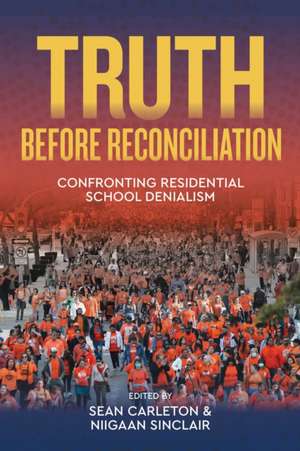
Truth Before Reconciliation
Editat de Sean Carleton, Niigaanwewidam James Sinclairen Limba Engleză Paperback – 9 sep 2026
Preț: 217.86 lei
Nou
Puncte Express: 327
Carte disponibilă
Livrare economică 09-23 noiembrie
Livrare prin curier în România Termenul estimat este afișat lângă disponibilitate.
Transport gratuit de la 400.00 lei Plată online sau ramburs, în funcție de opțiunile comenzii.
Retur gratuit în 14 zile Comandă securizată și suport în română.
Specificații
ISBN-13: 9781772841626
ISBN-10: 1772841625
Pagini: 282
Dimensiuni: 152 x 228 x 41 mm
Greutate: 1 kg
Editura: University of Manitoba Press
ISBN-10: 1772841625
Pagini: 282
Dimensiuni: 152 x 228 x 41 mm
Greutate: 1 kg
Editura: University of Manitoba Press
Notă biografică
Sean Carleton is a settler historian and associate professor in the departments of History and Indigenous Studies at the University of Manitoba. His award-winning research examines the history and political economy of schooling and settler capitalism in Canada.
Niigaan Sinclair is Anishinaabe (St. Peter’s/Little Peguis) and a professor at the University of Manitoba where he holds the Faculty of Arts Professorship in Indigenous Knowledge and Aesthetics in the Department of Indigenous Studies. Niigaan is also an award-winning writer, editor, and activist who was named to the “Power List” in 2022 by Maclean’s magazine as one of the most influential individuals in Canada.
Niigaan Sinclair is Anishinaabe (St. Peter’s/Little Peguis) and a professor at the University of Manitoba where he holds the Faculty of Arts Professorship in Indigenous Knowledge and Aesthetics in the Department of Indigenous Studies. Niigaan is also an award-winning writer, editor, and activist who was named to the “Power List” in 2022 by Maclean’s magazine as one of the most influential individuals in Canada.
Cuprins
Introduction, by Sean Carleton and Niigaan Sinclair
Chapter 1. Why Truth-Telling Matters: A Survivor’s Perspective, An Interview with Phyllis Webstad
Chapter 2. Orange Shirt Day Hangover: Municipalities, Indigenous Historians, and the Long History of Denialism, by Mary Jane Logan McCallum
Chapter 3. What We Choose to Forget: Residential School Denialism and the National Centre for Truth and Reconciliation Archives, by Raymond Frogner
Chapter 4. Understanding the Role of Archeology in Residential School Searches, An Interview with Andrew Martindale
Chapter 5. Exposing Residential School Denialism’s Transnational Network, by Sean Carleton, Alan Lester, Adele Perry, Omeasoo Wahpasiw
Chapter 6. Confronting Residential School Denialism in Canadian Classrooms, by Lindsay Gibson and James Miles
Chapter 7. Debunking the “Mass Grave Hoax” Conspiracy Theory, by Reid Gerbrandt and Sean Carleton
Chapter 8. Identifying the Techniques of Settler Colonial Genocide Denialism, by Andrew Woolford
Chapter 9. Residential School Denialism is a Crime, by Michelle Good
Chapter 10. Protecting Survivors, An Interview with Leah Gazan
Chapter 11. Sites of Remembrance: The Role of Public History and Commemoration in Challenging Denialism, An Interview with Krista McKracken, Jackson Pind, Erin Millions, and Skylee-Storm Hogan-Stacey
Chapter 12. Taking Care of Community, An Interview with Neegaunibinessikwe, Crystal Gail Fraser, and Kisha Supernant
Chapter 13: Standing Up for the Truth, An Interview with Kimberly Murray
Conclusion, by Sean Carleton and Niigaan Sinclair
Chapter 1. Why Truth-Telling Matters: A Survivor’s Perspective, An Interview with Phyllis Webstad
Chapter 2. Orange Shirt Day Hangover: Municipalities, Indigenous Historians, and the Long History of Denialism, by Mary Jane Logan McCallum
Chapter 3. What We Choose to Forget: Residential School Denialism and the National Centre for Truth and Reconciliation Archives, by Raymond Frogner
Chapter 4. Understanding the Role of Archeology in Residential School Searches, An Interview with Andrew Martindale
Chapter 5. Exposing Residential School Denialism’s Transnational Network, by Sean Carleton, Alan Lester, Adele Perry, Omeasoo Wahpasiw
Chapter 6. Confronting Residential School Denialism in Canadian Classrooms, by Lindsay Gibson and James Miles
Chapter 7. Debunking the “Mass Grave Hoax” Conspiracy Theory, by Reid Gerbrandt and Sean Carleton
Chapter 8. Identifying the Techniques of Settler Colonial Genocide Denialism, by Andrew Woolford
Chapter 9. Residential School Denialism is a Crime, by Michelle Good
Chapter 10. Protecting Survivors, An Interview with Leah Gazan
Chapter 11. Sites of Remembrance: The Role of Public History and Commemoration in Challenging Denialism, An Interview with Krista McKracken, Jackson Pind, Erin Millions, and Skylee-Storm Hogan-Stacey
Chapter 12. Taking Care of Community, An Interview with Neegaunibinessikwe, Crystal Gail Fraser, and Kisha Supernant
Chapter 13: Standing Up for the Truth, An Interview with Kimberly Murray
Conclusion, by Sean Carleton and Niigaan Sinclair