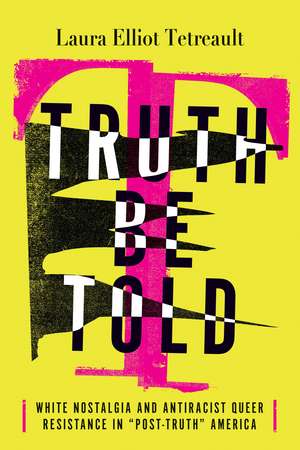
Truth Be Told: White Nostalgia and Antiracist Queer Resistance in “Post-Truth” America: Intersectional Rhetorics
Autor Laura Elliot Tetreaulten Limba Engleză Paperback – 18 sep 2025
In Truth Be Told, Laura Elliot Tetreault challenges the idea that the “post-truth” present is a novel crisis brought about by contemporary right-wing and digital media. Instead, the political control of “truth” has always been central to intersecting systems of oppression including white supremacy, colonialism, capitalism, and heteropatriarchy. Arguing that liberal counter-disinformation strategies based in a racialized ideal of civility are insufficient, the book advocates for centering the lived knowledge of oppressed communities to develop resistance and survival strategies for a disinformation environment.
Taking a critical disinformation studies approach, Tetreault analyzes post-truth political messaging in the US after 2016. Using racial rhetorical criticism combined with a queer lens, they focus on how contemporary antiracist, queer, and feminist activists used various forms of cultural production to work against disinformation and its circulation, enacting refusal and insisting on the validity of their own knowledges as a form of community care. Tetreault ultimately argues that it’s not just the truth that academics must advocate for; they must question whose truth and how that truth is mediated and circulated.
Taking a critical disinformation studies approach, Tetreault analyzes post-truth political messaging in the US after 2016. Using racial rhetorical criticism combined with a queer lens, they focus on how contemporary antiracist, queer, and feminist activists used various forms of cultural production to work against disinformation and its circulation, enacting refusal and insisting on the validity of their own knowledges as a form of community care. Tetreault ultimately argues that it’s not just the truth that academics must advocate for; they must question whose truth and how that truth is mediated and circulated.





Preț: 247.41 lei
Nou
Puncte Express: 371
Preț estimativ în valută:
43.78€ • 51.34$ • 38.45£
43.78€ • 51.34$ • 38.45£
Carte indisponibilă temporar
Doresc să fiu notificat când acest titlu va fi disponibil:
Se trimite...
Preluare comenzi: 021 569.72.76
Specificații
ISBN-13: 9780814259580
ISBN-10: 0814259588
Pagini: 178
Dimensiuni: 152 x 229 x 15 mm
Greutate: 0.3 kg
Editura: Ohio State University Press
Colecția Ohio State University Press
Seria Intersectional Rhetorics
ISBN-10: 0814259588
Pagini: 178
Dimensiuni: 152 x 229 x 15 mm
Greutate: 0.3 kg
Editura: Ohio State University Press
Colecția Ohio State University Press
Seria Intersectional Rhetorics
Recenzii
“Tetreault builds off of post-truth/disinformation literature, rhetoric of race scholarship, new media studies, and literature from the activist community itself to show how contemporary post-truth is the digital incarnation of a much longer US history of disinformation.” —Armond Towns, author of On Black Media Philosophy
“Truth Be Told offers a tool kit for unpacking disinformation from the standpoint of the oppressed and recognizing activist strategies for challenging disinformation through racial justice and queer lenses. Tetreault’s conclusions add to emerging research on the rhetoric of truth claims, gaslighting, and epistemic justice.” —Dana L. Cloud, author of Reality Bites: Rhetoric and the Circulation of Truth Claims in U.S. Political Culture
Notă biografică
Laura Elliot Tetreault is Assistant Professor of English and Affiliate Faculty in Women’s, Gender, and Sexuality Studies at the University at Albany, SUNY. They are coeditor (with Bruce Horner) of Crossing Divides: Exploring Translingual Writing Pedagogies and Programs.
Extras
When the terms of debate are set by those in power, activists challenging that power may find themselves in a double bind. Engaging only on the terms of dominant social reality further entrenches the perceived truth of that reality. However, complete refusal to “engage the reality frames of the powerful” can make “activists unintelligible and boring at the best of times and profoundly terrifying at the worst.” In the US, the dominant terms for political exchange are the terms of racial liberalism: a rhetorical trap. Activists must make strategic choices about how to resist and what they are willing to give up in the process. In this work, I build upon Cloud’s analyses of movement counterdiscourses and make the case for focusing on rhetorical strategies that multiply marginalized activists use to navigate this difficulty—including some that may seem unintelligible, boring, or terrifying on dominant terms but that are vital for activist survival because they help to sustain community epistemologies.
I argue that liberal counter-disinformation strategies are insufficient against fascist manipulations of truth because liberalism’s racialized yet abstracted ideal of civility actually plays into fascism’s hand. Tracing the history of racial liberalism and its interconnected roots with fascism reveals that the past is important to contemporary discussions of post-truth politics, but not the imagined past conjured by white liberal appeals to a bygone era of civil discourse. Instead, social movement histories from the perspectives of oppressed people, especially the rhetorical traditions of multiply marginalized communities, provide more effective frameworks for resistance beyond the limits of liberalism. Thus, I also argue that it is necessary to begin with the knowledges of the oppressed to develop strategies for surviving the disinformation environment within which fascism thrives. I use the word “survival” here intentionally, as these strategies may fail to bring about any large-scale liberatory change when measured in the short term. However, they provide rhetorical means for people to see each other, to affirm each other’s truths even when those are suppressed, and to enact forms of care that are necessary sustenance for long-term social movements. Movements take generations, but people in the here and now also need moments to hold onto.
As I write this in 2024 in the US, the daily violence is overwhelming, yet many people scrolling through headlines feel disempowered to do anything about it—disempowerment that is also by design. This nation is defined by ongoing systemic white supremacy and anti-Blackness, colonial domination, ever-escalating militarization, deliberately organized legislative attacks on transgender and queer people, violent ableism exacerbated by the COVID-19 pandemic, ongoing misogyny and sexism, the economic exploitation required to drive capitalism, and other intersecting forms of oppression, manifesting in the denial of life chances to people oppressed by these systems. Activists working for intersectional liberation must not only fight such attacks using the means of persuasion made available on terms set by dominant power (such as through the mechanisms of US deliberative democracy like the electoral and legal systems), but must also develop ways to sustain their own ways of knowing and caring for their communities in a threatening environment (involving rhetorical work that is often at odds with the available means of persuasion offered by dominant power). These rhetorical negotiations are made even more challenging when part of the goal is building and sustaining intersectional movements—requiring the cultivation of not only on-the-ground strategies for working across differences but also a shared liberatory imagination to keep movements united despite inevitable conflict. However, activists are especially effective at seizing opportune moments to contest the conditions of post-truth politics when they draw from their own community epistemologies, rather than fully accepting dominant terms for political engagement, which were designed from the beginning to deny oppressed people the ability to be recognized as rhetors in the public sphere. Sometimes activists must compromise with these terms strategically in service of certain goals, but in those cases, pairing this strategic engagement with a heightened affirmation of community epistemologies for an in-group audience is especially necessary.
From an intersectional, racial justice, and queer perspective, this book understands activist rhetorical efficacy as that which takes advantage of opportune moments to advocate for oppressed communities while also refusing to sacrifice these communities’ shared ways of knowing and relating in favor of making appeals on the terms set by dominant power. How and to what extent to work within dominant terms is a negotiation that activists make case by case, depending on the immediate context and community needs as well as longer-term visions. But there are always limits to such negotiations. “Compromise”—a lauded tenet of liberalism, along with “crossing the aisle”—is not actually possible when there is epistemological incommensurability. This is why the act of trying to persuade dominant power to listen to the oppressed so often results in a feeling of “banging one’s head against a brick wall”—one is experiencing the limitations of the available means but may not know where else to turn, either for additional strategies or just for relief.
I argue that liberal counter-disinformation strategies are insufficient against fascist manipulations of truth because liberalism’s racialized yet abstracted ideal of civility actually plays into fascism’s hand. Tracing the history of racial liberalism and its interconnected roots with fascism reveals that the past is important to contemporary discussions of post-truth politics, but not the imagined past conjured by white liberal appeals to a bygone era of civil discourse. Instead, social movement histories from the perspectives of oppressed people, especially the rhetorical traditions of multiply marginalized communities, provide more effective frameworks for resistance beyond the limits of liberalism. Thus, I also argue that it is necessary to begin with the knowledges of the oppressed to develop strategies for surviving the disinformation environment within which fascism thrives. I use the word “survival” here intentionally, as these strategies may fail to bring about any large-scale liberatory change when measured in the short term. However, they provide rhetorical means for people to see each other, to affirm each other’s truths even when those are suppressed, and to enact forms of care that are necessary sustenance for long-term social movements. Movements take generations, but people in the here and now also need moments to hold onto.
As I write this in 2024 in the US, the daily violence is overwhelming, yet many people scrolling through headlines feel disempowered to do anything about it—disempowerment that is also by design. This nation is defined by ongoing systemic white supremacy and anti-Blackness, colonial domination, ever-escalating militarization, deliberately organized legislative attacks on transgender and queer people, violent ableism exacerbated by the COVID-19 pandemic, ongoing misogyny and sexism, the economic exploitation required to drive capitalism, and other intersecting forms of oppression, manifesting in the denial of life chances to people oppressed by these systems. Activists working for intersectional liberation must not only fight such attacks using the means of persuasion made available on terms set by dominant power (such as through the mechanisms of US deliberative democracy like the electoral and legal systems), but must also develop ways to sustain their own ways of knowing and caring for their communities in a threatening environment (involving rhetorical work that is often at odds with the available means of persuasion offered by dominant power). These rhetorical negotiations are made even more challenging when part of the goal is building and sustaining intersectional movements—requiring the cultivation of not only on-the-ground strategies for working across differences but also a shared liberatory imagination to keep movements united despite inevitable conflict. However, activists are especially effective at seizing opportune moments to contest the conditions of post-truth politics when they draw from their own community epistemologies, rather than fully accepting dominant terms for political engagement, which were designed from the beginning to deny oppressed people the ability to be recognized as rhetors in the public sphere. Sometimes activists must compromise with these terms strategically in service of certain goals, but in those cases, pairing this strategic engagement with a heightened affirmation of community epistemologies for an in-group audience is especially necessary.
From an intersectional, racial justice, and queer perspective, this book understands activist rhetorical efficacy as that which takes advantage of opportune moments to advocate for oppressed communities while also refusing to sacrifice these communities’ shared ways of knowing and relating in favor of making appeals on the terms set by dominant power. How and to what extent to work within dominant terms is a negotiation that activists make case by case, depending on the immediate context and community needs as well as longer-term visions. But there are always limits to such negotiations. “Compromise”—a lauded tenet of liberalism, along with “crossing the aisle”—is not actually possible when there is epistemological incommensurability. This is why the act of trying to persuade dominant power to listen to the oppressed so often results in a feeling of “banging one’s head against a brick wall”—one is experiencing the limitations of the available means but may not know where else to turn, either for additional strategies or just for relief.
Cuprins
Contents
Introduction
Chapter 1 Black Lives Matter, Violent Imaginaries, and Narrative Activism
Chapter 2 Activist Relational Knowledge against Digital Disinformation in BLM and the Women’s March
Chapter 3 Charlottesville’s False Equivalencies: Rejecting “Both Sides” by Refusing to Waste Time
Chapter 4 Whose Insurrection? Rhetorical Gaslighting after January 6 and the Uses and Limits of Testimonial Acts
Chapter 5 Anti-Trans Disinformation and t4t Care through Joy and Spite
Conclusion
Acknowledgments
Works Cited
Index
Introduction
Chapter 1 Black Lives Matter, Violent Imaginaries, and Narrative Activism
Chapter 2 Activist Relational Knowledge against Digital Disinformation in BLM and the Women’s March
Chapter 3 Charlottesville’s False Equivalencies: Rejecting “Both Sides” by Refusing to Waste Time
Chapter 4 Whose Insurrection? Rhetorical Gaslighting after January 6 and the Uses and Limits of Testimonial Acts
Chapter 5 Anti-Trans Disinformation and t4t Care through Joy and Spite
Conclusion
Acknowledgments
Works Cited
Index
Descriere
Argues that counter-disinformation strategies based in nostalgia for racialized “civility” are insufficient and advocates for centering the knowledge of oppressed communities to develop survival strategies that resist disinformation.