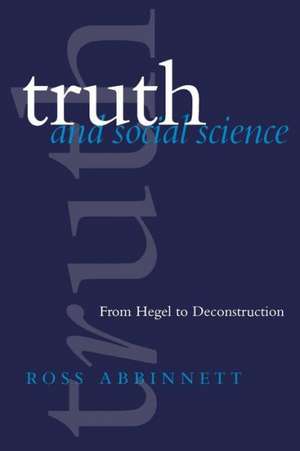
Truth and Social Science
Autor Ross Abbinnetten Limba Engleză Paperback – iun 1998
Preț: 736.44 lei
Preț vechi: 898.10 lei
-18%
Puncte Express: 1105
Carte tipărită la comandă
Livrare economică 30 noiembrie-14 decembrie
Livrare prin curier în România Termenul estimat este afișat lângă disponibilitate.
Transport gratuit pentru acest produs Plată online sau ramburs, în funcție de opțiunile comenzii.
Retur gratuit în 14 zile Comandă securizată și suport în română.
Specificații
ISBN-13: 9780803975934
ISBN-10: 0803975937
Pagini: 208
Dimensiuni: 156 x 234 x 11 mm
Greutate: 0.32 kg
Ediția:1
Editura: SAGE Publications
Locul publicării:London, United Kingdom
ISBN-10: 0803975937
Pagini: 208
Dimensiuni: 156 x 234 x 11 mm
Greutate: 0.32 kg
Ediția:1
Editura: SAGE Publications
Locul publicării:London, United Kingdom
V-ar putea interesa
-
 The Cultural Nature of Human DevelopmentBarbara Rogoff-21%Preț: 274.14 lei345.90 lei
 -
 Inclusion and DemocracyIris Marion Young-21%Preț: 354.43 lei448.93 lei
 -
 Seeing Reason: Image and Language in Learning to ThinkKeith Stenning-33%Preț: 709.75 lei1053.55 lei
 -
 Reassembling the Social: BestsellerBruno Latour-12%Preț: 274.28 lei311.07 lei
 -
 Services Marketing: Text and CasesSteve Baron-11%Preț: 509.49 lei572.46 lei
 -
 Non-Representational Theory: Space, Politics, AffectNigel Thrift-8%Preț: 429.97 lei467.35 lei
 -
 The Future Of MoneyBernard LietaerPreț: 117.15 lei
 -
 Applying Regression and CorrelationJeremy Miles-8%Preț: 481.94 lei523.84 lei
 -
 Classical SociologyBryan S. Turner-18%Preț: 827.57 lei1009.23 lei
 -
 A New Philosophy of Society: Assemblage Theory and Social ComplexityProfessor Manuel DeLanda-31%Preț: 210.40 lei305.16 lei
 -
 The Dynamics of Social PracticeElizabeth ShovePreț: 444.78 lei
 -
 The Body and Social TheoryChris Shilling-8%Preț: 451.89 lei491.19 lei
 -
 Immaterial BodiesLisa Blackman-8%Preț: 489.98 lei532.58 lei
 -
 Preț: 264.61 lei
Cuprins
Introduction
IDEALISM AND SOCIAL THOUGHT
THE RATIONAL AND THE SOCIAL
Kant and the Origins of Social Science
Hegel's Concept of Rational Life
Speculative Thought and Modernity
THE STRUCTURAL ORGANISATION OF TRUTH
Structure, Functions and Systems
Marx's Critique of Capital
The Powers of Totality
THE IDEALISM OF AUTONOMY
Weber and the Concept of Social Action
Habermas and the Ethics of Communication
POSTSTRUCTURALISM AND THE VIOLENCE OF TRUTH
Foucault and the Modern Domains of Power
Lyotard and the Community of Judgement
Violence, Rationality and Community
TRUTH AND MODERNITY
Marx and Weber
Utopic and Dystopic Ends
Community, Modernity and Speculative Judgement
Hegel, Derrida and the Metaphysics of Race
Bibliography
Index
IDEALISM AND SOCIAL THOUGHT
THE RATIONAL AND THE SOCIAL
Kant and the Origins of Social Science
Hegel's Concept of Rational Life
Speculative Thought and Modernity
THE STRUCTURAL ORGANISATION OF TRUTH
Structure, Functions and Systems
Marx's Critique of Capital
The Powers of Totality
THE IDEALISM OF AUTONOMY
Weber and the Concept of Social Action
Habermas and the Ethics of Communication
POSTSTRUCTURALISM AND THE VIOLENCE OF TRUTH
Foucault and the Modern Domains of Power
Lyotard and the Community of Judgement
Violence, Rationality and Community
TRUTH AND MODERNITY
Marx and Weber
Utopic and Dystopic Ends
Community, Modernity and Speculative Judgement
Hegel, Derrida and the Metaphysics of Race
Bibliography
Index
Notă biografică
Ross Abbinnett is a senior lecturer with research interests in classical and contemporary critical theory, and the social theory and philosophy of technology and technocracy. He has recently published 'The Thought of Bernard Stiegler' (Routledge 2017) and 'The Neoliberal Imagination' (Routledge 2020).
Descriere
This exciting and accessible guide to the discussions of truth in the social sciences can also be read as an account of the collapse of modernity, and the rise of new forms of thought which treat difference and ambivalence as positive values. Ross Abbinnett traces the debate on truth from the `objectifying powers' of Kant through more than 200 years of critique and reformulation to the unravelling of truth by Lyotard, Foucault and Derrida.