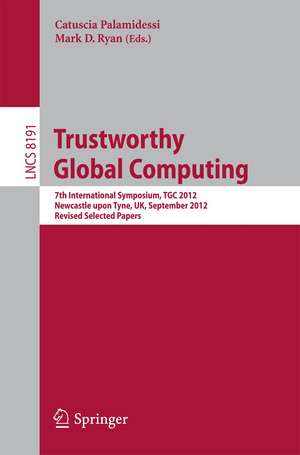
Trustworthy Global Computing
Editat de Catuscia Palamidessi, Mark D. Ryanen Limba Engleză Paperback – 13 sep 2013
Preț: 302.43 lei
Preț vechi: 378.04 lei
-20%
Puncte Express: 454
Carte tipărită la comandă
Livrare economică 07-21 decembrie
Livrare prin curier în România Termenul estimat este afișat lângă disponibilitate.
Transport gratuit de la 400.00 lei Plată online sau ramburs, în funcție de opțiunile comenzii.
Retur gratuit în 14 zile Comandă securizată și suport în română.
Specificații
ISBN-13: 9783642411564
ISBN-10: 3642411568
Pagini: 224
Ilustrații: X, 213 p. 37 illus.
Dimensiuni: 155 x 235 x 13 mm
Greutate: 0.35 kg
Ediția:2013
Editura: Springer
Locul publicării:Berlin, Heidelberg, Germany
ISBN-10: 3642411568
Pagini: 224
Ilustrații: X, 213 p. 37 illus.
Dimensiuni: 155 x 235 x 13 mm
Greutate: 0.35 kg
Ediția:2013
Editura: Springer
Locul publicării:Berlin, Heidelberg, Germany
V-ar putea interesa
-
 Computer Architecture: A Quantitative ApproachJohn L. Hennessy-39%Preț: 539.69 lei882.55 lei
 -
 Systematic Security: A CISO’s PlaybookTimur Qader-20%Preț: 374.44 lei468.04 leiRecomandat
 -
 Cryptography ApocalypseRoger A. Grimes-20%Preț: 175.39 lei219.24 lei
 -
 Security EngineeringRoss Anderson-20%Preț: 392.75 lei490.94 lei
 -
 Cryptography and Network SecurityWilliam Stallings-20%Preț: 634.17 lei792.71 lei
 -
 Computer SecurityWilliam Stallings-9%Preț: 654.62 lei719.37 lei
 -
 Alice and Bob Learn Secure CodingTanya Janca-20%Preț: 250.43 lei313.03 lei
 -
 Preț: 123.51 lei
 -
 Serious Cryptography, 2nd Edition: A Practical Introduction to Modern EncryptionJean-Philippe Aumasson-35%Preț: 301.76 lei464.51 lei
 -
 Formal Techniques for Distributed Objects, Components, and SystemsMohammad Reza Mousavi-20%Preț: 445.38 lei556.72 lei
 -
 Advances in Cryptology - CRYPTO 2024Leonid Reyzin-20%Preț: 468.25 lei585.31 lei
 -
 Networked SystemsSalem Lahlou-20%Preț: 996.76 lei1245.95 lei
 -
 -15%Preț: 672.87 lei791.62 lei
 -
 Security ProtocolsBruce Christianson-20%Preț: 335.02 lei418.78 lei
 -
 -20%Preț: 329.74 lei412.17 lei
 -
 Preț: 380.46 lei
 -
 Preț: 376.75 lei
 -
 -20%Preț: 314.22 lei392.77 lei
 -
 -20%Preț: 402.28 lei502.84 lei
 -
 Deploying Secure Data Science Applications in the CloudLucas H. Benevides e Braga-20%Preț: 225.24 lei281.55 lei
Public țintă
ResearchCuprins
From Rational Number Reconstruction to Set Reconciliation and File Synchronization.- Affine Refinement Types for Authentication and Authorization.- Seamless Distributed Computing from the Geometry of Interaction.- A Beginner’s Guide to the DeadLock Analysis Model.- Formal Modeling and Reasoning about the Android Security Framework.- A Type System for Flexible Role Assignment in Multiparty Communicating Systems.- A Multiparty Multi-session Logic.- LTS Semantics for Compensation-Based Processes.- Linking Unlinkability.- Towards Quantitative Analysis of Opacity.- An Algebra for Symbolic Diffie-Hellman Protocol Analysis.- Security Analysis in Probabilistic Distributed Protocols via Bounded Reachability.- Modular Reasoning about Differential Privacy in a Probabilistic Process Calculus.
Textul de pe ultima copertă
This book constitutes the thoroughly refereed post-conference proceedings of the 7th International Symposium on Trustworthy Global Computing, TGC 2012, held in Newcastle upon Tyne, UK, in September 2012. The 9 revised full papers presented together with 3 invited talks were carefully reviewed and selected from 14 submissions. The papers cover a wide range of topics in the area of global computing and reliable computation in the so-called global computers, i.e., those computational abstractions emerging in large-scale infrastructures such as service-oriented architectures, autonomic systems and cloud computing, providing frameworks, tools, algorithms and protocols for designing open-ended, large-scale applications and for reasoning about their behavior and properties in a rigorous way.
Caracteristici
State-of-the-art research Up-to-date results Unique visibility