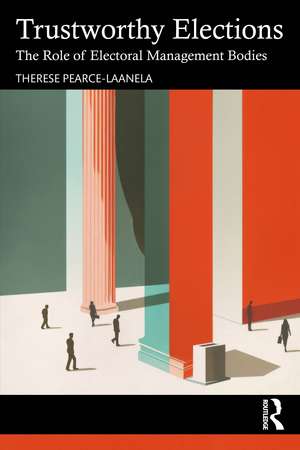
Trustworthy Elections: The Role of Electoral Management Bodies
Autor Therese Pearce Laanelaen Limba Engleză Paperback – 14 iul 2026
While the technical delivery imperatives of election administration are well understood, there is a wider range of stakeholder needs and expectations that matter for trust-building. In addition to delivery-oriented transactional trust, EMB trust-building must also include values-oriented relational trust and the predictability that allows for security-based trust. By highlighting stakeholder viewpoints, the book provides a social perspective to what has been seen as a technical and administrative problem and outlines a broader range of pathways for EMB trust-building policy and practice. Conceptually innovative, and drawing from a rich set of empirical data, it showcases the stresses and dynamics particular to elections and provides policy-oriented insights.
With this book, Therese Pearce Laanela aims to inspire and inform policy makers, practitioners, and scholars on strategies for electoral authorities to earn the trust needed for accepted elections and peaceful political transitions.
Preț: 387.27 lei
Puncte Express: 581
Carte disponibilă
Livrare economică 11-25 noiembrie
Livrare express 27-31 octombrie pentru 32.100 lei
Livrare prin curier în România Termenul estimat este afișat lângă disponibilitate.
Transport gratuit de la 400.00 lei Plată online sau ramburs, în funcție de opțiunile comenzii.
Retur gratuit în 14 zile Comandă securizată și suport în română.
Specificații
ISBN-13: 9781041039624
ISBN-10: 104103962X
Pagini: 216
Ilustrații: 6
Dimensiuni: 152 x 229 mm
Greutate: 0.4 kg
Ediția:1
Editura: Taylor & Francis
Colecția Routledge
Locul publicării:Oxford, United Kingdom
ISBN-10: 104103962X
Pagini: 216
Ilustrații: 6
Dimensiuni: 152 x 229 mm
Greutate: 0.4 kg
Ediția:1
Editura: Taylor & Francis
Colecția Routledge
Locul publicării:Oxford, United Kingdom
Public țintă
Postgraduate, Undergraduate Advanced, and Undergraduate CoreCuprins
1. Organising trustworthy elections
2. Electoral management bodies
3. Why trust institutions?
4. High stakes and impossible logistics-The EMB trust-building knot
5. An electoral trust-building deep dive
6. A practitioner-anchored trust-building model
7. Safeguarding trusted elections
2. Electoral management bodies
3. Why trust institutions?
4. High stakes and impossible logistics-The EMB trust-building knot
5. An electoral trust-building deep dive
6. A practitioner-anchored trust-building model
7. Safeguarding trusted elections
Recenzii
As Australia’s former electoral commissioner, I learned that trust is not abstract for election bodies. It is practical, hard won, and easily lost. Built step by step, it can disappear in a single misstep. In an era of mis- and disinformation, reputation determines authority. Credibility decides whether people believe the result. This book sets out the work required to earn and protect that trust.
Tom Rogers, Australian Electoral Commissioner 2014-2024
The issue of trust in political institutions is a central challenge around the world—especially in the sphere of elections. This book makes an essential contribution to the literature on electoral management, electoral integrity and the study of democracy. It provides a new electoral trust-building model. This contributes greatly to our understanding of how trust in key democratic institutions can be maintained and strengthened—and where/why they may face challenges in the future.
Toby James, Professor, University of East Anglia
The architect Gaudi teaches "first you need love, then technique". Both matter, as Laanela’s brilliant book shows. In examining how institutional trust works and how distrust spirals, the book reveals, in a practical way, that both technical delivery imperatives and relational confidence-building must converge. Evocative analysis of stakeholder viewpoints uncovers how predictability leavens and butters the bread of stable democracies. Laanela recounts compelling stories of how lost trust can be flipped to found trust and how the relational skills of electoral management bodies can turn high electoral emotions from a threat into a resource.
John Braithwaite, Emeritus Professor, Australian National University
Tom Rogers, Australian Electoral Commissioner 2014-2024
The issue of trust in political institutions is a central challenge around the world—especially in the sphere of elections. This book makes an essential contribution to the literature on electoral management, electoral integrity and the study of democracy. It provides a new electoral trust-building model. This contributes greatly to our understanding of how trust in key democratic institutions can be maintained and strengthened—and where/why they may face challenges in the future.
Toby James, Professor, University of East Anglia
The architect Gaudi teaches "first you need love, then technique". Both matter, as Laanela’s brilliant book shows. In examining how institutional trust works and how distrust spirals, the book reveals, in a practical way, that both technical delivery imperatives and relational confidence-building must converge. Evocative analysis of stakeholder viewpoints uncovers how predictability leavens and butters the bread of stable democracies. Laanela recounts compelling stories of how lost trust can be flipped to found trust and how the relational skills of electoral management bodies can turn high electoral emotions from a threat into a resource.
John Braithwaite, Emeritus Professor, Australian National University
Notă biografică
Therese Pearce Laanela, PhD, is Head of Electoral Processes at International IDEA, an intergovernmental organisation that works with election authorities worldwide. Through her work with leading bodies in the field such as IFES, The Carter Center, UNDP, and IDEA, Pearce Laanela has been deeply involved in the development of a variety of seminal publications, networks, databases, and training curriculum on electoral administration, including the ACE Electoral Knowledge Network and the BRIDGE course package. Her hands-on experience of organising elections began with United Nations missions in Cambodia and Mozambique in the early 1990s and has continued with international election observer and electoral assistance missions in Africa, Europe, and Asia for institutions such as the OSCE, the European Union, and The Carter Center. Her PhD from the Australian National University uses regulatory theory to investigate trust in EMBs, while her Masters degree from Stockholm University focused on the intersection between political financing, corruption, and electoral system design.
Descriere
This book explores how stakeholder feelings of injustice complicate transactions and information flow with electoral authorities and deplete the legitimacy capital that electoral management bodies require to expedite democracy.