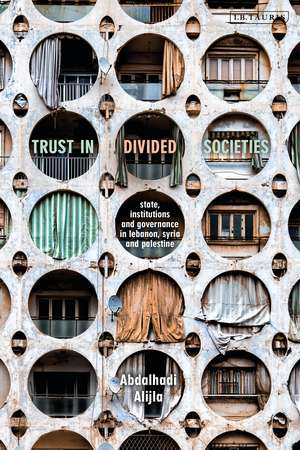
Trust in Divided Societies: State, Institutions and Governance in Lebanon, Syria and Palestine
Autor Abdalhadi M. Alijlaen Limba Engleză Paperback – 19 mai 2022
This book uses empirical and case study research, including qualitative comparative analysis (QCA), statistical methods, observations and interviews, to compare which policies and institutions to build trust have a greater impact on divided societies in the Middle East. The book focuses on Lebanon, Palestine, and Syria, but analyses the results from these societies by also comparing other political and ethno-religiously divided societies beyond the MENA region.
The book does not want to forward a universal 'theory' that gives us the origin of trust and how it is destroyed. Rather, it aims to provide a comprehensive explanation of generalised trust in divided societies and answer the question: under which institutions is generalised trust in a divided society maintained or destroyed, and how does this happen? Of key importance to Abdalhadi Alijla is to highlight the formal and informal institutions that inspire an elevated level of trust to help make societies less vulnerable to internal conflict, and also to give voice to the real people who live and experience divided societies.
Preț: 213.94 lei
Preț vechi: 288.19 lei
-26%
Puncte Express: 321
Carte tipărită la comandă
Livrare economică 07-21 decembrie
Livrare prin curier în România Termenul estimat este afișat lângă disponibilitate.
Transport gratuit de la 400.00 lei Plată online sau ramburs, în funcție de opțiunile comenzii.
Retur gratuit în 14 zile Comandă securizată și suport în română.
Specificații
ISBN-13: 9780755641185
ISBN-10: 0755641183
Pagini: 256
Dimensiuni: 152 x 232 x 16 mm
Greutate: 0.35 kg
Editura: Bloomsbury Publishing
Colecția I.B.Tauris
Locul publicării:London, United Kingdom
ISBN-10: 0755641183
Pagini: 256
Dimensiuni: 152 x 232 x 16 mm
Greutate: 0.35 kg
Editura: Bloomsbury Publishing
Colecția I.B.Tauris
Locul publicării:London, United Kingdom
Cuprins
Preface
Chapter 1: Introduction
Chapter 2: BetweenSocial Capital to Trust: Institutions, History and Cultures
Chapter 3: Broken windows: trust in divided societies
Chapter 4: Trust Beyond MENA: Does Institutions Matter?
Chapter 5: The Failure: Institutions, Corruption and Trust
Chapter 6: Lebanon Gone Wrong: Inequality and Trust in Lebanon
Chapter 7: Creating Hybrid society: Trust in Palestine
Chapter 8: Doomed After, Doomed Before Trust in Syria
Chapter 9: Refugees in Divided Societies: Syrian in Lebanon
Chapter 10: The Missing Virtue: Conclusion
Bibliography
Appendices
Chapter 1: Introduction
Chapter 2: BetweenSocial Capital to Trust: Institutions, History and Cultures
Chapter 3: Broken windows: trust in divided societies
Chapter 4: Trust Beyond MENA: Does Institutions Matter?
Chapter 5: The Failure: Institutions, Corruption and Trust
Chapter 6: Lebanon Gone Wrong: Inequality and Trust in Lebanon
Chapter 7: Creating Hybrid society: Trust in Palestine
Chapter 8: Doomed After, Doomed Before Trust in Syria
Chapter 9: Refugees in Divided Societies: Syrian in Lebanon
Chapter 10: The Missing Virtue: Conclusion
Bibliography
Appendices
Recenzii
A welcome addition to political science literature ... an accomplished and accessible book.
This is a thought-provoking book that significantly contributes to the debate on the role of trust as a key factor in understanding the dynamics of war-torn societies. A major strength of this book is that it combines theory debate along with empirical evidence and statistics available in a number of case studies. The author's personal experience in several conflict cases like Lebanon, Bosnia, Syria, and Palestine has enriched the discussion and reflection on the understanding of trust in divided societies. It is an important book for students and scholars studying conflict resolution, political science, social psychology, and comparative studies.
Using the concept of trust as a lens, Abdalhadi Alijla has provided a clear and compelling analysis of governance in Lebanon, Syria and Palestine. His analysis is sharp and this book is necessary reading for anyone interested in politics and society in this region.
Despite the emphasis placed on the role of institutions as well as of societal trust in social science literature during the last decades, the Middle East and the Arab world have been largely neglected. This important contribution is therefore timely and fills a significant gap within research. This is particularly so because of its comparisons with other diverse and divided societies. Thus, the book provides us with in-depth case studies from Lebanon, Palestine and Syria but also produces valuable comparisons and generalizations, of importance to scholars and practitioners alike.
This is a thought-provoking book that significantly contributes to the debate on the role of trust as a key factor in understanding the dynamics of war-torn societies. A major strength of this book is that it combines theory debate along with empirical evidence and statistics available in a number of case studies. The author's personal experience in several conflict cases like Lebanon, Bosnia, Syria, and Palestine has enriched the discussion and reflection on the understanding of trust in divided societies. It is an important book for students and scholars studying conflict resolution, political science, social psychology, and comparative studies.
Using the concept of trust as a lens, Abdalhadi Alijla has provided a clear and compelling analysis of governance in Lebanon, Syria and Palestine. His analysis is sharp and this book is necessary reading for anyone interested in politics and society in this region.
Despite the emphasis placed on the role of institutions as well as of societal trust in social science literature during the last decades, the Middle East and the Arab world have been largely neglected. This important contribution is therefore timely and fills a significant gap within research. This is particularly so because of its comparisons with other diverse and divided societies. Thus, the book provides us with in-depth case studies from Lebanon, Palestine and Syria but also produces valuable comparisons and generalizations, of importance to scholars and practitioners alike.