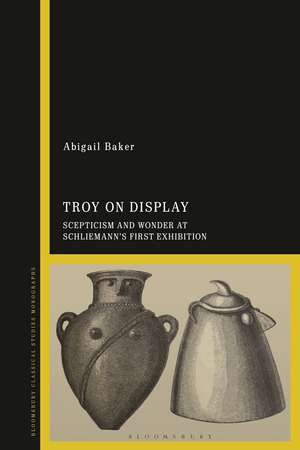
Troy on Display: Scepticism and Wonder at Schliemann's First Exhibition
Autor Dr Abigail Bakeren Limba Engleză Paperback – 22 apr 2021
Schliemann invited Londoners to see the very unclassical objects on display as the roots of classical culture. Artists, poets, historians, race theorists, bankers and humourists took up this challenge, but their conclusions were not always to Schliemann's liking. Troy's appeal lay in its materiality: visitors could apply analytical techniques (from aesthetic appreciation to skull-measuring) to the collection and draw their own conclusions. This book argues for a deep examination of museum exhibitions as a constructed spatial experience, which can transform how the past is seen. This new angle on a famous archaeological discovery shows the museum as a site of controversy, where hard evidence and wild imagination came together to form a lasting image of Troy.
Preț: 236.74 lei
Preț vechi: 322.95 lei
-27%
Puncte Express: 355
Carte tipărită la comandă
Livrare economică 25 noiembrie-09 decembrie
Livrare prin curier în România Termenul estimat este afișat lângă disponibilitate.
Transport gratuit de la 400.00 lei Plată online sau ramburs, în funcție de opțiunile comenzii.
Retur gratuit în 14 zile Comandă securizată și suport în română.
Specificații
ISBN-13: 9781350191365
ISBN-10: 1350191361
Pagini: 280
Dimensiuni: 154 x 232 x 20 mm
Greutate: 0.42 kg
Editura: Bloomsbury Publishing
Colecția Bloomsbury Academic
Locul publicării:London, United Kingdom
ISBN-10: 1350191361
Pagini: 280
Dimensiuni: 154 x 232 x 20 mm
Greutate: 0.42 kg
Editura: Bloomsbury Publishing
Colecția Bloomsbury Academic
Locul publicării:London, United Kingdom
Cuprins
List of figures
Acknowledgements
Part 1: Introduction
1. Troy and Truth
Part 2: Putting Troy on show
2. Bringing Troy to London
3. Making sense of the Trojan collection
4. How Schliemann Displayed his Treasures
Part 3: Schliemania?
5. Visualising Troy
6. The Appeal of the Primitive
7. Laughing at Schliemann
8. Weighing up Ancient Troy
Part 4: Troy's place in History
9. The Other Homeric Question
10. How old was Troy?
11. Who Were the Trojans?
Part 5: Successors and legacy
12. Jane Harrison's Odyssey
13. Arthur Evans' Labyrinth
14. Dream and reality
Notes
Bibliography
Index
Acknowledgements
Part 1: Introduction
1. Troy and Truth
Part 2: Putting Troy on show
2. Bringing Troy to London
3. Making sense of the Trojan collection
4. How Schliemann Displayed his Treasures
Part 3: Schliemania?
5. Visualising Troy
6. The Appeal of the Primitive
7. Laughing at Schliemann
8. Weighing up Ancient Troy
Part 4: Troy's place in History
9. The Other Homeric Question
10. How old was Troy?
11. Who Were the Trojans?
Part 5: Successors and legacy
12. Jane Harrison's Odyssey
13. Arthur Evans' Labyrinth
14. Dream and reality
Notes
Bibliography
Index
Recenzii
The study explores the wide-ranging impact of the exhibition on various aspects of 19th-century thought, "bringing together a range of receptions [to build] a composite picture of the exhibition" (p. 32). Baker's multifaceted approach touches on the specific ways that the Trojan exhibition impacted contemporary receptions, from fashion to monetary policy, but also relates Troy itself to larger cultural debates on ancient chronology and racial theory . Summing Up: Highly recommended. Lower-division undergraduates through faculty.
This handy little book, which can be read in one sitting, is a gold-mine of fascinating information. It also sets any reader (this reviewer included) thinking about the wider questions.
Baker's volume convincingly achieves its goal of demonstrating how much can be gained from considering temporary exhibitions and is to be commended for its accessible, engaging style ... A useful contribution to scholarship on Schliemann and a highly enjoyable read.
This handsomely produced, generously illustrated book expands the final chapter of Abigail Baker's PhD thesis into 14 chapters, appraising the sociocultural environment of the first museum display of Schliemann's finds from Troy and that exhibition's effects on subsequent attitudes to prehistoric archaeology.
Dr. Baker shows us the care with which Schliemann staged his exhibit, revealing a clear and calculating intent on his part to persuade the viewers that his views on Troy were the correct ones . [She] has successfully shown us that 'Troy with its untrustworthy excavator, archaeological complexity and combination of truth and fiction is an unusually fruitful site for thinking about what fascinates us about the past and questioning the methods we use to understand it' ( 16).
There is much to interest archaeologists, museologists, and historians in this excellent book, and it is written in a flowing and engaging style that also invites a non-specialist readership.
This handy little book, which can be read in one sitting, is a gold-mine of fascinating information. It also sets any reader (this reviewer included) thinking about the wider questions.
Baker's volume convincingly achieves its goal of demonstrating how much can be gained from considering temporary exhibitions and is to be commended for its accessible, engaging style ... A useful contribution to scholarship on Schliemann and a highly enjoyable read.
This handsomely produced, generously illustrated book expands the final chapter of Abigail Baker's PhD thesis into 14 chapters, appraising the sociocultural environment of the first museum display of Schliemann's finds from Troy and that exhibition's effects on subsequent attitudes to prehistoric archaeology.
Dr. Baker shows us the care with which Schliemann staged his exhibit, revealing a clear and calculating intent on his part to persuade the viewers that his views on Troy were the correct ones . [She] has successfully shown us that 'Troy with its untrustworthy excavator, archaeological complexity and combination of truth and fiction is an unusually fruitful site for thinking about what fascinates us about the past and questioning the methods we use to understand it' ( 16).
There is much to interest archaeologists, museologists, and historians in this excellent book, and it is written in a flowing and engaging style that also invites a non-specialist readership.