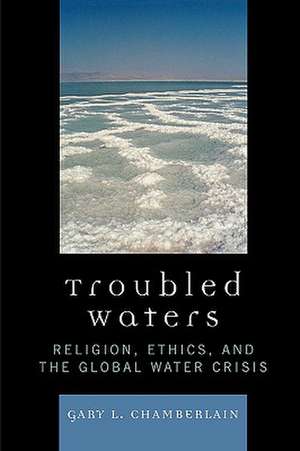
Troubled Waters: Religion, Ethics, and the Global Water Crisis
Autor Gary Chamberlainen Limba Engleză Paperback – 23 oct 2007
Chamberlain outlines many of the current water problems and lays out clear principles for action that engaged citizens from various traditions can undertake to meet the growing water challenges through conservation and water management policies. The book describes many religious practices from around the world that help sustain and restore water by using new technologies and reviving old ones. Offering creative suggestions for both personal practices and group action, Chamberlain advocates conservation, preservation, and restoration of our troubled waters.
Preț: 216.03 lei
Puncte Express: 324
Carte disponibilă
Livrare economică 06-20 noiembrie
Livrare express 22-28 octombrie pentru 33.35 lei
Livrare prin curier în România Termenul estimat este afișat lângă disponibilitate.
Transport gratuit de la 400.00 lei Plată online sau ramburs, în funcție de opțiunile comenzii.
Retur gratuit în 14 zile Comandă securizată și suport în română.
Specificații
ISBN-13: 9780742552456
ISBN-10: 0742552454
Pagini: 227
Dimensiuni: 156 x 233 x 18 mm
Greutate: 0.36 kg
Editura: Bloomsbury Publishing
Colecția Rowman & Littlefield
Locul publicării:New York, United States
ISBN-10: 0742552454
Pagini: 227
Dimensiuni: 156 x 233 x 18 mm
Greutate: 0.36 kg
Editura: Bloomsbury Publishing
Colecția Rowman & Littlefield
Locul publicării:New York, United States
V-ar putea interesa
-
 Handbook of Religion and HealthHarold Koenig-26%Preț: 2197.54 lei2971.84 lei
 -
 Why Beliefs Matter: Reflections on the Nature of ScienceE. Brian Davies-16%Preț: 187.51 lei224.52 lei
 -
 Turning Images in Philosophy, Science, and Religion: A New Book of NatureCharles Taliaferro-28%Preț: 514.07 lei716.59 lei
 -
 -21%Preț: 372.59 lei469.15 lei
 -
 -31%Preț: 962.83 lei1401.09 lei
 -
 -20%Preț: 354.42 lei444.71 lei
 -
 -19%Preț: 345.51 lei427.17 lei
 -
 -23%Preț: 352.91 lei458.59 lei
 -
 Preț: 107.99 lei
 -
 Living FossilsCarl WernerPreț: 261.65 lei
 -
 Preț: 385.28 lei
 -
 Preț: 140.75 lei
Cuprins
Chapter 1 Water in Indigenous and Asian Traditions
Chapter 2 Water in Abrahamic, Western Traditions
Chapter 3 Water: a Biography
Chapter 4 Water and the Human Cycle
Chapter 5 A Tenuous Relationship: Human Need and Water Resources
Chapter 6 Water Management: Privatization, Problems, and Resistance
Chapter 7 Rights to Water and a New Water Ethic
Chapter 8 "I Like Fountain Flow": Religion Revisited
Chapter 9 Where Do We Go from Here?
Chapter 2 Water in Abrahamic, Western Traditions
Chapter 3 Water: a Biography
Chapter 4 Water and the Human Cycle
Chapter 5 A Tenuous Relationship: Human Need and Water Resources
Chapter 6 Water Management: Privatization, Problems, and Resistance
Chapter 7 Rights to Water and a New Water Ethic
Chapter 8 "I Like Fountain Flow": Religion Revisited
Chapter 9 Where Do We Go from Here?
Recenzii
Gary Chamberlain's information and analysis is unique and will make an important contribution to the primacy of water in religious traditions and the ethical requirements for a just and adequate distribution.
Gary Chamberlain presents an interdisciplinary tour de force through the rising tide of water issues affecting all areas of life and global society. Written to effect major changes in how humans view, value, and treat this life-giving source, the book combines scholarship on world religions, history, hydrology, cosmology, social science, politics, and ethics in the service of water's restoration and democratic distribution. Like the water on which he creatively focuses, the book is an invaluable resource on many fronts.
Troubled Waters is a useful survey of different religious traditions' perspectives on the meaning and use of water. Gary Chamberlain makes an important contribution from a religious perspective to developing a new water ethos.
After reading Chamberlain's book I'm not going to look at my early morning glass of water without more profound reverence and thanksgiving. This book demonstrates clearly that cultural and religious dimensions rather than economic and technocratic perspectives must shape any future realistic management of our earth's precious water resources if we are to survive.
Given the present threats to fresh water from anthropogenic climate change, Chamberlain's book is timely.
Grounded in both thorough scientific knowledge and a profound caring for nature and people, the breadth of Gary Chamberlain's approaches to the question of water is breathtaking. Even more remarkable is his success in weaving all of these diverse perspectives-religion, history, science, culture, ethics and justice-into a coherent, compelling story that both inspires and calls us to action. In this critical time, we are in such need of engaging works like this that unite rather than divide the disciplines as we work to save ourselves, our fellow creatures, and the living, essential waters that we share.
In Troubled Waters , he exposes the problems surrounding water pollution, misuse, and scarcity that pose challenges no less pressing than those associated with global warming, and that are indeed no less difficult to resolve.
Gary Chamberlain presents an interdisciplinary tour de force through the rising tide of water issues affecting all areas of life and global society. Written to effect major changes in how humans view, value, and treat this life-giving source, the book combines scholarship on world religions, history, hydrology, cosmology, social science, politics, and ethics in the service of water's restoration and democratic distribution. Like the water on which he creatively focuses, the book is an invaluable resource on many fronts.
Troubled Waters is a useful survey of different religious traditions' perspectives on the meaning and use of water. Gary Chamberlain makes an important contribution from a religious perspective to developing a new water ethos.
After reading Chamberlain's book I'm not going to look at my early morning glass of water without more profound reverence and thanksgiving. This book demonstrates clearly that cultural and religious dimensions rather than economic and technocratic perspectives must shape any future realistic management of our earth's precious water resources if we are to survive.
Given the present threats to fresh water from anthropogenic climate change, Chamberlain's book is timely.
Grounded in both thorough scientific knowledge and a profound caring for nature and people, the breadth of Gary Chamberlain's approaches to the question of water is breathtaking. Even more remarkable is his success in weaving all of these diverse perspectives-religion, history, science, culture, ethics and justice-into a coherent, compelling story that both inspires and calls us to action. In this critical time, we are in such need of engaging works like this that unite rather than divide the disciplines as we work to save ourselves, our fellow creatures, and the living, essential waters that we share.
In Troubled Waters , he exposes the problems surrounding water pollution, misuse, and scarcity that pose challenges no less pressing than those associated with global warming, and that are indeed no less difficult to resolve.