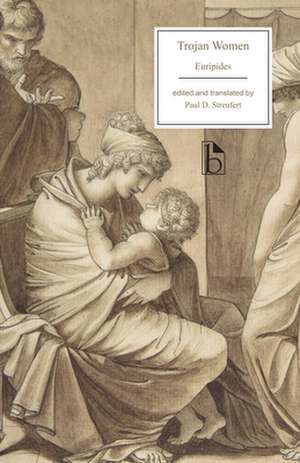
Trojan Women
Autor Euripides Editat de Paul D. Streuferten Limba Engleză Paperback – 18 mai 2021
This new translation features a text committed to accuracy and clarity, one developed in collaboration with actors for clear reading and performance. Appendices provide other important literary treatments of the central women in the play, with selections ranging from Homer to Shakespeare.
Preț: 132.36 lei
Preț vechi: 156.14 lei
-15%
Puncte Express: 199
Carte disponibilă
Livrare economică 18 mai-01 iunie
Livrare express 01-07 mai pentru 45.01 lei
Specificații
ISBN-13: 9781554814497
ISBN-10: 1554814499
Pagini: 152
Dimensiuni: 140 x 216 x 8 mm
Greutate: 0.27 kg
Editura: BROADVIEW PR
Colecția Broadview Press
Locul publicării:Peterborough, Canada
ISBN-10: 1554814499
Pagini: 152
Dimensiuni: 140 x 216 x 8 mm
Greutate: 0.27 kg
Editura: BROADVIEW PR
Colecția Broadview Press
Locul publicării:Peterborough, Canada
V-ar putea interesa
-
 Romantic OutlawsCharlotte Gordon-22%Preț: 67.25 lei86.27 lei
 -
 Medea and Other PlaysEuripides-28%Preț: 53.97 lei74.69 lei
 -
 The Bacchae and Other PlaysEuripides-19%Preț: 72.31 lei89.80 lei
 -
 Peer Gynt and BrandHenrik Ibsen-20%Preț: 71.97 lei89.60 lei
 -
 Preț: 131.17 lei
 -
 ElektraEuripidesPreț: 74.90 lei
 -
 Suppliant Women. Electra. HeraclesEuripidesPreț: 222.18 lei
 -
 The Kentucky CycleRobert SchenkkanPreț: 98.27 lei
 -
 HeraclesEuripides-13%Preț: 88.48 lei101.12 lei
 -
 MedeaEuripides-12%Preț: 89.11 lei101.49 lei
 -
 TelstarNick Moran-19%Preț: 81.04 lei99.72 lei
 -
 Rough CrossingsCaryl Phillips-11%Preț: 81.45 lei91.77 lei
 -
 Pressure DropMick Gordon-42%Preț: 57.70 lei99.62 lei
 -
 Spur of the MomentAnya ReissPreț: 81.19 lei
 -
 RAM: The Abduction of Sita into DarknessYaël Farber-25%Preț: 68.69 lei91.82 lei
 -
 MedeaEuripidesPreț: 28.55 lei
Recenzii
Trojan Women tells the story of the survivors of the Trojan War, the women and children taken into slavery by the victorious Greek army. Through the tragedy’s central character, the matriarch Hecuba, this late play (415 BCE) demonstrates Euripides’ commitment to speaking on behalf of the less powerful and offers a scathing critique of Athenian behavior as the city fought its own disastrous war with its southern neighbor, Sparta. Trojan Women features well-known characters from Greek mythology, including the prophetess Cassandra, the gods Athena and Poseidon, and, most notably, the infamous Helen, the cause of the war, who must defend herself to the husband she abandoned.
This new translation features a text committed to accuracy and clarity, one developed in collaboration with actors for clear reading and performance. Appendices provide other important literary treatments of the central women in the play, with selections ranging from Homer to Shakespeare.
“While Euripides’ tragedies are universally celebrated, they somehow seem just beyond the typical undergraduate’s appropriating grasp. This new edition of Trojan Women, by a distinguished translator and historian of ancient Greek drama, provides a point of entry to the non-specialist, and especially to those approaching classical theater for the first time. The introduction succinctly and engagingly lays out the important facts about Euripides’ life, the theatrical conditions and conventions of Greek theater, and the remarkably prescient issues explored in Trojan Women for the twenty-first-century world. The text itself is the highlight, transferring Euripides’ ideas, word play, even humor, into English as it channels the poetic voice and pathos of the great matriarch at the tragedy’s center, Hecuba. So for today’s theater practitioner, as well as for teachers and students of classical literature and theater, this edition has no rivals.” — Paul Whitfield White, Purdue University
“Paul Streufert’s translation of Trojan Women is a director’s dream. His clear, concise language retains Euripides’ soaring poetry, but it does so with a contemporary touch that is accessible to actors and audience members alike. His light and nuanced treatment of the text allows actors to navigate the play’s complex spoken arias with relative ease, which frees actors to shape their characters into compelling, full-bodied humans worthy of the stage. In short, Streufert humanizes Euripides’ tragic lament for our contemporary ears, which is no small feat!” — Rhett Luedtke, George Fox University
This new translation features a text committed to accuracy and clarity, one developed in collaboration with actors for clear reading and performance. Appendices provide other important literary treatments of the central women in the play, with selections ranging from Homer to Shakespeare.
“While Euripides’ tragedies are universally celebrated, they somehow seem just beyond the typical undergraduate’s appropriating grasp. This new edition of Trojan Women, by a distinguished translator and historian of ancient Greek drama, provides a point of entry to the non-specialist, and especially to those approaching classical theater for the first time. The introduction succinctly and engagingly lays out the important facts about Euripides’ life, the theatrical conditions and conventions of Greek theater, and the remarkably prescient issues explored in Trojan Women for the twenty-first-century world. The text itself is the highlight, transferring Euripides’ ideas, word play, even humor, into English as it channels the poetic voice and pathos of the great matriarch at the tragedy’s center, Hecuba. So for today’s theater practitioner, as well as for teachers and students of classical literature and theater, this edition has no rivals.” — Paul Whitfield White, Purdue University
“Paul Streufert’s translation of Trojan Women is a director’s dream. His clear, concise language retains Euripides’ soaring poetry, but it does so with a contemporary touch that is accessible to actors and audience members alike. His light and nuanced treatment of the text allows actors to navigate the play’s complex spoken arias with relative ease, which frees actors to shape their characters into compelling, full-bodied humans worthy of the stage. In short, Streufert humanizes Euripides’ tragic lament for our contemporary ears, which is no small feat!” — Rhett Luedtke, George Fox University
Cuprins
Acknowledgements
Introduction
Euripides and the Trojan War: A Brief Chronology
A Note on the Text
Trojan Women
Appendix A: Hecuba
Works Cited and Select Bibliography
Introduction
Euripides and the Trojan War: A Brief Chronology
A Note on the Text
Trojan Women
Appendix A: Hecuba
- 1. From Euripides, Hecuba 752–814a
- 2. From Ovid, Metamorphoses 13.441–534a
- 3. From William Shakespeare, Hamlet II.ii.497–560
- 1. From Aeschylus, Agamemnon 1256–1330
- 2. From Seneca, Agamemnon 695–774
- 1. From Homer, Iliad 6.388–528
- 2. From Euripides, Andromache 147–231
- 1. Lyric Poets • 124
- a. Sappho of Lesbos, Fragment 16
- b. Alcaeus of Lesbos, Fragment 283
- c. Alcaeus of Lesbos, Fragment 42
- 2. From Gorgias of Leontini, Encomium of Helen 4–20
- 3. From Euripides, Helen 16–67
- 4. From Joseph of Exeter, Trojan War III.223–98
Works Cited and Select Bibliography
Notă biografică
Euripides (c. 480–406 BCE) wrote some ninety plays, nineteen of which have survived. Richmond Lattimore (1906–84) was a poet, translator, and longtime professor of Greek at Bryn Mawr College. Glenn W. Most is a visiting member of the Committee on Social Thought at the University of Chicago and an external scientific member of the Max Planck Institute for the History of Science in Berlin. Mark Griffith is the Klio Distinguished Professor Emeritus of Classical Languages and Literature and professor of classics and of theater, dance, and performance studies at the University of California, Berkeley.