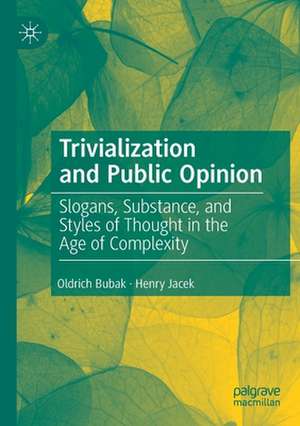
Trivialization and Public Opinion
Autor Oldrich Bubak, Henry Jaceken Limba Engleză Paperback – 14 aug 2020
Preț: 373.36 lei
Puncte Express: 560
Carte tipărită la comandă
Livrare economică 26 noiembrie-10 decembrie
Livrare prin curier în România Termenul estimat este afișat lângă disponibilitate.
Transport gratuit de la 400.00 lei Plată online sau ramburs, în funcție de opțiunile comenzii.
Retur gratuit în 14 zile Comandă securizată și suport în română.
Specificații
ISBN-13: 9783030179274
ISBN-10: 3030179273
Pagini: 292
Ilustrații: XVII, 271 p. 2 illus., 1 illus. in color.
Dimensiuni: 148 x 210 x 16 mm
Greutate: 0.38 kg
Ediția:1st ed. 2019
Editura: Springer
Locul publicării:Cham, Switzerland
ISBN-10: 3030179273
Pagini: 292
Ilustrații: XVII, 271 p. 2 illus., 1 illus. in color.
Dimensiuni: 148 x 210 x 16 mm
Greutate: 0.38 kg
Ediția:1st ed. 2019
Editura: Springer
Locul publicării:Cham, Switzerland
Cuprins
Part I: On Trivialization.- Chapter 1: Introduction.- Chapter 2: Trivialization.- Chapter 3: The Uneasy World of "isms".- Part II: Opinions and Their Public.- Chapter 4: Democracy (Re)imagined.- Chapter 5: Bringing in the Public.-Chapter 6: What We Can Learn.- Part III: Approaching Complexity.- Chapter 7: Assumptions and Precautions.-Chapter 8: Into a New Paradigm.- Chapter 9: Transformations.- Part IV: Shifting Cultures.- Chapter 10: Beyond Folklore.- Chapter 11: Thinking Change.
Notă biografică
Oldrich Bubak is a scholar and author focusing on society, politics, and technology. He is currently at McMaster University, Canada, where he conducts research in comparative public policy.
Henry Jacek is Professor Emeritus of Political Science and Public Policy at McMaster University, Canada. His teaching and research has focused on the organization of political life and the establishment and implementation of public policies.
Henry Jacek is Professor Emeritus of Political Science and Public Policy at McMaster University, Canada. His teaching and research has focused on the organization of political life and the establishment and implementation of public policies.
Textul de pe ultima copertă
"Taking a transdisciplinary view, this innovative title serves both as an important addition and a challenge to the existing research in communications and in social sciences more generally...I highly recommend this book to all readers seeking a more complete picture of change, so needed in our increasingly complex society."
-D. R. F. Taylor, Distinguished Research Professor, Carleton University, Canada
“This is an important book that should be read by anyone concerned about the current state of political discourse in the industrialized democracies...We should all learn to listen and to ask: ‘how do you know?’”
-Fred Fletcher, Professor Emeritus of Communication Studies and Political Science, York University, Canada
Centering on public discourse and its fundamental lapses, this book takes a unique look at key barriers to social and political advancement in the information age. Public discourse is replete with confident, easy to manage claims, intuitions, and other shortcuts; outstanding of these is trivialization, the trend to distill multifaceted dilemmas to binary choices, neglect the big picture, gloss over alternatives, or filter reality through a lens of convenience—leaving little room for nuance and hence debate. Far from superficial, such lapses are symptoms of deeper, intrinsically connected shortcomings inviting further attention. Focusing primarily on industrialized democracies, the authors take their readers on a transdisciplinary journey into the world of trivialization, engaging as they do so the intricate issues borne of a modern environment both enabled and constrained by technology. Ultimately, the authors elaborate upon the emerging counterweights to conventional worldviews and the paradigmatic alternatives that promise to help open new avenues for progress.
-D. R. F. Taylor, Distinguished Research Professor, Carleton University, Canada
“This is an important book that should be read by anyone concerned about the current state of political discourse in the industrialized democracies...We should all learn to listen and to ask: ‘how do you know?’”
-Fred Fletcher, Professor Emeritus of Communication Studies and Political Science, York University, Canada
Centering on public discourse and its fundamental lapses, this book takes a unique look at key barriers to social and political advancement in the information age. Public discourse is replete with confident, easy to manage claims, intuitions, and other shortcuts; outstanding of these is trivialization, the trend to distill multifaceted dilemmas to binary choices, neglect the big picture, gloss over alternatives, or filter reality through a lens of convenience—leaving little room for nuance and hence debate. Far from superficial, such lapses are symptoms of deeper, intrinsically connected shortcomings inviting further attention. Focusing primarily on industrialized democracies, the authors take their readers on a transdisciplinary journey into the world of trivialization, engaging as they do so the intricate issues borne of a modern environment both enabled and constrained by technology. Ultimately, the authors elaborate upon the emerging counterweights to conventional worldviews and the paradigmatic alternatives that promise to help open new avenues for progress.
Caracteristici
Conceptualizes trivialization and presents its key enablers Explores the implications of trivialization in public opinion and avenues for improvement Discusses a new paradigm and its promises to discourse and beyond