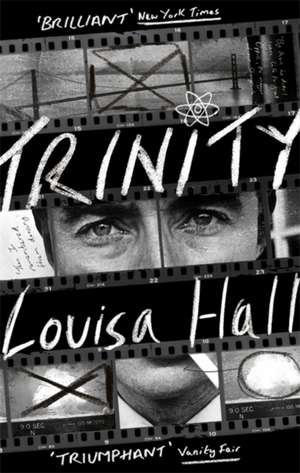
Trinity: Shortlisted for the Dylan Thomas Prize
Autor Louisa Hallen Limba Engleză Paperback – 4 apr 2019
Descoperim aici imaginea unui bărbat urmărit discret pe străzile din San Francisco de un agent al serviciilor secrete, o primă scenă care stabilește tonul de supraveghere și ambiguitate al întregului volum. În Trinity, Louisa Hall nu alege calea unei biografii liniare, ci preferă o structură caleidoscopică, fracturată în șapte voci distincte. De la amanta tânără a unui coleg din Los Alamos până la o femeie care fuge de McCarthyism, fiecare martor adaugă o tușă de culoare portretului lui J. Robert Oppenheimer, „părintele bombei atomice”. Notăm cu interes cum autoarea reușește să transforme o figură istorică monumentală într-un centru de greutate invizibil, a cărui prezență este simțită mai degrabă prin undele de șoc produse în viețile celor din jur.
În tradiția volumului Quartet for J. Robert Oppenheimer de Kelly Cherry, acest roman reimaginează viața savantului nu prin rigoarea datelor brute — pe care le găsim în lucrări precum American Prometheus — ci prin poezia și tragedia spațiilor private. Dacă în Speak autoarea explora limitele inteligenței artificiale și ale memoriei, iar în The Carriage House se concentra pe legăturile de familie și moștenire, în Trinity ea rafinează aceste teme, chestionând capacitatea minții umane de a crede propriile minciuni. Ritmul este unul contemplativ, eliptic, invitând la o reflecție profundă asupra puterii și vinovăției. Putem afirma că romanul funcționează ca un experiment de fizică literară: cu cât încercăm să fixăm mai clar imaginea lui Oppenheimer, cu atât el devine mai evaziv, lăsând în urmă doar urmele impactului său asupra istoriei și asupra sufletelor care l-au orbitat.
Preț: 48.35 lei
Preț vechi: 64.75 lei
-25%
Carte disponibilă
Livrare economică 03-17 noiembrie
Livrare express 17-23 octombrie pentru 38.35 lei
Specificații
ISBN-10: 1472154037
Pagini: 336
Dimensiuni: 126 x 198 x 26 mm
Greutate: 0.26 kg
Editura: Little Brown
Colecția Corsair
Locul publicării:London, United Kingdom
V-ar putea interesa
-
 The Boundless DeepRichard HolmesPreț: 194.51 lei
 -
 Inside The CentreRay Monk-24%Preț: 114.46 lei151.46 lei
 -
 Einstein's MonstersMartin Amis-22%Preț: 49.30 lei62.85 lei
 -
 The Book of DanielE. L. Doctorow-30%Preț: 64.49 lei92.36 lei
 -
 TrinityFrank Close-18%Preț: 88.93 lei108.85 lei
 -
 Robert OppenheimerRay MonkPreț: 156.92 lei
 -
 OppenheimerChristopher NolanPreț: 93.81 lei
 -
 Quartet for J. Robert OppenheimerKelly CherryPreț: 132.03 lei
 -
 TrinityJonathan Fetter-VormPreț: 105.41 lei
 -
 -14%Preț: 117.07 lei135.69 leiRecomandat
 -
 Oh Pure and Radiant HeartLydia Millet-18%Preț: 101.49 lei123.23 lei
 -
 Daikon: A NovelSamuel Hawley-19%Preț: 87.57 lei107.55 leiRecomandat
 -
 The MANIACBenjamin Labatut-24%Preț: 61.28 lei80.52 lei
 -
 True NatureLance RichardsonPreț: 231.44 lei
 -
 Crick: A Mind in Motion – from DNA to the BrainProfessor Matthew Cobb-17%Preț: 194.01 lei234.30 lei
 -
 -23%Preț: 108.46 lei141.47 lei
 -
 The Scientist Who Wasn't ThereJoanne BriggsPreț: 142.67 lei
 -
 The Difficult GhostLeila GuerrieroPreț: 76.82 lei
 -
 Preț: 111.09 lei
 -
 Trinity: A NovelA. J. HartleyPreț: 134.99 lei
De ce să citești această carte
Pentru cititorii pasionați de biografiile reinterpretate literar, Trinity oferă o experiență de lectură intelectuală și emoționantă. Veți câștiga o perspectivă nuanțată asupra dilemelor etice ale secolului XX, fără a primi răspunsuri gata preparate. Este o carte despre secretele pe care le ascundem de noi înșine, ideală pentru cei care au apreciat profunzimea narativă din Speak sau rigoarea istorică din American Prometheus.
Despre autor
Louisa Hall a crescut în Philadelphia și a absolvit Universitatea Harvard. Înainte de a se dedica scrisului, a jucat squash la nivel profesional și a lucrat într-un laborator de cercetare la Spitalul Albert Einstein. Deține un doctorat în literatură de la University of Texas din Austin. Cariera sa literară este marcată de o explorare constantă a intersecției dintre știință, tehnologie și condiția umană, teme vizibile în romanele sale Speak, nominalizat la Dylan Thomas Prize, și Reproduction. Stilul său este recunoscut pentru eleganță și pentru modul ingenios în care integrează fapte istorice în structuri narative inovatoare.
Descriere
J. Robert Oppenheimer - the father of the atomic bomb - was a brilliant scientist, a champion of liberal causes, and a complex and often contradictory character. In Louisa Hall's kaleidoscopic novel, seven fictional characters bear witness to his life. From a secret service agent who tailed him in San Francisco, to the young lover of a colleague in Los Alamos, to a woman fleeing McCarthyism who knew him on St. John, as these men and women fall into the orbit of a brilliant but mercurial mind at work, all consider his complicated legacy while also uncovering deep and often unsettling truths about their own lives.
In Trinity, Louisa Hall has crafted an explosive story about what it means to truly know someone, and about the secrets we keep from the world and from ourselves.
Recenzii
J. Robert Oppenheimer - the father of the atomic bomb - was a brilliant scientist, a champion of liberal causes, and a complex and often contradictory character. In Louisa Hall's kaleidoscopic novel seven fictional characters bear witness to his life. From a secret service agent who tailed him in San Francisco, to the young lover of a colleague in Los Alamos, to a woman fleeing McCarthyism who knew him on St. John, as these men and women fall into the orbit of a brilliant but mercurial mind at work, all consider his complicated legacy while also uncovering deep and often unsettling truths about their own lives.
In Trinity, Louisa Hall has crafted an explosive story about what it means to truly know someone, and about the secrets we keep from the world and from ourselves.
'A striking portrait of a man who fathered the bombs dropped on Hiroshima and Nagasaki, and then went on to embrace liberal causes, lie about love affairs and lobby against nuclear proliferation' Mail on Sunday
'A splintered and intriguing portrait' Erica Wagner, Financial Times
'A brilliant imagining of how the details omitted from one notorious man's story might define him more fully than the broad strokes we already know . . . Trinity sounds a wake-up call' Time
[An] elegant novel . . . It leaves you with the dazed feeling that trying to understand a person, to really know them, is an impossible task.
History, Hall insists, happens on the human scale and the narratives in which we find ourselves caught up often blind us to larger truths. This is an intelligent, serious novel saved from ponderousness by an abundance of sharp-edged details and the intensity of its characters need to speak
Louisa Hall understands the words we don't write can be just as important as the ones we do . . . Few words go to waste in her new book, Trinity, a brilliant imagining of how the details omitted from one notorious man's story might define him more fully than the broad strokes we already know . . . Trinity sounds a wake-up call to those who have failed to ease the threat of planetary destruction . . . Oppenheimer changed course in his own life - and through Hall's imagined reading of his mind, she shows us that we still can too
Louisa Hall has created a splintered and intriguing portrait of this brilliant and conflicted man . . . Hall's explosive fragmentation of Oppenheimer's life makes for an original book, a novel of the unseen and finally, the unknowable
Triumphant . . . Compelling . . . With beautiful specificity and nuance, Hall interrogates such major issues as this in scientific discovery and breaching the chasm between public and private selves
Louisa Hall's intelligent, elegant and yet strangely elusive novel about the father of the atomic bomb . . . [is] elegant and true
Trinity is an intelligent and sweeping account of the characters - some real, some fictional - swirling around the testing of the first atomic bomb. It is also an affecting meditation on the ways in which we betray others and, in the process, ourselves.
Hall excels at creating distinct characters whose voices illuminate their own lives and challenges, as well as the historical period that saw Oppenheimer's fall from grace. Taken together, they only burnish the endlessly fascinating enigma of the flawed genius who became known as the father of the atomic bomb.
Lushly written, this is an ambitious, unsettling novel that takes on big issues in a passionate, personal way
Trinity is a dizzying, kaleidoscopic marvel of a book, and a beautiful reflection on the impossibility of creating a truly accurate narrative of any person's life
A boldly imagined scenario that explores themes of guilt and betrayal.
Textul de pe ultima copertă
Through narratives that cross time and space, a set of seven fictional characters bears witness to the life of Oppenheimer. As these men and women fall into the orbit of a brilliant but mercurial mind at work, all consider his complicated legacy while also uncovering deep and often unsettling truths about their own lives.
In this stunning, elliptical novel, Louisa Hall has crafted a breathtaking and explosive story about public and private tragedy, about power and guilt, and about the secrets we keep from the world and from ourselves.
Notă biografică
Louisa Hall grew up in Philadelphia. She is the author of the novels Speak and The Carriage House, and her poems have been published in The New Republic, Southwest Review, and other journals. She is a professor at the University of Iowa, and the Western Writer in Residence at Montana State University.