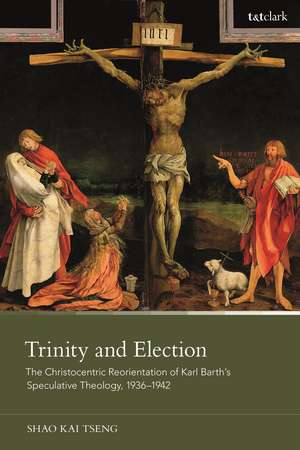
Trinity and Election: The Christocentric Reorientation of Karl Barth’s Speculative Theology, 1936-1942
Autor Dr. Shao Kai Tsengen Limba Engleză Paperback – 22 aug 2024
This book argues that Barth adopted the Anselmian mode of speculation in which immediate self-identity between subject, object, and act is found in the triune God alone, while the speculative identity that enables human knowledge of God is none other than the identity between God-in-and-for-Godself and God-for-us. Exploring the nationalistic dimension of speculative metaphysics in 19th-century Germany, Tseng identifies this as an important aspect of the context of Barth's development of a Christocentric form of speculative theology.
Preț: 207.93 lei
Preț vechi: 289.77 lei
-28%
Puncte Express: 312
Carte tipărită la comandă
Livrare economică 10-24 noiembrie
Livrare prin curier în România Termenul estimat este afișat lângă disponibilitate.
Transport gratuit de la 400.00 lei Plată online sau ramburs, în funcție de opțiunile comenzii.
Retur gratuit în 14 zile Comandă securizată și suport în română.
Specificații
ISBN-13: 9780567709356
ISBN-10: 0567709353
Pagini: 280
Dimensiuni: 154 x 232 x 16 mm
Greutate: 0.4 kg
Editura: Bloomsbury Publishing
Colecția T&T Clark
Locul publicării:London, United Kingdom
ISBN-10: 0567709353
Pagini: 280
Dimensiuni: 154 x 232 x 16 mm
Greutate: 0.4 kg
Editura: Bloomsbury Publishing
Colecția T&T Clark
Locul publicării:London, United Kingdom
Cuprins
Introduction
Chapter 1:
Sketching the Background: The Post-Kantian Paradigm Re-examined
Chapter 2:
Sketching the Background: Barth and the Intellectual History of Speculative Theology
Chapter 3:
Sketching the Contours: Actualistic Ontology and Speculative Theology
Chapter 4:
Painting the Portrait: The Christocentric Reorientation of Barth's Speculative Theology in 1936
Chapter 5:
Painting the Portrait: Barth's Christocentric Revision of Vestigium Trinitatis Speculation in 1938
Chapter 6:
Painting the Portrait: Solidifying the Basically Chalcedonian Form of Speculative Identity in 1942
Chapter 7:
Framing the Picture: Barth's Speculative Theology of Nationhood: Christocentric Reflections from 1936-1938
Conclusion
Bibliography
Index
Chapter 1:
Sketching the Background: The Post-Kantian Paradigm Re-examined
Chapter 2:
Sketching the Background: Barth and the Intellectual History of Speculative Theology
Chapter 3:
Sketching the Contours: Actualistic Ontology and Speculative Theology
Chapter 4:
Painting the Portrait: The Christocentric Reorientation of Barth's Speculative Theology in 1936
Chapter 5:
Painting the Portrait: Barth's Christocentric Revision of Vestigium Trinitatis Speculation in 1938
Chapter 6:
Painting the Portrait: Solidifying the Basically Chalcedonian Form of Speculative Identity in 1942
Chapter 7:
Framing the Picture: Barth's Speculative Theology of Nationhood: Christocentric Reflections from 1936-1938
Conclusion
Bibliography
Index
Recenzii
In this compelling work, Shao Kai Tseng offers a careful, detailed, sophisticated and convincing alternative to both ahistorical and historicized readings of Karl Barth with practical implications regarding social and political matters. By carefully considering the Anselmian and Hegelian moments in Barth's theology, this important book moves Barth studies beyond the problems embedded in McCormack's view of Barth's "actualism." Anyone interested in Barth's theology today will surely want to read this book.
Tseng's illuminating analysis of Barth's Christological concentration in the 1930s confirms the far-reaching theological fruitfulness of in-depth studies of Barth's theological development. It is on the precise determination of election and Trinity that the clarity of Barth's chosen path is decided. At the same time, the political implications that Tseng finally brings into focus show that his emphasis on the speculative character of Barth's thought is by no means in complete contradiction to a critical rationalism that Barth is attested by others.
Over against the neo-Kantian paradigm that has drawn so much attention these last decades, Tseng offers us a fascinating new reading of the intellectual impetus of Barth's mature theology. There may be (too) many books about Barth; but this is one any serious Barth scholar will have to reckon with.
Tseng's illuminating analysis of Barth's Christological concentration in the 1930s confirms the far-reaching theological fruitfulness of in-depth studies of Barth's theological development. It is on the precise determination of election and Trinity that the clarity of Barth's chosen path is decided. At the same time, the political implications that Tseng finally brings into focus show that his emphasis on the speculative character of Barth's thought is by no means in complete contradiction to a critical rationalism that Barth is attested by others.
Over against the neo-Kantian paradigm that has drawn so much attention these last decades, Tseng offers us a fascinating new reading of the intellectual impetus of Barth's mature theology. There may be (too) many books about Barth; but this is one any serious Barth scholar will have to reckon with.